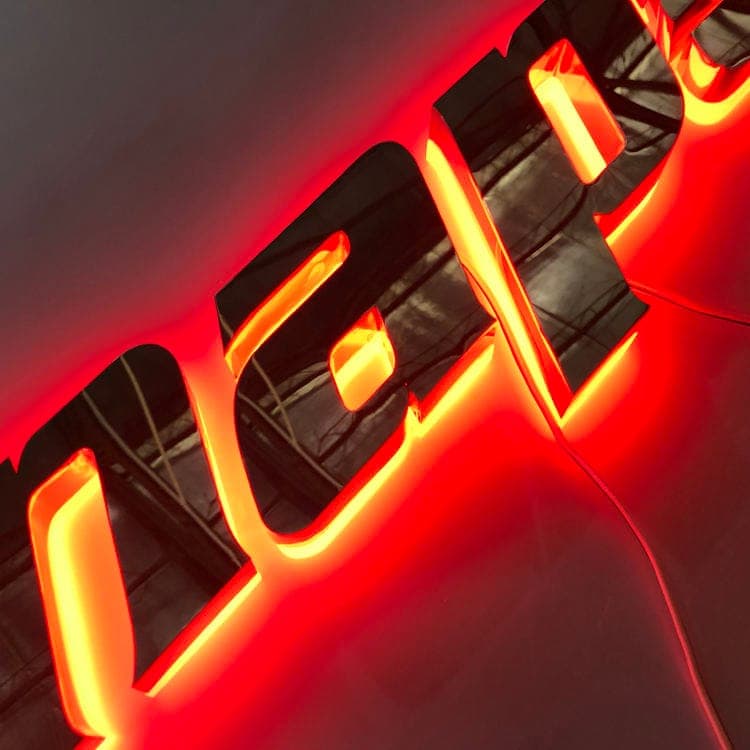
Walk into any barbershop from the 1950s and you’d hear it before you saw it—the soft 60Hz hum of a neon transformer, the flicker of a tube fighting to stay lit. That sound still echoes in a few joints in Las Vegas and Miami. But something else is eating its lunch. LED neon flex. Flexible, dead silent, and shipping for $30-100 to your door.
I’ve spent fifteen years inside a 3,000m² sign factory in Lu’an, China. I’ve watched crates of traditional glass neon arrive looking like a bag of crushed candy after a 50-day sea journey. I’ve also packed LED neon flex signs so compact you’d mistake the box for a yoga mat. The shift is real. But the old guard still asks: does LED flex save real money? Is it safe? Will it last past the first rainy season?
This is no catalog fluff piece. I’ll put every number on the table—watts, dollars, and years—so you can make the call without the marketing haze.
Traditional glass neon is a handcraft. A glass tube gets heated over a ribbon burner, bent by a craftsman into a letter “S” or a looping logo, then filled with argon or neon gas and coated with phosphors. A high-voltage transformer—2,000 to 15,000 volts—excites the gas. It’s gorgeous art, but it’s also an electrical weapon wrapped in glass.
LED neon flex takes a different road. A flexible PCB is embedded with surface-mounted LEDs. We use SMD 2835 chips that push 100-150 lumens per watt. That board gets encased in a continuous silicone or PVC jacket, diffusing the light into a uniform ribbon. No glass. No high voltage. Just 24 volts DC that you can touch while it’s running.
And the factory floor wisdom? A glass bender might take two hours on a single letter “G”. Our UV printer and CNC plotter knock out an LED flex letter’s backplane in eight minutes. The human touch is different, but the output consistency is on another planet.
When a client in Texas asks me what a simple “OPEN” sign will cost them, I don’t give them a single number. Here’s why. Glass neon carries three costs: the tube bending, the transformer, and the housing—plus the inevitable repair call six months later. LED flex front-loads almost nothing and spreads the rest over a decade of energy savings.
Let’s pin this down with a 24" x 12" sign, 4 linear feet of glowing face, operating 12 hours a day, every day.
| Cost Factor | Traditional Glass Neon | LED Neon Flex (Factory-Direct) |
|---|---|---|
| Product & hardware (landed, excl. install) | $260–$400 | $80–$250 (Factory sign $30–200 + express shipping ~$50) |
| Annual energy cost (4 ft, 12h/day, $0.12/kWh) | $63.07 (120 W total) |
$12.61 (24 W total) |
| 5-year energy total | $315.35 | $63.05 |
| Transformer/driver replacement within 5 years | 1 transformer ($60–$100) + 1 tube re-bend ($80–$150) | None expected (LED L70 50,000 h) |
| Total 5-year ownership cost | $715–$965 (approx.) | $143–$313 (approx.) |
These numbers assume a factory-direct LED flex sign from a supplier like Aochuang Sign, where an “OPEN” flex unit costs $30 to $200. Add $50 express freight to the US, and you’re still miles below the glass sticker. If you buy that same LED flex sign through a US distributor, expect to pay $200–$700 retail. Glass neon installed at a US storefront rarely leaves the driveway for less than $500.
A linear foot of standard 15mm glass neon red tube pulls about 30 watts. Four feet? 120 watts. That’s a lightbulb from the 1970s. An equivalent LED neon flex pulling from a 24 V driver sips around 6 watts per foot—24 watts total. Same brightness, one-fifth the current.
Now stretch that to a 20-foot main street sign. Glass neon: 600 watts. Ten hours a night, that’s six kilowatt-hours daily. At the national average $0.12 per kWh, you’re burning through over $260 a year just to keep the tubes glowing. LED flex on the same 20-foot run: 120 watts, $52 a year. Over the warranty period of a new sign, the flex pays its own way.
One thing old-school sign guys don’t always mention: glass neon transformers lose efficiency as they age. A 50-lb magnetic transformer’s core gets noisy and hot; the power factor can drop below 0.5, meaning the utility is billing you for wasted energy you can’t even see. LED drivers, well, they stay above 0.9 and weigh less than a bag of coffee.
Let’s be blunt. Traditional glass neon runs on voltages that can stop a heart. Neon secondaries spit out 2 kV to 15 kV. I’ve seen cracked electrode housings arc to metal sign frames, making the whole storefront live. Even with UL-listed transformers, wire runs must be enclosed in metal conduit, and any moisture becomes a danger.
LED neon flex operates on 24V DC. You can cut it while it’s on (don’t, but you could) and nothing happens except a dim section. The silicone jacket is IP65 minimum at our factory—dust-tight and jet-proof. We 100% QC test each sign with an 8-to-12-hour burn-in before it leaves Lu’an. A cracked glass tube, on the other hand, becomes a sharp-edged hazard the moment the freight truck hits a pothole.
Here
Factory-direct since 2010. Free quote within 24 hours — no obligation.
Get a Free Quote →MOQ: 1 piece · 7-15 days · 2-year warranty · Worldwide shipping