Stop Guessing. Here's What Actually Works.
You've seen the spec sheets. Lumens per watt, lifespan, beam angle. And you've also seen two identical-looking modules where one dies at 14 months and the other runs for six years.
The ugly truth is that the chip size — 2835, 5050, 5730 — tells you the package dimensions, not the quality inside. And quality is what determines whether your channel letters still glow in 2029 or turn into a dark storefront before the lease is up.
I've been building signs for 16 years. This is the comparison I wish someone gave me before I wasted money on the wrong LED modules.
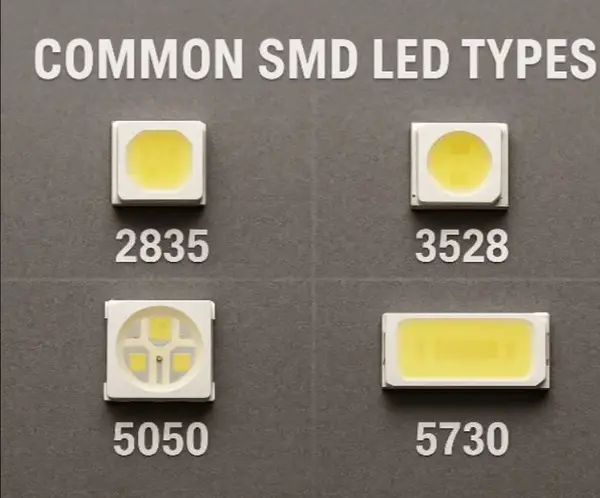
SMD 2835: The Workhorse You Can Trust
SMD 2835 is the industry standard for front-lit channel letters. It cranks out 100–150 lumens per watt, which is more than enough for a 6-inch letter with a white acrylic face. You'll see it in most commercial signs because it balances brightness, heat, and cost better than any other module.
Here's what nobody tells you: the 2835 is a single-chip package. No RGB, no fancy effects. It's built to do one thing — light up a sign reliably for 50,000 hours to L70. That's over five years of continuous operation before brightness drops to 70%.
For our
front-lit channel letters, we use SMD 2835 modules from Samsung or Osram. They cost more upfront than the cheap stuff you'll find on Alibaba for a quarter of the price. But the cheap stuff burns out in 12–18 months. Then you're paying a crane service, a crew, and a re-run to fix a $200 problem. That's not saving money. That's gambling.
The 2835 is also forgiving on heat. It runs cooler than higher-power chips, which matters when you seal a letter with silicone and bake it in the Arizona sun. You can push it in tighter letters, smaller returns, tighter radii. It's the default for a reason.
SMD 5050: The "Looks Good on Paper" Option
SMD 5050 is bigger — 5.0mm × 5.0mm — and it's the package you'll find in RGB color-changing modules. If you want your channel letters to cycle through purple, orange, and sea green for a casino or a nightclub, 5050 is the route.
But here's the catch. For white light, the 5050 typically runs three smaller chips inside one package. That means more heat density and lower efficiency per watt than a modern 2835. The old-school 5050 modules from 2015? They were the gold standard. Today, if someone tries to sell you 5050 white modules for a standard sign, ask why.
The honest answer is that 5050 modules are fine for color effects, not for white channel letters. They're also thicker, which can make them harder to pack into shallow returns. I've seen this go wrong: a shop bought 5050 modules because they looked brighter on the test bench, then found the letters had hot spots and the acrylic face warped from the heat. That's a rookie mistake.
If you need color-changing channel letters, go 5050. For anything else, use 2835. Period.
SMD 5730: The Brightest Option — If You Need It
SMD 5730 pushes 40–60 lumens per chip, which makes it the highest-brightness module in this lineup. It's the one you pick when you need a halo that punches through a deep return, or when your sign faces direct sunlight and you can't afford to look washed out.
The trade-off is heat and power draw. More lumens means more watts. More watts means more heat. You can't just cram 5730 modules into a channel letter and hope it works. You need proper spacing, adequate ventilation, and a sign cabinet that can handle the thermal load.
We recommend 5730 for
back-lit halo letters and large-format signs where the viewer is far away. It also works well for dual-lit designs where you want the face and the halo both visible during the day. But you should never use 5730 on a shallow 3-inch return without calculating the heat. That's a recipe for premature LED failure.
And yes, the cheap 5730 modules on eBay? They melt. I've personally seen a letter come back with a blackened acrylic face because someone used 240 mA modules at 1.0W each in an enclosed box. That's not an LED problem. That's a design problem.
Lifespan: The Number Nobody Wants to Talk About
Every manufacturer will quote L70 at 50,000 hours. That's the time until the LED emits 70% of its original light. Sounds great, right? But that number is only valid under specific conditions — usually 25°C ambient, with proper heat sinking and the right drive current.
The ugly truth is that in a sealed channel letter on a south-facing wall in Texas, the ambient temperature inside the letter can reach 70°C. At that temp, a cheap module's lifespan drops to 12–18 months. A quality module with Samsung or Osram chips and a proper constant-current driver? It'll still be running at 5 years.
So when you're comparing SMD 2835 vs 5050 vs 5730, the chip size matters less than the brand of the die inside. We specify Samsung, Osram, or Lan Jing modules. We pay 30–50% more for those. You know what we get? Calls from customers saying "the sign still looks brand new." That's worth it.
How to Pick the Right Module for Your Project
Here's a simple decision tree I use in our shop:
- Standard front-lit channel letters, 4–10 inches tall: SMD 2835. It's bright enough, efficient, and easy to seal. This covers 80% of storefront jobs.
- Back-lit halo letters, deep returns, or letters over 2.5m wide: SMD 5730. Use lower density and bigger spacing to manage heat.
- RGB or color-changing signs: SMD 5050. Accept the lower efficiency because you're not going for white light anyway.
- Halo letters with thin returns under 4 inches: SMD 2835 in a low-profile module. Don't let anyone talk you into 5730.
You'll also hear people argue about the spacing of LEDs — 3 per foot, 4 per foot, whatever. Here's my opinion: spacing only matters after you've chosen the right chip and the right quality. You can tune a good module. You can't polish a turd.
What Our Factory Can and Can't Do
Let's be straight with you.
We make channel letters in our 3,000m² facility in Lu'an, Anhui. We've shipped worldwide. We have CE, RoHS, and ISO 9001 certifications. If you order from us, you're getting factory-direct pricing — 50–65% less than what US retail installation shops charge. Our
aluminum letters start at $10–25 per letter, and front-lit channel letters run $20–80 depending on size and complexity.
But we don't do UL 48 certification in-house. That's the truth. Getting an LED module UL listed costs $4,000–15,000 and takes 4–9 months with quarterly audits. We built our business on CE and ISO instead. That means if you're doing a big commercial project in Chicago that requires UL-listed components, you need to know that going in. We can build to NEC Article 600 specs and provide components that a local inspector will sign off on, but we won't hand you a UL sticker that doesn't exist.
Most importers don't tell you that. They slap a "UL equivalent" label on a box and hope no one looks. That's dishonest, and it gets you a failed inspection and a lost client.
What we can do is this: your orders ship in 7–15 days. We run an 8–12 hour aging test on every batch of LEDs before they go into letters. We do 100% QC inspection on each sign. We pack in foam, carton, and plywood crates so a sea shipment doesn't destroy your project.
And we'll tell you honestly if you're overspec'ing. If a client wants 5730 modules for a 6-inch letter in a mall corridor, I'll tell them to save their money. That's not good for our margins. It's good for your relationship with your client.
Pricing Reality Check
Here's the breakdown you'll see in the real world:
- SMD 2835 modules, quality brand: roughly $0.15–0.30 per module. You'll need 2–4 per foot of letter stroke.
- SMD 5730 modules, quality brand: $0.30–0.60 per module. Higher brightness, higher cost, double-check heat.
- Cheap no-name modules: $0.05–0.10 each. You'll replace them in 18 months. You'll lose the crane fee, the labor, and your reputation.
The difference between a $100 LED package and a $300 one is often a single failure-year in the field. On a 10-letter storefront, that's the difference between a $600 upcharge and a $2,500 service call.
Do the math. Then buy the good stuff.
The Bottom Line
SMD 2835 is your default for channel letters. SMD 5730 is your specialist for halo or high-brightness work. SMD 5050 is only for RGB.
Don't let anyone sell you on "newest" or "most powerful." The best LED module is the one that matches the sign's size, depth, and location. And the best supplier is the one who'll tell you that you don't need the expensive one.
That's what we do. You bring us a job, we'll spec it right, fabricate it in 7–15 days, and ship it anywhere. If you're ready to talk numbers, ask us for a quote on your next channel letter project. We'll give you a price, a lead time, and an honest answer about what works.
Don't gamble your sign on a chip that looks good in a catalog. Use the one that's proven on a roof, in the rain, under the sun, for five years. That's SMD 2835. Use everything else for the right reason, not the wrong one.