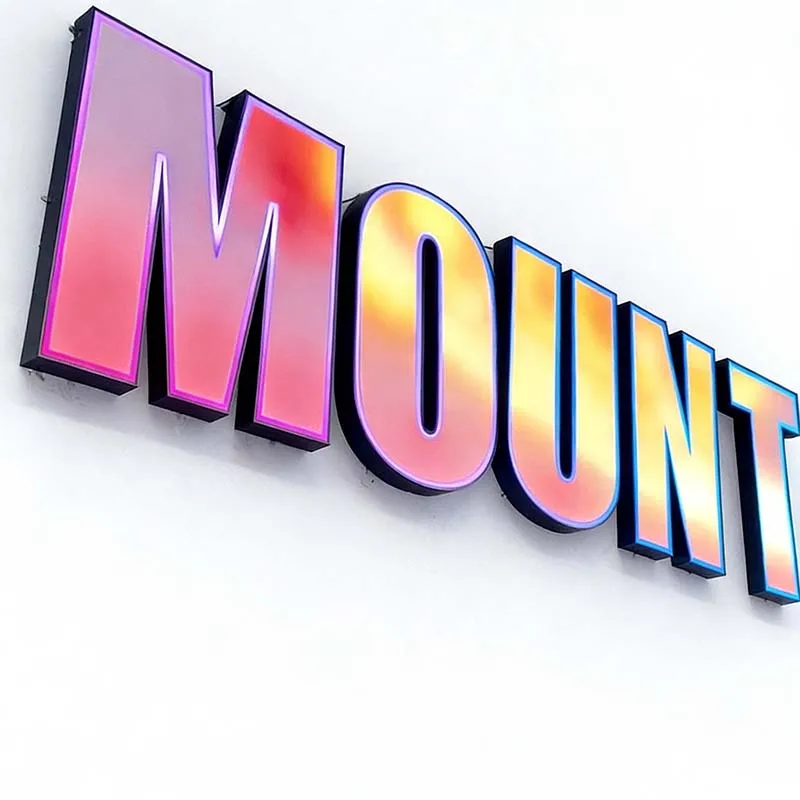
Here's what nobody tells you: most sign shop owners are overpaying for
channel letters by thousands of dollars per job. Not because their local fabricator is dishonest. Because that fabricator has overhead — rent, insurance, a guy named Dave who's been welding for 14 years and deserves his paycheck.
I've watched sign shops pay $800 for a front-lit letter. Same 304 stainless, same Samsung LEDs that we build for $120 at our factory in Lu'an, Anhui. That's not a 20% markup. That's 550%.
The factory-direct price on
front-lit channel letters runs $20-80 per letter. The same product, installed by a US retail shop? $200-700 per letter.
Nobody tells you that.
What You're Actually Paying For at a Local Shop
Walk into any local fabrication shop and look around. You're paying for the 3,000-square-foot building. You're paying for the $100,000 CNC router that runs half capacity. You're paying for the truck that hauls the finished sign to the site at 6 AM. You're paying for the sales guy who took you to lunch.
None of that makes your sign brighter.
Let me break down a typical local quote. Say the going rate is $300 per letter. Roughly $90 goes to materials — acrylic, stainless trim, LED modules, transformer. About $110 goes to shop labor at $75-85 an hour. That leaves $100 for overhead, sales commission, and profit. Defensible math, honestly. A shop that does this work well deserves to eat.
But here's the thing: you've got your own crew. You're a sign contractor, a shop owner, an importer. You know how to hang a letter. You pull permits in your sleep. You're paying $100 per letter for services you'll never use on a $15,000 job.
The ugly truth is that most local fabricators source the same materials you'd get from us. Same Mitsubishi acrylic. Same Samsung LED modules. Same 304 stainless from the same mills. They just mark it up because the economics of a small shop force them to. That's not a moral failing. It's the difference between their pricing model and a factory's.
That gap is your margin.
What Factory-Direct Gets You (and What It Doesn't)
Look, I run a factory. I'm not going to stand here and tell you buying direct is right for every job. It's not. Let's be straight about both sides.
What we do well:
- Laser cutting at ±0.1mm tolerance. Your local shop's router might do ±0.5mm on a good day. At sign scale, that's the difference between a tight seam and a gap you can slide a dime into.
- TIG welding on stainless, not spot welds that come apart in year three. Our welders have been at this for 15-plus years. They don't rush.
- An 8-12 hour aging test on every single
LED sign before it ships. That's not a sales feature. That's basic QC that too many small shops skip because the owner wants to deliver on Friday.
- Real certifications. CE, RoHS, ISO 9001, UL 48. Not screenshots. Certificates you can verify.
What we can't do:
- Install. We're not flying to Ohio to hang your sign. You need a local crew for that.
- Permits and code compliance. NEC Article 600 for US electrical. ADA tactile requirements — 48-60 inch mounting, non-glare finish, Grade 2 Braille. That's your jurisdiction, not ours.
- Rush jobs. Need it in three days? Call the shop down the street. Our standard lead time is about 5-15 days. That's fast for a production run. It's not "tomorrow" fast.
- Service calls. If an LED dies in year two, you can't have us drive over. We honor the warranty — 2 years on LEDs, 1 year on power supplies — but you ship it back and we replace it. Or your crew swaps it in forty-five minutes. That's the trade you're making.
If you don't have the infrastructure to handle logistics, go local. No shame in that. But if you're a working shop with a lift truck and a license, you're leaving $8,000 on the table every job.
The Real Costs Nobody Quotes — Shipping, Tariffs, Lead Time
Here's what nobody tells you: the factory price isn't the real price. Shipping isn't free. Tariffs aren't fake. You need to run these numbers before you compare quotes, or you'll underbid a job and blame the factory.
- Express: about 5-15 days, $30-100. Fine for a sample order or a single letter.
- Air freight: about 10 days, $4-12 per kg. The sweet spot for medium orders that need to move.
- Sea freight: about 65 days, $80-200 per m³ LCL. A full container runs $1,200-3,000. This is where real savings live, but you need to plan ahead.
- US Section 301 tariff: right around 30%. You're going to pay it. Anyone who pretends it doesn't exist is either naive or lying to you.
Let me run the math. Fifty front-lit channel letters, 50cm tall, 3mm acrylic face, 304 stainless trim, quality Samsung modules.
Local fabricator: $250-350 per letter, not installed. That's $12,500-17,500.
Factory direct: $40-80 per letter. Call it $60 average — $3,000. Add 30% tariff — $900. Add air freight at $8/kg, fifty letters at roughly 2kg each — another $800. Total landed: $4,700. Your crew hangs them in a day.
You just saved $8,000 on one order. That's not a rounding error. That's a second truck payment, or a new employee's first quarter, or a 40% margin on a job your competitor quoted at 15%.
Some shops go the other direction and upgrade to
back-lit halo letters — $35-120 per letter from the factory, versus $400-1,000 installed locally. That's how you land the high-end hotel job and still win the bid.
That's the whole game.
How to Know If a Factory Is Worth Your Money
I've seen this go wrong: someone orders from a factory they found on a directory, and three weeks later they're unboxing what looks like letters welded by an octopus on a bad day. Now they think every factory is garbage. I get it. But you can filter out 90% of the junk with three questions.
Ask for the CE certificate — with today's date on it. CE marking costs 20,000-50,000 RMB to maintain. Most factories claim they have it. Ask to see the actual certificate, not a PDF they've been passing around since 2019. Same for ISO 9001. If you're selling into the US, ask about UL 48 or ETL. ETL is UL's practical alternative — 10-30% cheaper, same coverage, and it doesn't take 9 months. UL 48 certification runs $4,000-15,000 and requires quarterly audits. That's why so few Chinese factories bother. We bothered, because US buyers deserve a verifiable mark.
Order a sample first. Not to be dramatic — because you should. One letter, shipped express. Take it to your shop, run it through your own installation process. Check the welds. Measure the acrylic against the spec sheet. Run the LED module at full brightness for a night. Test what happens when a hose sprays the seam. Then decide.
Ask about the LED modules by brand. There's Samsung, Osram, and quality Chinese manufacturers like Blueview (Landscape), and then there's cheap stuff that goes dim in 12-18 months. Quality modules carry an L70 rating of 50,000 hours — that's real lifespan. The SMD 2835 is our industry standard at 100-150 lm/W. SMD 5730 pushes 40-60 lm per chip for maximum brightness. If a factory quotes you $15 for a
metal letter, they're using cheap LEDs. You'll find out in year two when the customer calls you angry at 9 PM.
When NOT to Buy Direct (Read This Before You Order)
I'm going to lose some sales right now, and I couldn't care less.
Don't buy direct if you're a landlord doing a one-off sign. You don't have a crew, you don't want to deal with a shipping crate, you just want the sign up. The local shop will charge you more, and it'll be worth every dollar. This article isn't for you.
Don't buy direct if you need it in three days. We can't do that. Nobody legitimate can. If a factory promises it in 72 hours, they're selling you something they'll ship on day six and blame the courier.
Don't buy direct for a single ADA compliance sign. The shipping and logistics on one item eat the savings. This