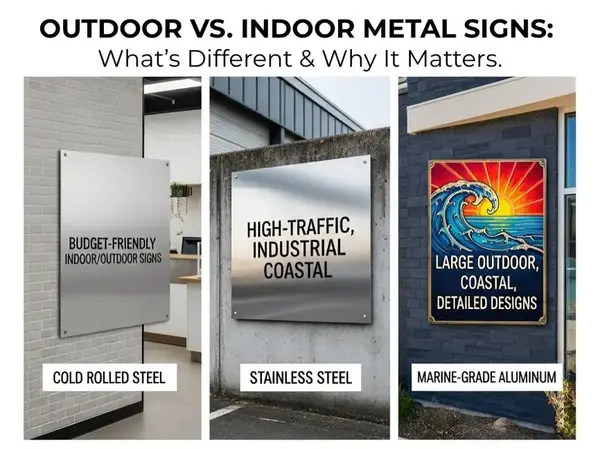
Got a call last week from a guy in Destin, Florida. His three-year-old stainless steel letters looked like they'd been dragged behind a boat for a decade — pitting, rust bleeding down the storefront, the whole nightmare. He sent photos. I could tell from the pinholes and brown streaks what happened before he even told me: someone spec'd 304 stainless for a beachfront install. That's a $4,000 mistake he gets to explain to his client.
Here's what nobody tells you: stainless steel is *stainless*, not *stainproof*. It shrugs off rust because of a microscopic chromium oxide layer that heals itself in normal conditions. But salt air — specifically the chloride ions in sea spray — eats that layer for lunch. Once the chromium oxide breaks down, the iron underneath oxidizes, and you get that ugly brown corrosion that makes business owners call you at 7am sounding frantic. If you're installing signs within a mile of salt water, the metal choice isn't a line-item decision. It's an existential one.
304 stainless is the workhorse. It's got 18% chromium and 8% nickel, costs a reasonable amount, and handles normal outdoor conditions for 10+ years without breaking a sweat. I've seen it in Arizona deserts, Chicago winters, and Texas Gulf Coast parking lots. Inland, it's bulletproof. But it's got a weakness: chlorides — the airborne salt that's basically a constant presence near the ocean — punch through its oxide layer. Once that happens, the pitting starts, and it doesn't stop.
316 stainless is what you need for coastal work. Same chromium and nickel base, but it picks up 2-3% molybdenum. That seemingly tiny addition changes the game — molybdenum makes the oxide layer far harder for chlorides to break down. It's the difference between a sign that looks presentable for 15 years and one that's rusted in front of a beach shop in three. The catch? 316 costs 20-30% more than 304. For a strip mall in Ohio, 304 is fine. For Miami Beach, pay for 316 or you're replacing letters in 3 years. That's not me being dramatic, that's me being uncreative.
But here's the thing that drives me nuts: most fabricators won't tell you which grade they're using. They'll say "stainless steel" and slap a marine-grade sticker on the quote. The ugly truth is that stainless steel letters leaving a factory in Anhui or Arkansas or Ohio all look identical when they're new, and the difference only shows up after the warranty expires. Ask for mill certificates. Ask for the actual grade. If your supplier hesitates or starts mumbling about "equivalent grades," hang up — they don't stock 316 and they're hoping you won't check.
You don't need a PhD in metallurgy to know what to spec. Just remember: half a mile. That's my rule of thumb for any corporate or local signage job. Within half a mile of the ocean, or in any industrial zone with aggressive air (think chemical plants, paper mills, busy freeway interchanges where road salt gets airborne), 316 is your baseline. Above that half-mile radius, 304 will do the job — but I always ask where the client's business is actually located and how their neighbors' signs look.
Salt rides the wind, not just the spray zone. I live in places where storm systems blow onshore days after a "canonical" saltwater event. The salt settles on everything, including your letter faces and returns. In a beachfront town, even a so-called calm day has measurable salt in the air. Fifteen years ago, I had a customer in Galveston who insisted on 304 because the budget was tight. I quoted him the price difference, he waffled, and I made him sign a waiver. He called me four years later asking for a discount on replacement mirror polished letters. I didn't give him a discount, and I wasn't nice about it.
The counterpoint — and I've seen this go wrong too many times — is the guy who thinks 316 is a magic shield. It's not. 316 handles chloride attack much better, but it still needs proper drainage, proper standoffs, and a design that doesn't trap saltwater in crevices. If you weld the returns shut, or you mount the letters so water collects inside the channel, you'll get corrosion no matter what grade you pay for. I've watched sign shops pay $800 for a front-lit letter from a domestic fabricator. Same 304 stainless, same Samsung LEDs. We ship that letter for $120. But the best price in the world doesn't help if the product is engineered to fail.
Here's what nobody tells you: the 20-30% premium for 316 is on the material cost, not the full installed price. If raw 304 costs a fabricator $10 per pound, 316 might cost $12.50-$13. On a $3,000 sign order, the actual metal upgrade is maybe $100-$150. Nothing compared to the labor and installation costs. But guess what? Many shop owners quote the entire job at a 25% markup just because they're using 316, pocketing the difference.
I've been in this industry since 1998, and I've got a 27-year habit of checking prices with domestic fabricators versus what our factory in Lu'an, Anhui produces. For front-lit channel letters, the factory price range is $20-$80 per letter for front-lit, $35-$120 for halo-lit, and $15-$40 for stainless steel non-lit. US retail installed runs $200-$700 per letter for front-lit, $400-$1,000 for halo-lit. Factory-direct savings of 50-65% are real on product cost, but shipping eats some of that — express takes 7-15 days and runs $30-$100 for small orders, air runs $4-$12/kg, and sea freight takes 50-70 days at $80-$200/m³ for LCL.
But here's my brutal honesty for the reader: don't order direct if you don't know how to spec marine-grade materials. The factory will build what you ask for. If you write "stainless steel letters" without specifying "316 stainless steel, 1.5mm thickness, brushed #4 finish," you're gambling. I've seen plenty of importer nightmares where crates show up with lower-grade steel and bad welds. LCL sea freight: your crate gets handled 6-8 times between our dock and yours. Every touch is a chance for damage. That's not in the brochure.
Don't be fooled into thinking you're choosing between one type of stainless and a magical alternative. There's also the finish to consider. A rough, unpolished surface gives salt a place to grab. A smooth, polished surface lets water bead and run off. If you're in a coastal region and you're set on gold or chrome electroplated letters, think again — electroplating adds a copper layer that can corrode aggressively when it meets salt. Brass and copper are gorgeous in a covered indoor mall, but they're a maintenance nightmare anywhere within sniffing distance of the ocean.
The ideal coastal spec is 316 stainless with a brushed #4 finish or a mirror #8 finish, depending on the look — and the finish isn't just aesthetic. A tighter surface finish reduces the surface area where chlorides can collect. Combined with proper drainage holes in the returns and sealed standoff mounting points, it's your best defense. I know the brushed look is popular right now; that's the #4 finish, and it hides fingerprints and water spots far better than a mirror finish.
But here's a final reminder: pay attention
Products mentioned or relevant to this topic — factory-direct, custom built.
Factory-direct since 2010. Free quote within 24 hours — no obligation.
Get a Free Quote →MOQ: 1 piece · 7-15 days · 2-year warranty · Worldwide shipping