You're staring at a quote for 300 linear feet of front-lit channel letters and a freight forwarder's asking if you want air or sea.
I've shipped signs worldwide from our factory in Lu'an. I've seen every freight mistake a sign shop can make. Air freight isn't always faster when customs gets involved. Sea freight isn't always cheaper once you factor demurrage and storage.
Here's what nobody tells you: the invoice price for the signs is maybe half your landed cost. Freight, tariffs, customs brokerage, and import bonds eat the rest.
You don't need a freight calculator. You need the real ranges from someone who signs the shipping docs.
Air freight runs $4-12 per kilogram. Transit time is about 10 days door-to-door after our 7-15 day production schedule. Sea freight LCL runs $80-200 per cubic meter, about 65 days transit. Full container load runs $1,200-3,000 depending on origin and destination.
The ugly truth is most sign shops compare the air quote per kilogram to the sea quote per cubic meter and think sea wins every time. It doesn't.
I've seen this go wrong: a contractor needed 40 back-lit halo letters for a grand opening in six weeks. He chose sea freight to save $800. The ship sat outside Long Beach for nine extra days. He missed the opening, paid $2,100 in rush charges from a local shop to cover the gap.
Air freight makes sense when your order is under 200 kg and your installation deadline is fixed. We ship small orders by express for $30-100, about 5-15 days. Air cargo is cheaper per kg once you pass about 100 kg.
Here's what nobody tells you: air freight costs more per kilogram, but your signs spend less time in transit. That means less time for forklift damage, less time for moisture to sit on the acrylic faces, and less time for your customer to call you asking where the hell their sign is.
Sea freight makes sense for large volume. If you're importing 50 acrylic light boxes or a 20-foot container of stainless steel letters, the per-sign freight cost drops to almost nothing.
But sea freight is where I see rookie importers lose their shirts. They budget $1,800 for LCL and forget port congestion fees, customs exams, chassis fees, and warehouse storage after the free 3-day window.
The ugly truth is a $1,200 LCL shipment can turn into $2,800 before you get a truck appointment. And that's before the 30% Section 301 tariff.
These are the line items I tell my customers to ask about before they book anything.
Add that to your sea freight quote and suddenly air freight doesn't look so stupid.
You pay for speed one way or another. Air freight ties up your cash for 2-3 weeks. Sea freight ties it up for 2-3 months. If you're financing the order on a credit card at 18%, that interest is a real cost.
Look, a $5,000 order shipped sea freight might sit in transit for 60 days. That's sixty days you can't bill the client. The same order shipped air might arrive in 12 days. You invoice, get paid, and move on to the next job.
Cash flow isn't just about interest. It's about opportunity. The contractor who flips jobs fast wins the next bid.
We pack every sign in foam, then carton, then plywood crate. That's standard for sea freight because the container gets stacked, forklifted, and dropped at least five times before you see it. Air freight still needs the same crate, but it gets handled less.
Here's what nobody tells you: the crating for a 3-meter stainless steel sign might weigh 40 kg and cost $60. On air freight that crate adds $240-480 in freight alone. On sea freight it adds maybe $20.
If you're bringing in back-lit halo letters, those aluminum returns are light but bulky. You'll hit dimensional weight on air freight, not actual weight.
That's why I don't push one mode over the other. The order details dictate the answer.
The 30% Section 301 tariff applies whether your signs fly or float. No way around it unless you're paying a customs broker to file the wrong HTS code, which I don't recommend.
I've watched sign importers get hit with a $4,200 customs bill on a $14,000 order. They didn't budget for it because the freight forwarder quoted "shipping only." That's not the forwarder's fault. That's the buyer not asking the right question.
Ask for an all-in landed cost quote. If they won't give you one, find another forwarder.
First mistake: ordering without a clear install date. If the site is ready in 30 days, air freight is the only option. Sea freight might save $500 on freight but cost you $3,000 in idle labor.
Second mistake: comparing quotes by mode instead of by landed cost. A factory price of $120 per letter means nothing if you pay $800 in freight and tariff. Compare the total cost per sign in your hand.
I've seen this go wrong: a client ordered stainless steel letters for a restaurant opening. Air freight was $980. Sea freight was $420. He chose sea.
The ship got rerouted to Vancouver for a crew medical emergency. Twelve days lost. His opening had a blank wall and a very angry owner.
We can produce your order in about 5-15 days. We can't make a ship sail faster or get customs to skip your container.
Our MOQ is one piece. That means you can test air freight on a single back-lit halo letter before you commit to a 40-foot order. I'd rather you lose $60 on a trial than $6,000 on a mistake.
Our acrylic faces use Mitsubishi or Degussa material that doesn't yellow for 5-8 years. The cheap domestic acrylic yellows in 1-2 years. That matters if your shipment sits in a humid container for 60 days.
We ship worldwide. We've learned which forwarders to trust for air and which for sea. If you don't have a broker, we can recommend one. We don't get kickbacks, so the advice is straight.
Look, I'm not going to pretend sea freight is bad and air freight is good. They're tools. Use the right one for the job.
Order under $2,000 and you need it in three weeks? Air express or air cargo. You'll pay $30-150 in freight, and you'll have your signs before the paint on the wall dries.
Order over $10,000 and you have eight weeks? Sea freight LCL. You'll pay $80-200 per cubic meter, and you'll save enough to cover the tariff.
Just run the numbers with the 30% tariff, the broker fees, and the port charges included. Then decide.
And if a forwarder tells you air freight is always faster, ask them about the time a customs exam in Memphis held a pallet for 11 days.
Factory-direct since 2010. Free quote within 24 hours — no obligation.
Get a Free Quote → Copy EmailMOQ: 1 piece · Flexible lead time · 2-year warranty · Worldwide shipping

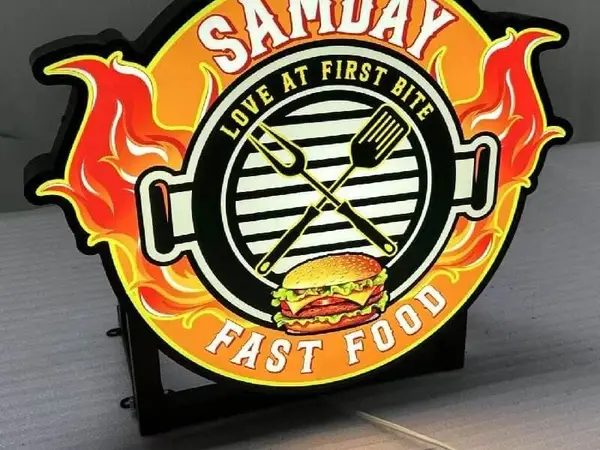
Real photo from our production floor — every sign we ship is made here.
See pricing, specs, and get a free quote for the sign type you need. Built in our factory, shipped worldwide.