11 p.m. I just finished hand-polishing a 316 stainless letter for a hotel in Miami. The client thinks he saved money by going with a local shop that quoted $450 a letter. He didn't. He's getting 304 stainless, and three years from now, that letter will look like it has acne.
I've been
building signs since 2010, on a factory floor in Lu'an, Anhui. The shop is 3,000 square meters with 50 workers. Sawdust and acrylic shavings end up in my boots. I've burned my hands on hot acrylic, argued with LED suppliers, and watched too many sign shops make the same damn mistakes. Here's what actually matters when you spec a building sign.
Building Sign Types and Their Business Applications
Picking a sign type isn't about looks. You're matching the business's needs and what the landlord allows. Front-lit
channel letters are the workhorse for storefronts. They run cheap, stay visible day and night, and look clean. If you're ordering
front-lit channel letters for a retail client, you're making the safe call.
Back-lit halo letters are the premium option. The light spills out behind each letter and leaves a soft glow on the wall. Architects love them for corporate lobbies and high-end restaurants. They cost more and they say 'we care about details.' Check out
back-lit halo letters for that architectural look.
Then you've got light boxes and monument signs. Light boxes are cheap and bright, perfect for gas stations and strip malls. Monument signs are ground-mounted, usually masonry or aluminum, and they need engineering. Don't even think about a monument sign without a structural engineer's stamp.
Here's what nobody tells you: dual-lit letters—visible day and night with a different effect—are a pain to install but they make a building stand out. Not every shop can do them right. For most businesses, a simple front-lit or halo-lit set works. Don't overcomplicate it.
A restaurant in a historic district might only get stainless steel letters past the design review board. A dentist office can use a simple lightbox with a tooth graphic. Match the sign to the business's price point and the landlord's rules.
Permitting, Code Compliance, and ADA Requirements
Permits are the part that makes sign shop owners want to quit. Every city has different rules, and the people who wrote them have never installed a sign. You need to know NEC Article 600 for electrical, and if you're in the US, your sign had better be UL 48 or ETL listed. UL 48 testing costs $4,000 to $15,000 and takes 4 to 9 months, with quarterly audits. ETL is basically the same but 10-30% cheaper. If your local inspector accepts ETL, use it.
Landlords have their own sign rules. They'll reject a sign because the font is too big, the color clashes with the facade, or the mounting method might damage their precious stucco. Always get the landlord's sign criteria in writing before you design anything. I've seen a $20,000 sign order cancelled because the tenant didn't confirm the max letter height. That's a rookie mistake.
CE marking is a joke in this industry. A real CE certificate costs 20,000 to 50,000 RMB. Most factories will tell you they have it. Ask to see the certificate with today's date. Watch them sweat.
Same with IP ratings. IP65 means the sign handles water jets from any direction. It doesn't mean the sign survives a Florida hurricane. If you're on the coast, you need IP66 or IP68 and a wind load calculation. Don't let a sales rep quote IP65 and call it weatherproof.
ADA is non-negotiable for interior wayfinding and room signs. Tactile signs need Grade 2 Braille, non-glare finish, and mounting between 48 and 60 inches to the center of the sign. Not 47 inches. Not 61. The inspector will measure.
Material Systems Compared: Aluminum, Acrylic, LED, and More
Aluminum is your default for
lightboxes and trim. It weighs a third what steel weighs and won't rust on its own. Outdoors, it lasts 8 to 12 years. Need a light, cheap letter? Aluminum works. But if the letters take abuse, stainless steel beats it. 304 stainless has 18% chromium and 8% nickel; it'll last 10+ years outdoors. 316 stainless adds 2-3% molybdenum, making it marine grade. For Miami Beach or a chemical plant, pay the 20-30% premium for 316, or you'll be replacing letters in three years. I've watched it happen.
When you're specifying
304/316 stainless steel letters, check the finish. Brushed #4 hides fingerprints. Mirror #8 shows every smudge. Powder coated can be any RAL color, but if the coating chips, the steel underneath stays protected. That's a good choice for harsh environments.
Acrylic is the face material for lit signs. UV-resistant acrylic from Mitsubishi or Degussa lasts 5 to 8 years before yellowing. Domestic stuff gives up after 1 to 2 years. That's a massive gap. Most shops don't know this: a 3mm acrylic face transmits 92% of light, a 2mm face transmits 90%. Your customer won't notice the 2% difference but they will notice a 40% cost bump when you spec 3mm for a small sign. Don't oversell. Only go 5mm or thicker when the sign is over 2.5 meters wide and needs the structural integrity.
LEDs are where the money is. SMD 2835 modules run 100-150 lumens per watt—industry standard. SMD 5730 chips push 40-60 lumens per chip when you need extra brightness. Quality modules from Samsung, Osram, or Blueview last 5+ years in the real world. Cheap no-name modules from Shenzhen markets die in 12-18 months, then half the diodes go dark and the sign looks like a jack-o'-lantern with missing teeth. I've replaced enough of those to know: the labor to swap a failed module costs more than the module itself. Pay for quality up front.
Cost Drivers and Total Cost of Ownership
Let's talk real numbers, because most sign shop owners don't know what factory-direct pricing looks like. From my factory, a front-lit channel letter costs $20 to $80. A back-lit halo letter runs $35 to $120. Non-lit stainless letters run $15 to $40. A 3D fabricated letter costs $40 to $120. Light boxes run $80 to $250 per square meter. That's factory pricing, before shipping and tariffs. Now compare US retail installed prices:
front-lit letters go for $200 to $700 per letter, halo-lit for $400 to $1,000. Factory-direct saves you 50-65% on the product itself. That's not a secret, it's math.
Let that sink in.
Shipping is where people screw up. Express takes about 5-15 days and costs $30-100 for a small box. Air freight takes about 10 days at $4-12 per kilogram. Sea freight takes about 65 days, LCL is $80-200 per cubic meter, FCL is $1,200-3,000 for a full container. Then the US Section 301 tariff slaps another 30% on top. Don't factor that 30% into your quote? You're eating the loss.
I've seen this go wrong: a contractor ordered a full set of channel letters for a mall renovation. He went with the cheapest sea freight option to save $500. The crate passed through six to eight hands between our dock and his, and every touch risks damage. He ended up with three dented letters, a cracked acrylic face, and a two-week delay. The $500 he saved turned into $2,000 in rework. LCL sea freight is fine if you have time and a good freight forwarder, but don't pretend it's risk-free.
Total cost of ownership matters. A cheap sign with cheap LEDs might save you $800 up front, but you'll be replacing LED drivers in 18 months. Quality power supplies from Mean Well or equivalent last 3-5 years, but the warranty is only 1 year because nobody covers lightning strikes or power surges. Cheap drivers die right after the warranty expires. I've watched clients pay twice for a sign because they thought they were saving money. Don't be that client.
Designing for Visibility, Readability, and Wayfinding
Design isn't art. You're engineering for the eye. The color temperature of your LEDs determines how the sign feels. 3000-3500K is warm, good for restaurants, hotels, and places that want to feel cozy. 4000-5000K is neutral, the safe choice for corporate offices and retail. 6000-6500K is cool, almost blue, and it works for industrial sites and highway signs. Get it wrong and your client's high-end restaurant looks like a gas station.
Readability is about contrast and simplicity. Don't put a script font on a channel letter with a tight stroke and expect it to be readable from across the street. The stroke will close up. Use a bold sans-serif or a clean serif. And don't let a designer talk you into a 6-inch letter height for a building 50 feet from the road. That's a mistake.
Wayfinding signs are a whole different beast. They need to be consistent, durable, and ADA compliant. If you're doing a hospital or a campus, you need a system, not a bunch of random signs. Plan the entire path from the parking lot to the front door. Use the same font, the same colors, the same mounting height. A good
wayfinding and directional system saves money because you're not redoing it every time a new tenant moves in.
Here's what nobody tells you: most clients think they want their logo huge and bright. What they actually need is a sign that's legible from the street at 30 miles per hour. Speed kills readability. A driver passing at 40 mph has about 3 seconds to read a sign. If your font is too fancy or your contrast is low, they won't read it. Keep it simple.
Factory-Direct Sourcing and Installation Best Practices
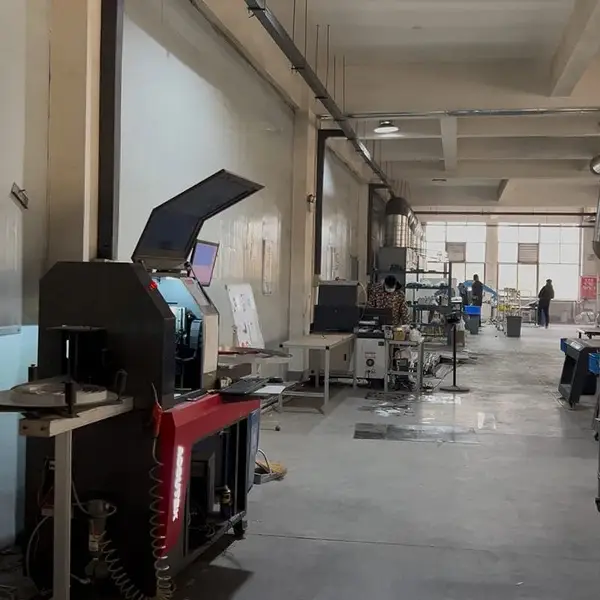
If you're buying signs from a middleman, you're paying a markup for nothing. My factory in Lu'an, Anhui is 3,000 square meters with 50+ skilled workers. We've been exporting since 2010. We have CE, RoHS, and ISO 9001. Minimum order is one piece. Lead time is about 5-15 days. Warranty is 2 years on LEDs and 1 year on power supplies. That's the baseline any serious factory should meet.
The production process matters. Here's the 10-step flow: design confirmation takes 1 day, laser cutting with ±0.1mm tolerance takes 1-2 days, bending and TIG welding 1-2 days, grinding and polishing 1-2 days, acrylic face CNC 1 day, LED assembly 1-2 days, sealing with neutral silicone 1 day, then an 8-12 hour aging test, 100% QC inspection, and export packaging with foam, carton, and plywood crate. That's why lead time runs about 5-15 days—not because we're slow, but because we don't skip steps.
Installation best practices: always use neutral silicone for sealing. Acidic silicone will corrode aluminum and damage LEDs. Test every LED module before you mount the sign. Use proper anchors rated for the weight and wind load. And for God's sake, don't drill through the face of an
acrylic letter. I've seen a crew ruin a $2,000 sign in ten minutes because they didn't mark the stud positions.
Look, I'm not saying every factory is perfect. I've seen bad factories with dirty workshops and no QC. But if you do your homework, factory-direct is the only way to get quality signs at a price that leaves you profit. Ask for photos of the production floor. Ask for their CE certificate with today's date. Ask for a sample letter. If they hesitate, walk away.
The Questions I'm Sick of Answering
What's the difference between UL 48 and ETL? They're both safety standards for electric signs. UL 48 costs $4,000-$15,000 and takes 4-9 months. ETL is equivalent and 10-30% cheaper. Your inspector might accept either. Stop asking which is 'better'—AHJs accept both. Just check with your local building department before you order.
How long do LED channel letters actually last? Quality modules from Samsung, Osram, or Blueview last 5+ years. Cheap ones die in 12-18 months. The L70 rating is 50,000 hours, which is over 5 years at 24/7. But the power supply will fail before the LEDs do. Expect to replace drivers every 3-5 years.
Can I install a sign without a permit? No. Not legally. Not safely. And if the building inspector finds out, you'll pay double fines plus removal. I've seen a sign shop lose their license over an unpermitted install. Don't be stupid.
Why is factory-direct so much cheaper? What's the catch? The catch is shipping time and tariff costs. Sea freight is slow, and the US tariff is 30%. But you're cutting out the domestic fabricator who marks up 50-65%. My factory ships the same 304 stainless letter with Samsung LEDs for $120 that a US shop charges $800 for. The only catch is you have to plan ahead and wait for shipping. If you need it tomorrow, pay the markup.