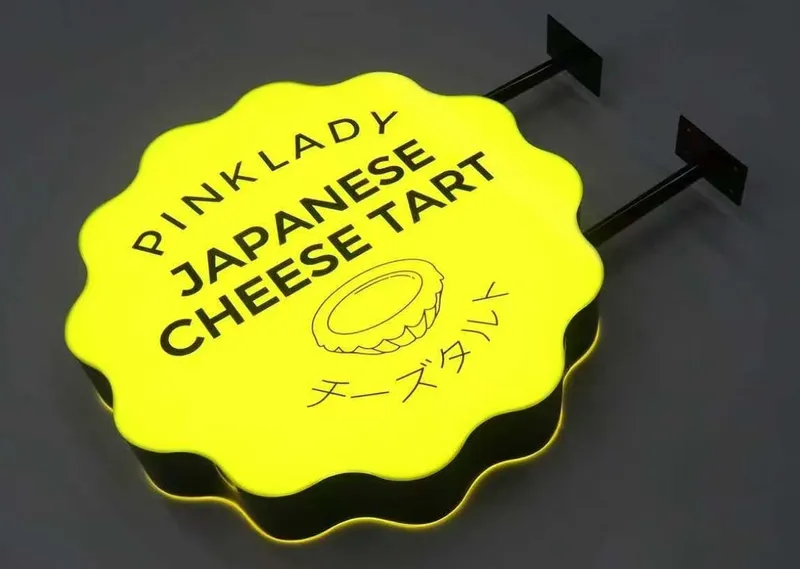
I've watched sign shops pay $800 for a front-lit letter from a domestic fabricator. Same 304 stainless, same Samsung LEDs. We ship that letter for $120. That's not a discount—that's the difference between a factory that owns its laser cutter and a middleman who marks up everything by 300%. Most buyers don't realize that 80% of the cost in a custom sign comes from three things: material thickness, LED quality, and whether someone actually sealed the seams with neutral-cure silicone instead of cheap caulk. Start with the substrate, because everything else is just decoration.
The spec says… but in reality… a 3mm acrylic face will bow under wind load if the sign is over 2.5 meters. That's why we use 5mm for anything above eight feet. Mitsubishi or Degussa UV-resistant acrylic lasts 5-8 years before yellowing. Domestic acrylic? 1-2 years, tops. The difference is a few dollars per sheet, but once it's installed and you see that ugly yellow haze on year two, you're not calling the installer—you're calling me. And I'll tell you what I told your guy at the start: buy the good stuff or buy it twice.
Here's the math: stainless 304 has 18% chromium and 8% nickel. That's what makes it rust-resistant. In an inland strip mall with standard weather, it'll hold up 10+ years. But if you're within a mile of saltwater—coastal restaurant, beachfront hotel—you need 316 stainless. That extra 2-3% molybdenum costs 20-30% more. I've seen a $4,000 set of 304 letters pitted beyond recognition in three years on a Miami Beach storefront. The owner saved $800 upfront and spent $6,000 on replacements. That's the kind of math that keeps me up at night.
Quickest way to spot bad LED modules: look at the solder joints. Dull gray = won't last 18 months. Shiny silver = proper lead-free solder with a reliable reflow profile. I've torn apart "bargain" modules from no-name factories—the solder is brittle, the chips are under-driven, and the whole thing dies in a year. Quality modules using Samsung or Osram chips (or Lan Jing, which is a solid Chinese OEM) will hit L70 ≥50,000 hours. That's about 5.7 years of continuous 24/7 operation. Cheap modules with generic SMD 2835 chips? Lucky to get 18 months.
Let me break this down: color temperature isn't just "warm" or "cool." It's a measurable spec. 3000-3500K for hospitality—makes steak look good. 4000-5000K for corporate—reads clean on white backgrounds. 6000-6500K for industrial—cuts through fog but makes everything look like a morgue. I've seen a high-end retail store install 6500K cool white in a jewelery display. The diamonds sparkled, but the clients looked like they'd seen a ghost. That's not a design choice—that's a spec error.
Most buyers don't realize that the LED power supply is where corners get cut. A quality 1-year warranty on the power supply is standard. We actually test our power supplies for 8-12 hours in an aging test before they leave the factory. That's the step most skip. And if the power supply fails, the whole sign goes dark. Not the LEDs—the supply. So when your sign shop quotes you $200 per letter, ask them what brand the power supply is. If they can't tell you, you're buying a lottery ticket.
CE marking costs 20,000-50,000 RMB. Most factories will say they have it. Ask to see the certificate with today's date. Watch them sweat. I've had factories send me expired certificates from 2015. CE is valid for 5 years, and it requires annual audits. A factory that can't produce a current certificate doesn't have it. Period.
IP65 sounds impressive. It means dust-tight and water jets from any direction. It does NOT mean your sign survives a Florida hurricane. For that, you need IP66 or IP68. IP66 handles powerful jets—think pressure washer. IP68 means it can be submerged. But here's the brutal truth: most outdoor signs fail not because of water ingress but because the silicone sealant cures brittle and cracks in thermal cycles. We use neutral-cure silicone because it doesn't outgas acetic acid (vinegar smell) that corrodes electronics. Cheap acid-cure silicone eats the LED board within 18 months. That's the common industry lie—"sealed with silicone" sounds good until you know what kind.
UL 48 certification costs $4,000-15,000 and takes 4-9 months with quarterly audits. Most small factories don't have it. ETL is 10-30% cheaper and is accepted by many US inspectors as an alternative. If you're installing a sign in a jurisdiction that follows NEC Article 600, you need a listing mark. That's not optional. I've seen signs pulled from jobsites because the inspector spotted a missing UL sticker. The contractor ate the cost of removal and re-fabrication. Don't be that guy.
ADA compliance is another trap. Tactile signs must be mounted 48-60 inches from the floor, with Grade 2 Braille. Non-glare finish, high contrast. Most custom sign buyers don't know that the Braille must be spaced exactly 0.125-inch between dots. A 0.010-inch error fails inspection. Our CNC router holds ±0.1mm precision. That's tighter than ADA requires, but it means we never fail.
LCL sea freight: your crate gets handled 6-8 times between our dock and yours. Every touch is a chance for damage. That's not in the brochure. I've had crates show up with forklift holes through the plywood, corner brackets crushed, and one time a pallet of stainless letters literally dragged through a puddle because the port terminal used a chain instead of straps. That's why we export-pack everything: foam wrap, double-wall carton, then a 12mm plywood crate with cleats. It costs more, but I've never had a damage claim from a properly crated shipment.
The spec says… but in reality… US Section 301 tariff adds about 30% to Chinese-origin signs. If you're buying factory-direct, that's factored into the $120 letter you see online. But if a domestic reseller imports the same letter and adds their markup, you're paying 30% tariff ON TOP of their 300% margin. I've done the math for clients: a $120 factory-direct letter becomes $156 after tariff and shipping. A domestic reseller's $800 letter only has maybe $60 in actual materials. You're paying $740 for a phone call and a markup.
Express shipping (7-10 days, $30-100 for small) works for single letters or small signs. Air freight (about 10 days, $4-12/kg) is for medium-sized jobs. Sea freight (about 65 days, $80-200/m³ LCL) is for full storefronts. Most buyers don't realize that sea freight costs about $1,200-3,000 for a full container (FCL), which can hold 50-100 signs. Per sign, that's negligible. But LCL by volume? It can double the cost of a small order. Always get a consolidated shipping quote before you commit.
Let me break this down: factory direct prices per letter are roughly front-lit channel $20-80, back-lit halo $35-120, stainless non-lit $15-40, aluminum $10-25. A light box runs $80-250 per square meter. Compared to US retail installed at $200-700 per letter (front-lit) or $400-1,000 for halo, you're saving 50-65% on the product itself. But installation is local—that's non-negotiable. You still have to contract an electrician to wire it and mount it. That's another $500-2,000 depending on height and accessibility.
Most buyers don't realize that the MOQ (minimum order quantity) is often irrelevant. Our factory has a MOQ of 1 piece. Lead time about 5-15 days. The "will they take my small order" anxiety is unfounded. I've shipped a single 8-inch letter to a coffee shop in Nebraska. It cost them $35 plus shipping. A local shop quoted them $150 for the same thing in 2mm acrylic. Same material, same quality, four times the price.
Here's the math: a 10-letter storefront sign with 3mm acrylic, 304 stainless returns, SMD 2835 LED modules at 4000K. At factory direct, total cost (letters + lightbox) around $800. At a domestic custom shop, $3,000-5,000. You can literally fly to China, tour the factory, have a nice meal, and fly back with the sign in your luggage for less than the US markup. I've had clients do it.
Warranty is where most people get burned. We offer 2 years on LEDs, 1 year on power supply. That's standard for quality sign manufacturers. If a shop offers "lifetime warranty" on a $50 LED module, they're betting you'll go out of business before it fails. Run. Real components have defined lifespans—50,000 hours to 70% lumen maintenance (L70). After that, the sign still lights, but it's dimmer. That's physics, not a design flaw.
The spec says… but in reality… NEC Article 600 requires that all outdoor signs be listed for wet locations. That means the junction box, conduit, and wiring must be rated for moisture. I've seen signs wired with standard indoor Romex. It lasted two rainy seasons before the copper corroded and shorted. Then the sign sparked, tripped the breaker, and the business had a dark storefront for a week while the electrician rewired it. The cost of that rewrite? More than the sign itself.
Coastal installation is a different beast. 316 stainless is the minimum. Aluminum also works—it's naturally rust-proof and weighs one-third of steel. But aluminum anodizing can degrade in 8-12 years if the coating is thin. Powder coating adds protection. I've used 0.063-inch (1.6mm) aluminum for letters on a beachfront boardwalk, and they still look good after 7 years. The key is not just the material but the grade—5052 or 6061 aluminum, not the cheap 1100 series that bends like tinfoil.
One brutal truth I'll leave you with: the aging test is a scam in many factories. We do 8-12 hours of full-power burn-in on every sign.

Real photo from our production floor — every sign we ship is made here.
Products mentioned or relevant to this topic — factory-direct, custom built.
From $24/letter · MOQ 1 piece · Flexible lead time · CE & UL certified · ships to 20+ countries
Custom sizes, colors, and finishes. Get a factory price in 24 hours.
Get a Free Quote Copy EmailWhatsApp +86 13865703472 · business@aochuangsign.cn
See pricing, specs, and get a free quote for the sign type you need. Built in our factory, shipped worldwide.