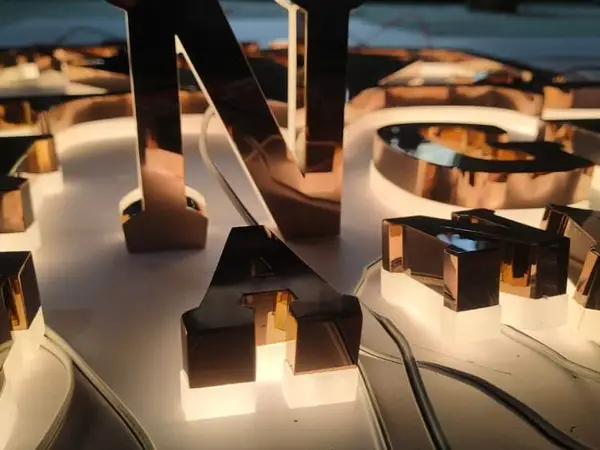
Look, every sign face eventually fails. The question is when and how much it costs to replace.
You've got three main ways to get graphics or color onto an acrylic or polycarbonate face: digital print, vinyl, or paint. Each has a place. Each has a failure mode that'll bite you if you don't plan for it.
I've built light boxes for 16 years. I've seen $3,000 digital prints peeling in 14 months and $12 worth of cast vinyl still looking sharp after 6 years.
The difference is never the face material. It's the prep, the ink or film quality, and whether someone tried to save $4 a square foot.
Digital print is the default for anything with gradients, photos, or more than three spot colors. Nothing beats it for photorealistic. But the ink is the weak link, not the acrylic.
We print UV-cured ink directly onto acrylic faces for our acrylic light boxes. The acrylic itself can have 90-92% light transmittance. UV-resistant Mitsubishi or Degussa sheet runs 5-8 years before yellowing. Domestic sheet? 1-2 years. That's the base you're printing on.
Here's what nobody tells you: the ink doesn't last as long as the acrylic. I've watched a printed face on a south-facing storefront fade from cherry red to dusty pink in under two years. The acrylic was fine. The ink was done.
You can laminate. It adds a few bucks per square meter factory cost. Worth it if the face gets direct afternoon sun.
Rookie mistake: ordering a digital print on domestic acrylic because it was $10 cheaper. The ink might be fine, but the acrylic starts yellowing in 1-2 years. Now the whole face looks like stale lemonade. You saved $10 and bought a $200 replacement.
Vinyl gets a bad rap because cheap vinyl exists. Monomeric calendered vinyl is what you buy for a 6-month sale sticker. Cast vinyl is what you put on a sign face that needs to survive.
We apply translucent cast vinyl to acrylic faces for food menu signs and light boxes when the design is simple. The vinyl is cut, weeded, and wet-applied. No ink to fade. No cure time. If the vinyl fails, you strip it and re-skin the same acrylic face in an hour.
The ugly truth is most sign shops spec cheap calendered vinyl to win the bid. It shrinks. It cracks at the edges. It lifts in the first winter. Then the client blames the whole sign, not the $3/sqm vinyl.
Cast vinyl on acrylic, properly applied, can outlast a digital print. That's not opinion. That's 16 years of watching both fail.
Painted sign faces used to be the only option. You'd spray enamel on acrylic or polycarbonate, back-light it, and hope the paint didn't run behind the mask.
I've seen this go wrong: a shop in Florida painted a 4x8 face with rattle-can red. Within 14 months, the paint delaminated from the acrylic and fell into the light box. Looked like a bag of chips inside the sign.
Real painted faces use 2-part polyurethane or acrylic enamel, sprayed in a clean booth. They can look fantastic. But labor is brutal. Masking, sanding, flash times, color matching. You can't beat digital print for anything with gradients, and you can't beat vinyl for clean spot colors.
We don't offer painted faces as a standard product. If a client insists, we'll quote it with a warning: the cost will be 2-3x a vinyl face and the warranty drops to 1 year. That's honest.
Look, you're reading this because you want a number. Here it is.
Our factory light boxes — including face, aluminum frame, LED, and power supply — run $80-250/sqm depending on size, depth, and LED quality. A digital print face pushes you to the high end of that range. A vinyl face keeps you in the middle. A painted face? That's custom, and custom means you're paying for labor, not materials.
If you're buying retail installed in the US, a comparable light box sign runs $500-1,200/sqm. That's before permits and wiring. So factory-direct saves you 50-65% on product. The face material choice might swing the factory price by $15-40/sqm. On a 3-square-meter sign, that's real money.
But here's the part most importers miss: shipping and tariffs. A small face ships express for $30-100. A big light box via sea freight costs $80-200/m³ LCL, plus about 30% Section 301 tariff if you're in the US. Still cheaper than buying retail. But not free.
I had an importer last month ask for a 5-square-meter digital print face with 3-day turnaround. I told him about 5-15 days production is real. Express shipping adds $30-100. Air freight takes about 10 days, sea about 65 days. You plan around that or you pay stupid money.
Nothing lasts forever. Here's what actually fails first on each option.
Digital print: ink fade and chipping. Expect 2-5 years depending on sun exposure and laminate. After that, you're reprinting the face or replacing it. The acrylic behind it might be fine, but the print is dead.
Vinyl: edge lift and shrinkage. Cast vinyl on clean acrylic with a proper wet application can go 5-8 years. Calendered vinyl? 1-2 years before it looks like a sunburnt sticker. The acrylic face itself with UV-resistant sheet lasts 5-8 years before yellowing. Domestic sheet yellows in 1-2 years.
Painted: paint adhesion and color fade. If sprayed correctly, 3-5 years before it needs a respray. If not, 14 months like that Florida shop. The face material might be fine. The paint is the problem.
Here's what nobody tells you: UV-resistant acrylic doesn't mean UV-proof. Mitsubishi and Degussa sheet gives you 5-8 years outdoors before yellowing. After that, even a perfect vinyl or print job looks tired because the face itself has shifted color.
IP rating matters too. If your light box is outdoors, the face needs a sealed housing rated IP65 minimum. That's dust-tight and water jets from any direction. IP66 for coastal. IP68 is submersible — overkill unless you're in a hurricane zone.
We're Aochuang Sign in Lu'an, Anhui. 3,000 square
Factory-direct since 2010. Free quote within 24 hours — no obligation.
Get a Free Quote → Copy EmailMOQ: 1 piece · Flexible lead time · 2-year warranty · Worldwide shipping
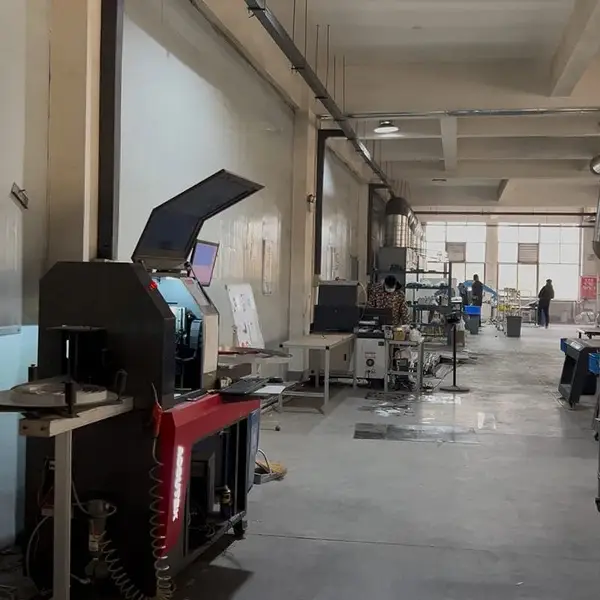
Real photo from our production floor — every sign we ship is made here.
See pricing, specs, and get a free quote for the sign type you need. Built in our factory, shipped worldwide.