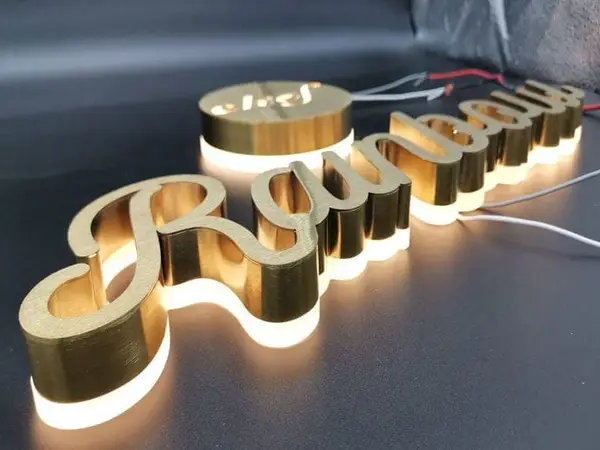
A custom storefront sign from a real factory runs $0.6–$0.8 per centimeter of letter height for stainless steel baked-paint letters. Do the math: a typical 30 cm letter costs $18–$24 before freight, not the $800 your local shop quoted.
I know because I've watched sign shops pay that. Same 304 stainless, same Bluesky LED modules. We ship that letter for $120.
Here's what nobody tells you: the hardest part isn't fabrication—it's knowing what to order before you spend a dime. So let's do this in order.
Look, a sign isn't decoration—it's a tool with a job. Do you need it readable from the highway at 60 mph or from a sidewalk 10 feet away? That one call changes letter height, stroke thickness, and lighting brightness more than any design trend.
If your business is a drive-by restaurant on a commercial strip, you need front-lit channel letters with high-contrast faces and 6000–6500K cool white LEDs. That's what cuts through glare and rain. A boutique law office in a walkable downtown? 3000–3500K warm white backlit letters feel expensive and inviting. Retail and corporate lobbies sit in the middle at 4000–5000K neutral.
The ugly truth: most buyers never measure the viewing distance. They pick a pretty font, then wonder why nobody can read it from the parking lot. Don't be that person. Measure it.
Three workhorses carry most of the industry: front-lit channel letters, backlit halo letters, and non-illuminated metal letters. Front-lit is the bread-and-butter storefront sign. Backlit halo letters are the high-end architectural look—you pay more for the glow behind the letter, but that's the difference between "strip mall" and "corporate headquarters." Non-illuminated 304 stainless steel letters won't rust for 10+ years and cost less to run because there's no electricity.
Materials matter more than design. Acrylic faces run 90–92% light transmittance. UV-resistant acrylic from Mitsubishi or Degussa lasts 5–8 years outdoors. Domestic acrylic yellows in 1–2 years. I've seen it happen. If your quote just says "acrylic" and no brand, you're probably getting the yellowing kind.
Nobody talks about LED modules, but they're the real cost driver. SMD 2835 at 100–150 lm/W is the industry standard. SMD 5730 gives you 40–60 lm per chip and the highest brightness, but it costs more. Cheap modules die in 12–18 months. Good modules from Bluesky or Rishang run 5+ years real lifespan with L70 ≥ 50,000 hours. Check the solder joints to spot the junk: dull gray means it won't last 18 months, shiny silver means proper lead-free solder.
For a strip mall in Ohio, 304 stainless is fine. For Miami Beach, pay for 316 stainless—it has 2–3% molybdenum and lasts 15+ years in salt air. It'll cost 20–30% more, but skip it and you're replacing letters in 3 years.
Here's what nobody tells you: the municipality and the landlord can kill your sign before the factory even cuts metal. Budget 3–6 weeks for permit approval in most US cities. You'll need a scaled site plan, sign elevation drawings, material specs, and sometimes a zoning variance if your sign exceeds the square footage allowance.
Common rejection reasons: wrong electrical certification, missing wind load calculations, or a landlord who didn't approve the exact color and size in writing. NEC Article 600 covers electrical signs in the United States—if your fabricator hasn't heard of it, walk away.
If the sign sits within 48–60 inches of the floor and people will touch it, ADA applies. That means non-glare finish and Grade 2 Braille. No exceptions. I've watched customs reject whole shipments at the dock because someone skipped this.
IP ratings aren't a hurricane guarantee. IP65 means dust-tight and stands up to water jets. It doesn't mean the sign survives a Florida storm. For coastal or high-wind areas, you need IP66 or IP68 plus proper mounting engineering, minimum. Don't let a vendor wave an IP65 sticker and call it "waterproof." That sticker doesn't make it true.
Look, if you send a quote request that says "I need a sign, how much?" you'll get either silence or a padded number. Factories need five things: letter height in centimeters, material and finish, lighting type, voltage (110V for US, 220V for EU), and whether it's indoor or outdoor. That's it.
Real factories price by the centimeter of letter height. Stainless steel baked-paint letters run $0.6–$0.7/cm. Electroplated or antique finishes run $0.7–$0.8/cm. Front-lit letters with stainless trim and acrylic faces: $0.7–$0.9/cm. Backlit letters: $1.0–$1.5/cm depending on finish. Floor-standing RGB letters 60–120 cm tall: $1.5–$1.8/cm.
For round double-sided lightboxes, a 60 cm unit costs $70, a 100–120 cm unit costs $200. That's factory-floor pricing. If you want an exact quote, we ask for quantity, size, material finish, and destination market—we quote US and EU developed markets higher because freight and compliance cost more. Anyone who quotes you a flat price without asking those questions is guessing.
We'll take an order as small as 1 piece. Samples ship in about 5 days; mass production takes about 15 days, depending on quantity and size. We warranty the LED modules for 2 years and the power supply for 1 year.
The ugly truth: most "sign companies" are brokers. They take your order, add 40–60%, and send it to a factory like ours. That's fine if they handle installation and permits. But don't pay a broker's markup and think you bought a factory.
Ask every supplier these questions: do you have UL 48 certification? Who supplies the LED modules? What thickness is the stainless—1.2 mm or 1.5 mm? Is the acrylic UV-resistant, and from whom? Can you provide the CE certificate with today's date?
CE marking costs 20,000–50,000 RMB and takes 2–8 weeks. Most factories will say they have it. Ask to see the certificate with today's date. Watch them sweat. That's the fastest way to separate a real export factory from a middleman with a website. UL 48 runs $4,000–$15,000 and 4–9 months with quarterly audits. ETL is a UL alternative that's 10–30% cheaper and accepted in many US jurisdictions.
Our shop is 3,000 m² with 50+ skilled workers, and we opened in 2010 in Lu'an, Anhui, China. We export worldwide. But don't trust me—trust the questions. If a supplier can't answer them in writing, move on.
You'll approve a digital proof before we cut anything. Check the spelling twice. Check the logo file resolution. If you send a 72 dpi screenshot from your website, the CNC router will cut jagged edges and you'll blame the factory. That's not the factory's fault.
Production runs 7–15 days once you lock the artwork. The 10-step process looks like this: design confirmation (1 day) → laser cutting at ±0.1 mm (1–2 days) → TIG welding and bending (1–2 days) → grinding and polishing (1–2 days) → acrylic face CNC (1 day) → LED assembly (1–2 days) → sealing with neutral silicone (1 day) → 8–12 hour aging test → 100% QC inspection → export packaging with foam, carton, and plywood crate. That last step matters: your crate changes hands 6–8 times between our dock and yours on LCL sea freight. Every touch is a chance for damage. That's not in the brochure.
Shipping times: express 7–10 days, air about 10 days, fast sea 40–50 days, standard sea about 65 days. We quote freight per destination and volume—never accept a flat freight quote without giving the shipping address.
Installation isn't an afterthought. A 50 kg stainless sign needs proper anchors, not drywall screws. If you're not an electrician, hire one. Wiring mistakes void the LED warranty faster than a cheap power supply.
Maintenance on good LEDs? Almost zero for 5+ years. L70 ≥ 50,000 hours means the LEDs still put out 70% of their original brightness after 50,000 hours—about 11 years of nighttime operation at 12 hours a day. The power supply will fail before the LEDs do. That's why we warranty it for 1 year and the LEDs for 2.
ROI math is simple: a $3,000 storefront sign that lasts 10 years costs $300 a year. If it brings in one extra customer a week who spends $20, that's $1,040 a year. You do the math. The expensive sign is the cheap one you replace every 18 months because the LEDs burned out and the acrylic yellowed like a smoker's teeth.
Here's another thing nobody tells you: a 3 mm acrylic face cuts 92% of the light. A 2 mm face cuts 90%. Your customer won't notice that 2%, but they will notice the 40% cost bump if you insist on 3 mm for a backlit sign. Stop over-specing thickness and spend the money on better LEDs.
How long does a custom sign actually last? A 304 stainless sign with UV-resistant acrylic and good LEDs lasts 10+ years outdoors. Cheap domestic acrylic and no-name LED modules might last 18 months. If your vendor won't name the acrylic brand or LED brand, you're buying the 18-month version.
Why is the price per centimeter not a final quote? Because a 60 cm letter costs more than twice a 30 cm letter—it's not linear. Finish, quantity, power supply voltage, and destination market all move the number. If you want a real price, send the spec sheet. Not a one-line email.
Can I skip the permit and just install it? Sure, if you like fines, landlord liens, and having to take the sign down at your own expense. Don't come back complaining when the city makes you remove it.
Why should I buy from China instead of a local shop? You shouldn't always. If you need someone to handle permits, installation, and a single sign within 20 miles, use a local shop. If you want factory pricing on fabricated letters and you're willing to manage freight and install yourself, that's where we make sense. Just don't pay a local shop $800 for a letter we ship at $120 and call it "custom." That's the lie.
Products mentioned or relevant to this topic — factory-direct, custom built.
From $16/letter · MOQ 1 piece · 7–15 day production · CE & UL certified · ships to 20+ countries
Custom sizes, colors, and finishes. Get a factory price in 24 hours.
Get a Free QuoteWhatsApp +86 13865703472 · cairuisheng@aochuangsign.cn