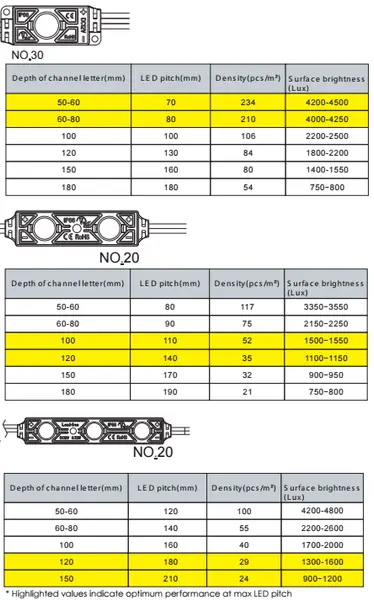
That number means nothing until you've seen it fail on a wet wall in Seattle. I've been installing commercial signs for two decades across 30+ states. I've watched rookies spec out LED modules based on brochure promises and then spend an extra weekend ripping out half a sign because the light was too dim or the color looked like a hospital hallway. Let me save you that headache. My company, SignWrights Inc., has been in the business since 2003, and we follow IESNA RP‑19 and UL 8750 as a baseline. I share these pitfalls because I've learned them the hard way.
Every module claims a lumen-per-watt figure. SMD 2835 is the industry workhorse – 100 to 150 lm/W. SMD 5730 pumps out 40 to 60 lm per chip, which sounds lower until you realize it's per chip, not per module. Here's the lie they don't put in the marketing: those numbers are measured at 25°C on a test bench with perfect heat dissipation. In a real sign, inside a sealed channel letter under summer sun, the junction temperature hits 60-70°C. Lumen output drops by 15-25%. I've watched guys spec modules for a 14-foot letter on a south-facing facade and end up with anemic light because they trusted the datasheet.
Quickest way to spot bad LED modules: look at the solder joints. I wrote that one down 10 years ago after opening a box of cheap modules that looked fine on the outside – dull gray joints inside. Those modules died in 14 months. Shiny silver solder means proper lead-free soldering and reasonable lifespan. Dull gray means they used cheap flux and the joint will crack from thermal cycling. Don't make the mistake I made: trusting a factory's lumen claim without running an 8-12 hour aging test in a hot box.
Another dirty secret: some manufacturers quote "peak lumens" at 200% overdrive current for the first 30 seconds. That's not continuous operation. Always ask for "steady-state lumens at rated current" and get it in writing. I've installed this in a parking garage where the owner complained the sign was too dim after three months. Turned out the modules were being pushed at twice their rated milliamps. They lasted six months. Reputable testing labs like UL or CSA often verify continuous ratings – look for their mark.
3000-3500K warm – hospitality, restaurants, anything trying to feel cozy. 4000-5000K neutral – most retail, corporate lobbies, strip malls. 6000-6500K cool – industrial yards, highway signs, anything that needs to be seen from half a mile away. That's the simple version. Here's what the permit office won't tell you: color temperature shifts over time. An LED module at 4000K fresh out of the box will drift 200-300K after 20,000 hours. If you're matching a sign that already has LEDs, you need to know whether the old ones are on their last legs or still fresh. Mix a 3-year-old warm module with a new one and you'll see two distinct colors in the same letter. I've had clients refuse to pay because the "R" looked pink compared to the rest.
Pro tip: Order all your modules from the same production batch. Even Samsung bins LEDs into different color tolerance groups. A factory may change suppliers mid-run and you'll never know until the sign is glowing. Ask for the bin code before you pay. If they can't provide it, move on.
Most datasheets skip CRI (Color Rendering Index). For retail signs – especially clothing, food displays, or cosmetics – a CRI of 80+ is the bare minimum; 90+ is what you want. Low‑CRI modules (often 70 or below) will make reds look brown and whites look gray. In a parking garage or industrial yard, CRI matters less; 70 is acceptable. The pitfall: some manufacturers claim “up to 80 CRI” but only at a specific drive current. Test the actual modules you receive. I once had a batch of 4000K modules that measured 72 CRI at 350mA, even though the box said 80. The client’s mannequins looked sickly. We replaced them with Samsung chips binned at 90 CRI – problem solved.
Every module boasts L70 ≥ 50,000 hours. That means after 50k hours – about 5.7 years of continuous operation – the light output drops to 70% of original. Sounds great. Here's the catch: that's at 25°C with perfect airflow. Inside a closed sign with no ventilation, the internal temperature can hit 80°C. At that temp, L70 drops to maybe 15,000 hours. Cheap modules? 12-18 months real lifespan. I've seen Chinese no-name modules fail in under a year. Quality modules using Samsung, Osram, or 蓝景 (Lanjing) chips actually hit 5+ years in the field because they're binned and have proper thermal management.
IP65 sounds impressive. It means dust-tight and protection from water jets from any direction. It does NOT mean your sign survives a Florida hurricane. I've seen IP65 modules fail after one storm because the gaskets degraded in UV. For coastal areas, look for IP66 or IP67, and insist on UV‑stabilized housing. Also, never assume L70 data from a Chinese factory matches reality – ask for an LM‑80 test report from a third party. That's the only standard that tracks actual lumen decay over time.
You've seen the traps: phony brightness, color drift, lifespan lies, and IP ratings that don't hold up. Here's your checklist for every LED module order:
I wish someone had handed me this list twenty years ago. Would have saved me thousands in rework and burned bridges with clients. You're now armed with the real‑world data that datasheets hide. Use it, and your signs will still be glowing when the competition's LEDs are in the trash. If you have a specific project – parking garage, restaurant, or highway sign – I'm always happy to weigh in. Drop me a line at SignWrights; I've got a 90‑day aging test rig in the shop that never lies.
Factory-direct since 2010. Free quote within 24 hours — no obligation.
Get a Free Quote →MOQ: 1 piece · 7-15 days · 2-year warranty · Worldwide shipping