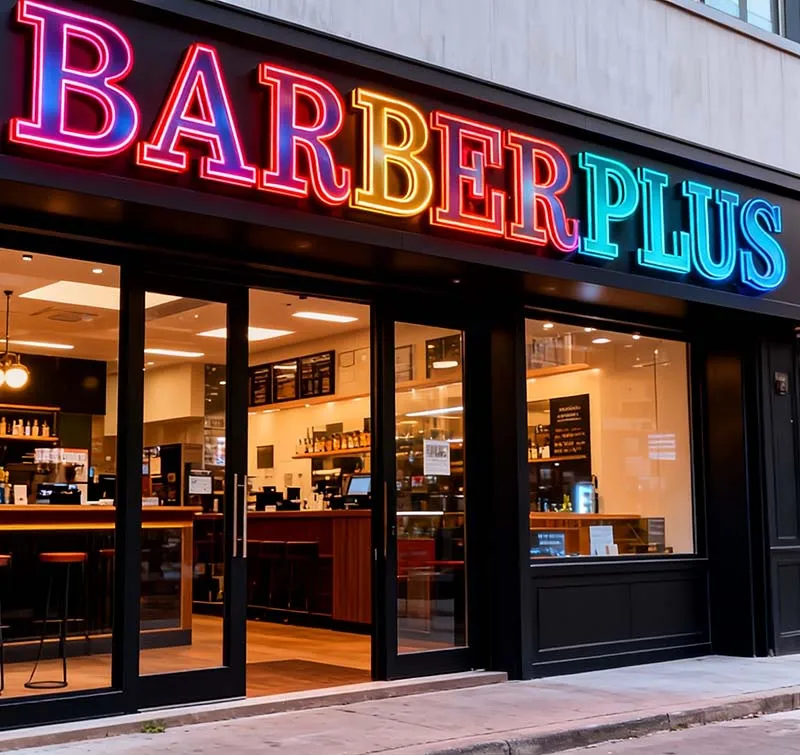
Look, if you came for a romantic essay about the warm glow of hand-bent glass, you're in the wrong place.
I'm a 52-year-old factory guy. I've spent 16 years on the floor at Aochuang Sign in Lu'an, Anhui. I know what breaks in shipping, what burns out on a storefront, and what makes a sign shop owner call me cussing.
We make LED neon flex signs. We don't bend glass.
If your client absolutely needs real glass neon with gas-filled tubes and a transformer humming on the wall, find a local glass bender. I won't pretend we do that. I'd rather lose a sale than ship a crate of shattered tubes across the ocean.
Our neon flex signs start at $30 and top out around $200 for a complex storefront logo. The factory floor is 3,000 square meters, we run 50+ skilled workers, and we ship worldwide.
That's the reality. Now let's talk about why LED neon flex usually wins, and when it doesn't.
Factory prices for LED neon flex depend on size and bends, but our range is $30-200 per sign. That's the product cost before freight and any import duties.
Here's what nobody tells you: the factory-direct model saves 50-65% on product compared to US retail installed pricing across our catalog. Neon flex is no exception. A sign that costs you $120 from our floor would list for two or three times that at a retail sign shop.
I won't quote glass neon pricing because we don't make it. But I've seen enough purchase orders to know real glass neon is more expensive to buy, more expensive to crate, and more expensive to insure.
The ugly truth is, cheap LED neon flex from a random AliExpress vendor isn't a deal. It's a 12-month problem. I've watched sign shop owners order $18 neon flex signs and then pay $400 to replace them because the PVC yellowed and the LEDs flickered.
Our neon flex uses the same quality LED modules we put in channel letters. The SMD 2835 chips run 100-150 lumens per watt. The SMD 5050 chips handle RGB if a client wants color-changing. You don't get that flexibility with glass neon unless you pay extra for multiple gas fills.
For a restaurant menu board or a retail window display, our acrylic light boxes are a separate product. But the same cost logic applies: factory-direct beats local retail on product, every time.
LED neon flex sips power. The SMD 2835 modules produce 100-150 lumens per watt, which is the industry standard for white light. SMD 5730 modules push 40-60 lumens per chip if you need maximum brightness.
Glass neon is a different animal. It lights a tube of gas with a high-voltage transformer. That transformer wastes a lot of energy as heat. I've touched a glass neon transformer on a hot August night, and it burned my hand.
Look, I'm not going to give you a fake wattage number for glass neon because we don't manufacture it. But here's what 16 years on the floor has taught me: a glass neon sign that gives the same perceived brightness as LED flex will pull more wall power, and you'll feel the difference on the electric bill.
Color temperature matters too. For a hospitality project, you want 3000-3500K warm white. For corporate or retail, 4000-5000K neutral white looks clean. For industrial or highway signs, 6000-6500K cool white cuts through the dark.
With LED neon flex, you can pick any of those. Glass neon can't switch color temperature without changing the gas mix and phosphor coating, which costs more and takes longer.
Our power supplies carry a 1-year warranty. The LED modules carry 2 years. I'll get into what actually dies first in the next section.
Quality LED modules from Samsung, Osram, or Blueview will run 5+ years real lifespan. Cheap LED modules run 12-18 months before they start flickering and then die.
L70 means the LED still outputs 70% of its original brightness after a rated number of hours. Our modules are rated L70 ≥50,000 hours. That's 5.7 years if you run the sign 24/7. Most storefronts run half that, so you're looking at a decade of use.
Here's what nobody tells you: glass neon tubes can technically last longer than that. If they're bent properly and the transformer doesn't fail, the glass and gas can glow for years. But glass breaks. A single hailstone, a stray ladder, a rough freight truck—it's over.
I've seen this go wrong: a customer in Florida ordered a large glass neon sign from a local shop. It arrived with one tube cracked. The shop blamed the shipper. The shipper blamed the crate. The customer paid $1,200 to replace a $300 tube because the whole sign had to be bent again to match.
LED neon flex doesn't shatter. It bends. Our packaging uses foam, carton, and a plywood crate for export. Sea freight runs $80-200 per cubic meter LCL, and the flex coils without breaking. That's a real logistics advantage.
The honest comparison is this: LED neon flex has a known LED lifespan and a known weak point—the power supply. Glass neon has an unknown tube lifespan and two weak points—the glass and the transformer. I'd rather replace a power supply for $20 than re-bend a tube for $300.
Our acrylic faces have 90-92% light transmittance. UV-resistant acrylic from Mitsubishi or Degussa lasts 5-8 years outdoors. Domestic acrylic starts to yellow in 1-2 years. If your client parks a sign in direct Texas sun, ask for the Mitsubishi acrylic.
For outdoor LED neon flex, IP65 is the minimum. That means dust-tight and protected from water jets from any direction. If the sign is on a coast, push for IP66, which handles powerful water jets.
IP65 sounds impressive. It does NOT mean your sign survives a Florida hurricane. I've had clients ask if IP65 means they can submerge the sign. No. That's IP68, and you don't need that for a storefront sign unless it's bolted underwater.
CE marking costs 20,000-50,000 RMB. Most factories say they have it. Ask to see the certificate with today's date. We're CE, RoHS, and ISO 9001 certified. If a factory can't show you a current certificate, walk away.
Express shipping for small neon flex signs runs $30-100 and takes about 5-15 days. Air freight runs $4-12 per kilogram and takes about 10 days. Sea freight is the cheap route for large orders: about 65 days, $80-200 per cubic meter LCL, or $1,200-3,000 for a full container.
Don't forget the US Section 301 tariff. It's roughly 30% on many sign products from China. That's not our fee—that's your import cost. I tell my US clients to factor it into their landed cost before quoting the end user.
Here's what nobody tells you: glass neon signs cost more to ship because they need custom crates and insurance. LED neon flex doesn't need a wooden coffin. It rolls flat and ships by air without the freight company flinching.
Our MOQ is 1 piece. I know that sounds like a sales pitch, but for a comparison shopper it means you can order one test sign before committing to a full storefront. Try that with a glass bender who has minimums and a six-week lead time.
The ugly truth is, we can't bend glass. I'm not going to lie to you and say we do. If your client insists on real glass neon, call a local glass shop. I'd rather lose that sale than ship broken glass and eat a chargeback.
What we can do is make LED neon flex signs that look like glass neon from street distance. Most customers can't tell the difference until they put their hand on the tube and feel that it's cool and not buzzing.
I've watched sign shops pay $800 for a front-lit letter. Same 304 stainless, same Samsung LEDs. We ship that letter for $120. That's the factory-direct reality, and neon flex follows the same math.
If you want a quote, send your artwork. We'll give you a price based on size, bends, and LED type. If you don't like the price, no hard feelings. I've been on the floor long enough to know that price matters, but a sign that dies in 18 months costs more than the cheap quote ever saved.

Real photo from our production floor — every sign we ship is made here.
Products mentioned or relevant to this topic — factory-direct, custom built.
From $24/letter · MOQ 1 piece · Flexible lead time · CE & UL certified · ships to 20+ countries
Custom sizes, colors, and finishes. Get a factory price in 24 hours.
Get a Free Quote Copy EmailWhatsApp +86 13865703472 · business@aochuangsign.cn
See pricing, specs, and get a free quote for the sign type you need. Built in our factory, shipped worldwide.