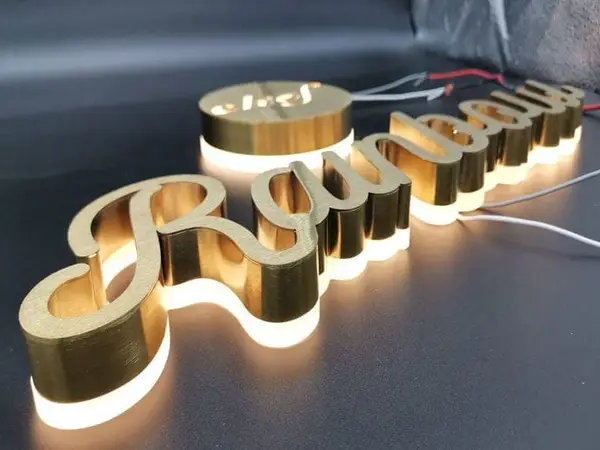
Let's get one thing straight before we talk looks. Push-through letters are the ones where the acrylic face sits flush inside a metal channel. The light comes straight out at you. Reverse channel letters — also called halo letters — are the opposite. The metal letter body faces you, and the light bounces off the wall behind it, creating that soft outline. Same bones, totally different personality.
I've watched sign shop owners burn hours arguing about which one looks "more premium." That's a waste. Premium is about how clean the install is, not which style you pick. But I've also seen buyers pick the wrong style for their building and pay for it in rework. So let's break it down with actual numbers and real-world experience.
Here's what nobody tells you: push-through letters are daylight workhorses. The acrylic face with 90-92% light transmittance gives you bright, even illumination even in direct sun. You can color the face with vinyl to match your brand, and the light punches through cleanly. Think storefronts, strip malls, shopping centers—places that need to be read from a car at 50 feet.
Reverse channel letters are a night-time animal. The halo effect is dramatic, architectural, and quieter. The light comes from LEDs mounted inside the return of the letter, shining backward onto the wall. The metal front stays dark. That means you get a crisp silhouette with a glow around it. Looks stunning on dark facades. But in daylight, those same letters rely on the metal face — brushed stainless, painted aluminum, whatever you pick — to carry the design.
The ugly truth is: most owners choose reverse channel because they saw a photo at night. They don't ask what it looks like at noon. If your sign faces west and you've got harsh afternoon sun, the halo effect washes out completely. You'll see a flat metal letter with a faint shadow. That's not a defect. That's physics.
For push-through letters, the critical part is the acrylic face thickness. Common sizes are 2mm, 3mm, and 5mm. If your letters are over 2.5 meters tall, don't even think about 2mm. It'll flex, crack at the corners, and look cheap within a year. Use 5mm. The metal channel is typically aluminum (1.0-1.6mm) or stainless steel (1.0-3.0mm) depending on your environment. Aluminum is naturally rust-proof and weighs a third of steel. Stainless 304 gives you 10+ years outdoor life; 316 is for coastal salt air and costs 20-30% more.
For reverse channel letters, the metal thickness matters more because the metal is the visible face. Bending and welding a 1.2mm stainless sheet into a clean, sharp letterform takes skill. We TIG weld, grind, and polish every seam. If you buy from a factory that's too lazy to polish, you'll see weld lines from across the street. The back face — where the light escapes — is usually open with an acrylic diffuser or a clear back panel. Some shops use polycarbonate instead of acrylic for the back to save a few bucks. Don't let them. Polycarbonate yellows in 12-18 months. UV-resistant acrylic (Mitsubishi or Degussa) lasts 5-8 years before any yellowing. Domestic acrylic starts going amber in 1-2 years. That's the difference between a sign that looks new and a sign that looks expired.
LEDs are where most factories try to cheat you. Quality SMD 2835 modules with Samsung or Osram chips run L70 at over 50,000 hours — that's 5+ years of real lifespan. Cheap modules from no-name brands die in 12-18 months. I've opened up signs that were "wired with quality LEDs" and found re-labeled garbage inside. You want receipts. You want to see the bin number on the reel. At our factory, we use either Samsung/Osram or Blueview (a solid Chinese brand for budget jobs). Ask your supplier which one you're getting. If they can't answer, walk.
Factory prices for front-lit channel letters — which covers push-through — run from $20 to $80 per letter depending on size and finish. Reverse channel halo letters are $35 to $120 per letter. That's a 50-75% premium. Why? More labor. Metal must be bent, welded, polished, the back cavity machined for LEDs, the light engineered to spread evenly. You're paying for craftsmanship and material, not magic.
Here's what nobody tells you: the biggest cost difference isn't the sign itself — it's the installation. Push-through mounts flat to the wall. Simple. Reverse channel needs standoffs to keep the letter 40-60mm off the wall, so the halo can breathe. That's more hardware, more precision alignment, more labor hours. If your installer quotes you double for reverse channel, they're not ripping you off. They're charging for the headache.
But don't let that scare you. Factory-direct, you're still saving 50-65% versus US retail installed prices. A typical halo-lit stainless letter that would cost you $400-1,000 installed in the US? We ship that letter for $80-120. You pay the shipping, your local electrician does the install. That's the whole game.
I've seen this go wrong: push-through letters with cheap silicone sealant that hardens and cracks after the first winter. Then water gets in, the LEDs short out, and you're replacing modules in year two. Use neutral silicone for sealing. Always. Not acetic acid cure — that eats your wiring. And do an 8-12 hour aging test before shipping. We do it on every order. It's not enough to turn the LEDs on for two minutes. Leave them running overnight. Catch the failures before the sign goes up, not after.
Reverse channel letters trap heat differently. The LEDs are enclosed between the metal face and the wall, with less airflow. If you use cheap modules, they'll cook themselves. Quality modules with proper heat dissipation — aluminum-backed PCBs, not flimsy strips — will go the distance. Also, the standoff gap collects dust and bugs. You'll need to blow it out with compressed air once a year. That's not a red flag, that's reality.
Coastal buyers, listen up: 304 stainless is fine for a regular commercial strip, but if you're within half a mile of saltwater, pay for 316. It contains 2-3% molybdenum, and that makes it 15+ year marine grade. The extra 20-30% cost is cheap compared to replacing a rust-streaked sign in three years. I've seen guys fight this on every budget spreadsheet. Then they call me after the first winter asking for a discount on replacement. No.
You want maximum brightness at all hours. You've got a retail storefront, a gym, a urgent care clinic — places where the sign is the workhorse. Front-lit front-lit channel letters with an acrylic face are your best bet. They're easy to read, easy to repair (swap the acrylic or the LEDs), and the pricing is friendlier. If your brand colors are light, translucent vinyl over a white LED cavity gives you that 90-92% transmittance pop.
Also read: push-through works well when your letters are small — under 12 inches. Reverse channel needs a minimum depth to create a visible halo. Small reverse letters look like glowing mushrooms floating on the wall. Not premium. Just weird.
This is for architects, high-end retail, law offices, hotels, restaurants. Places that want the sign to whisper, not shout. Back-lit halo letters (back-lit halo letters) mounted on dark graphite, wood, or stone facades look like money. The light defines the letterform without blinding anyone. If you want both looks — bright by day, halo by night — consider dual-lit channel letters. They light the acrylic face during the day and the back halo at night. Costs more, but it's the best of both.
One warning: reverse channel requires a clean, flat wall. If your facade is rough brick or heavy texture, the halo gets lumpy and the shadow looks broken. You'll need a mounting panel or a back spacer to smooth it out. That's added cost and an extra thing to maintain. Budget for it.
The ugly truth is that a lot of overseas factories claim UL certification and most of them are lying. We don't have UL. We have CE, RoHS, and ISO 9001, and we'll show you the certificates dated this week, not 2017. If you need a UL-listed sign for a US jurisdiction, we can build to UL standards and ship you the components, but the final UL listing has to happen in your country. Don't pay a Chinese factory for UL unless you've verified it with UL directly. It costs $4,000-15,000 and takes 4-9 months with quarterly audits. We're not going to fake that for you.
What we can do: build the sign to your exact spec, run the aging test, pack it so it survives the ocean trip, and get it to your port in about 5-15 days production plus whatever shipping you choose. Express is about 5-15 days for small packages at $30-100. Air freight runs $4-12/kg and arrives in about 10 days. Sea freight takes about 65 days but costs $80-200 per cubic meter LCL, or $1,200-3,000 per full container. And yes, the US Section 301 tariff of ~30% applies — we can't magic that away. Anyone who promises to skip it is lying to you.
We also can't guarantee that your local installer won't mess up the wiring. We can't stop your building management from mounting the sign where nobody sees it. We can't fix a design that's too narrow to actually read from the street. That's on you. We're a factory, not a miracle worker.
If you're comparison shopping, here's what to send us: your exact text, the letter dimensions, the material you want (stainless 304, 316, aluminum, brass), the LED color temperature, and your city so we can factor the environment. Color temp matters more than people think: 3000-3500K warm for restaurants and hospitality, 4000-5000K neutral for retail and offices, 6000-6500K cool for industrial or highway signs. Don't say "white." Say "4200K neutral on 304 stainless with brushed finish." Then we'll give you a real quote.
Ask for a sample letter if you're unsure. Yes, we make one-off samples. MOQ is 1 piece for everything we sell, and that applies to production orders, not just samples. But be smart: a single 8-inch sample doesn't tell you what a 4-foot letter looks like from across the parking lot. Scale changes everything. If you can, order a small batch first — 5 letters, 10 letters — install them temporarily with double-stick tape, and evaluate for two weeks before committing to the full set. That's the professional move.
Also, if you're a sign shop reselling our work, don't try to hide it. We're happy to white-label. Just tell us so we can skip our logo on the packaging. And for God's sake, don't ask us to put a "Made in USA" sticker on anything. We won't do that. That's fraud, and we've got enough to do.
I've been doing this for 16 years. I've seen push-through "flat" letters made with bent acrylic that looked like melted Tupperware, and I've seen reverse channel letters that cost twice as much as they should because some middleman needed a new boat. The good news is you're here, doing the homework. The difference between a good sign and a garbage sign is rarely the style — it's the material grade, the LED quality, and the sealing. Buy those three things right, and either style will serve you well for years.
If you're still torn, go look at actual signs in your area. Snap photos, note the time of day, then decide which look matches your building. Bring those photos to your next call with us or any factory. We'll tell you straight which one we'd build for you — and which one we'd walk away from.

Real photo from our production floor — every sign we ship is made here.
Products mentioned or relevant to this topic — factory-direct, custom built.
From $24/letter · MOQ 1 piece · Flexible lead time · CE & UL certified · ships to 20+ countries
Custom sizes, colors, and finishes. Get a factory price in 24 hours.
Get a Free Quote Copy EmailWhatsApp +86 13865703472 · business@aochuangsign.cn
See pricing, specs, and get a free quote for the sign type you need. Built in our factory, shipped worldwide.