You're Not Picking a Mounting Method—You're Picking a Relationship With That Wall
I've been on enough rooftops and ladders to know that the first question ain't "which mount looks cleanest." It's "what's that wall made of and how much do I hate my crew today?"
Three ways to hang a sign: raceway, direct, flush. Sounds simple. But I've watched guys spend half a day wrestling a flush-mount letter onto EIFS because nobody told them the substrate's weaker than wet cardboard. Or a shop owner order raceway for a brick storefront, then realize the conduit shows from the street like a sore thumb.
Let's cut the marketing. Here's what actually happens on the job.
Raceway Mount: The Old Workhorse, Ugly but Reliable
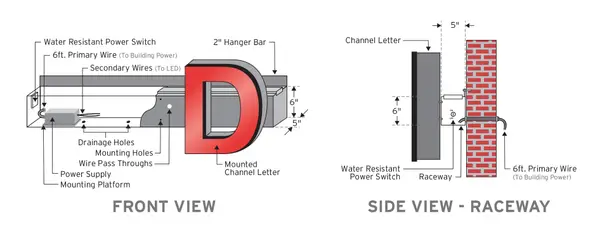
Raceway is a metal channel—usually aluminum or galvanized steel—that you bolt to the wall first, then mount your sign letters onto it. Wires run inside the channel. No chasing studs, no drilling 47 holes into brick.
Look, if your building has concrete tilt-up panels, or you're dealing with a landlord who says "don't you dare penetrate my stone veneer," raceway is your only friend. You mount the raceway with expansion anchors every 24 inches, slide in your letter wiring, and you're done.
Front-lit channel letters on a raceway? Standard spec. Cheap, fast, easy to service.
Here's what nobody tells you: raceway adds shadow lines. When the sun hits a south-facing wall, that 4-inch channel throws a dark stripe across your letters. Architects hate it. But architects don't pay for the rework when a direct-mount letter falls off stucco at 3AM.
The ugly truth is raceway gets a bad rap because guys install it with galvanized conduit that rusts in two years. Use powder-coated aluminum raceway, same color as your letters, and it's barely visible from 20 feet. For a strip mall with 12 tenants? Raceway means one crew can hang all 12 signs in a day. Direct mount? Three days, three times the labor.
For tricky walls like corrugated metal—think warehouse loading docks—raceway is the only way without opening a can of leaks. Use stainless steel self-drilling screws with neoprene washers. IP65 rated? Please. That's for water jets. You need IP66 if the pressure washer guy hits it. And never use zinc-plated screws on raceway over metal. Galvanic corrosion will eat the channel in 18 months.
Direct Mount: The "Clean Look" That Tests Your Patience
Direct mount means each letter gets its own set of studs drilled into the wall. No raceway. No visible wiring. Just letters floating on the facade. Looks great. But it's the most skill-dependent install in the trade.
I've seen this go wrong: a crew drills into brick, hits a soft mortar joint, uses plastic anchors, and three years later the letter's hanging by one stud because the anchor crumbled. Proper direct mount on brick means stainless steel wedge anchors or epoxy-set threaded rods. Minimum 1/4-inch diameter. And you need pilot holes drilled with a carbide-tipped bit—hammer drill, not a cordless screwdriver.
For metal wall panels—those vertical standing-seam jobs—direct mount is a nightmare unless you plan. You can't just drill anywhere. You need to hit the structural girts behind the metal. If you don't have a blueprint, you'll be playing "guess the stud" with a magnet. And if you miss, that letter will rattle in the wind until it cracks the acrylic.
Here's a hard fact: direct mount into EIFS (exterior insulation finish system) requires a special fastener—a cavity-wall anchor with a long sleeve that bites into the concrete behind the foam. Most sign guys skip this. They use a standard tapcon, which just crumbles the foam. Then the letter sags. Then the building owner calls you at midnight.
Best practice for EIFS: remove a small plug of the coating, install a stainless steel barrier anchor rated for 200+ lbs, then seal the hole with silicone that's compatible with the EIFS coating. Don't use silicone with acetic acid—it eats the acrylic. Use neutral cure.
The one advantage of direct mount: no shadow lines, no conduit showing. It's the go-to for
stainless steel letters on high-end retail. If the wall is poured concrete or brick with solid mortar, direct mount is faster than raceway. But you better have a 3/4-inch impact and a steady hand.
Flush Mount: The "Looks Like It Grew There" Option
Flush mount is when the back of the sign sits tight against the wall—no gap, no channel, no studs sticking out. Usually means the sign has a metal backplate that screws into the wall, and the letters are welded or bolted to that plate. Or it's a light box with a rear flange.
The ugly truth is flush mount is the most overrated method in the industry. Everyone thinks it looks cleaner. But let me tell you: if the wall isn't perfectly flat, your flush mount isn't flush. It's "flush-ish." And that gap collects dirt and bugs.
Flush mount works great on wood walls or flat metal panels. You can screw directly through the backplate into the structure. But on brick or stone? Forget it. You'd have to grind the backplate to match the irregularities, which nobody does. Instead you end up shimming, which defeats the purpose.
Here's something nobody tells you: flush mount on glass curtain walls is a specialty. You need standoffs—glass-to-metal fittings with silicone gaskets. The sign hangs off the glass, not from behind it. That's technically a surface mount, not flush. But I've seen guys try to drill into glass. Don't. You'll shatter a $5,000 panel. Use clamp fittings on the frame or a structural silicone bond.
For
front-lit channel letters in a lobby with a drywall wall, flush mount is the easiest thing you'll do. Just find a stud, use #12 wood screws, and you're done. But on drywall without studs—like a hollow partition—you need toggle bolts rated for the weight. A 12-inch letter weighs maybe 4 pounds. Three toggles hold. But if the drywall is 1/2-inch, use metal toggles, not plastic. Plastic cracks.
Flush mount's hidden cost: maintenance. When an LED module fails inside a flush-mount channel letter, you have to pull the whole thing off the wall to access the back. With direct mount, you can sometimes reach it through the face if it's removable. With raceway, you slide the letter off the channel. Flush mount is the hardest to service. Factor that into your lifetime cost.
Lifetime Cost Analysis: Upfront vs. What You'll Pay Later
Let's run the numbers on a typical 8-letter sign, each letter 18 inches tall, 304 stainless front-lit with Samsung LEDs. Wall is brick.
- Raceway mount: Materials (raceway + anchors + wire) $150, labor 4 hours at $85/hr = $340. Total $490. Replacement: swap a letter in 20 minutes. LED lifespan with quality modules: 5+ years. After 5 years, maybe change two modules. Minimal cost.
- Direct mount: Materials (studs, anchors, conduit for wire runs) $200, labor 8 hours because you drill and seal each hole individually = $680. Total $880. Replacement: same letter takes 40 minutes because you remove studs and reseal. More labor.
- Flush mount: Materials (backplate fabricated, heavy-duty fasteners) $350, labor 10 hours because the plate must be installed level and shimmed = $850. Total $1,200. Replacement: full sign off, bench work, reinstall. Expensive.
Now add the fact that cheap LED modules from unknown factories die in 12-18 months. If you install those with a flush mount, you're paying service calls three times as often. Always demand modules with Shin-Etsu thermal compound and shiny solder joints. That's the difference between a 3-year sign and a 10-year sign.
I work with Aochuang Sign in China. They use Samsung or Osram chips, and their
stainless steel letters come with 304 or 316 options. For a coastal job, you want 316—adds 20-30% cost. For Ohio, 304 is fine. And their lead time is 7-15 days. Most US fabricators quote 4-6 weeks. The savings? 50-65% off domestic pricing. That covers the tariff and shipping.
Installation Best Practices for Non-Standard Substrates
Here's what I've learned the hard way:
EIFS (synthetic stucco): Use stainless steel cavity-wall anchors with a 3-4 inch sleeve that goes through foam to the concrete behind. Drill with a masonry bit, not a wood bit. Apply neutral-cure silicone to the bracket before mounting. Do not use acid-cure silicone—it eats the EIFS coating.
Glass curtain walls: Never drill the glass. Use standoff brackets clamped to the aluminum framing. The sign weight must be supported by the frame, not the glass. For large light boxes, you need a full structural engineer's stamp. Minimum 1/2-inch standoffs with silicone gaskets on both sides.
Corrugated metal: Use self-drilling #12 screws with sealing washers (neoprene). Fasten into the high ribs, not the valleys—water runs in valleys. Space screws every 12 inches. If the sign is heavy, use a continuous backplate so the load distributes across multiple ribs.
Brick: Wedge anchors are best. Drill into the brick face, not the mortar (mortar crumbles over time). For heavy signs, epoxy-set threaded rods—drill hole, blow out dust, inject epoxy, insert rod. Wait 24 hours before torqueing.
FAQ: The Questions I Still Get (And Sigh At)
Can I use direct mount on EIFS without special anchors?
No, and if you do, I'll find you and make you redo it. The foam has zero holding strength. You must anchor to the structural wall behind. Use barrier anchors. If the EIFS is more than 2 inches thick, you'll need extended-length anchors. And seal everything with urethane sealant, not silicone that shrinks.
Does raceway look unprofessional?
Only if you use galvanized conduit and paint it later. Factory powder-coated aluminum raceway in the same color as your letters is standard for any strip mall or multi-tenant building. Architects won't love it, but they also don't love the cost of direct mount on 2,000 square feet of tilt-up concrete.
How do I handle wiring for direct mount when there's no raceway?
You drill a small