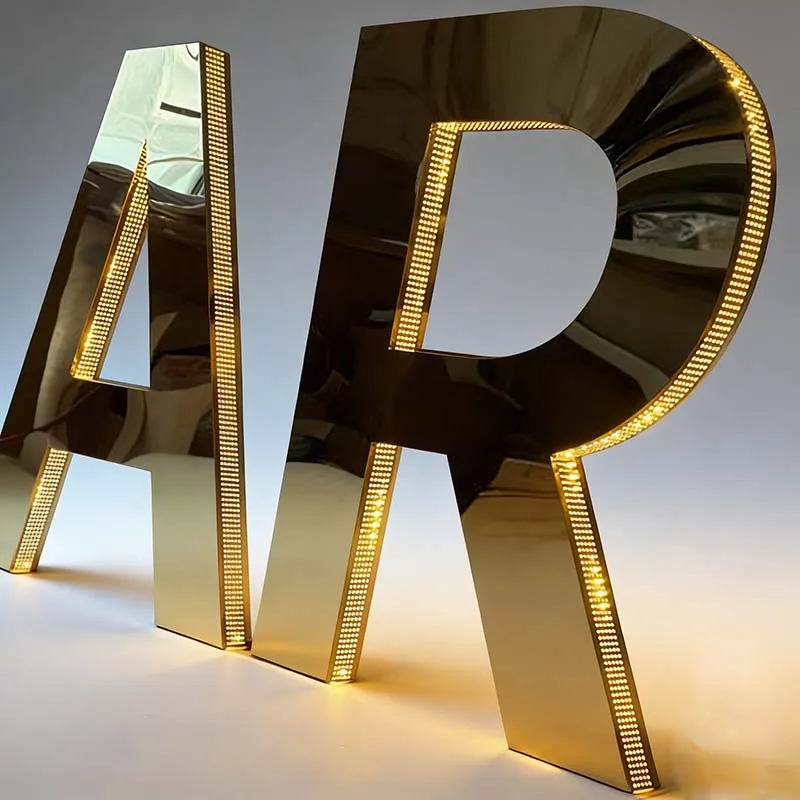
That’s 16 years of burning my hands on hot acrylic, arguing with stainless steel suppliers, and watching LED modules fail because some purchasing manager bought the cheapest reel on Alibaba. Now I run Aochuang Sign — 3,000 square meters, 50+ skilled workers, shipping custom fabricated signs worldwide. The question I get every single week: “Should I buy ready-made signs off the shelf or go custom?” Here’s the answer they don’t print on wholesale catalogs.
Here’s what nobody tells you: most ready-made channel letters sold online are packed with domestic acrylic that starts yellowing in 18 months and generic LEDs that burn out faster than a cheap Christmas light string. They look fine in the product photo because the photo was taken on day one. I’ve seen the same letters after a Phoenix summer — the plastic face looks like a smoker’s teeth. Yet contractors keep buying them because the price tag is seductive.
Ready-made signs live in a world of fixed dimensions, two font choices, and mystery materials. You get a 12-inch letter. It’s painted aluminum composite with an acrylic face. The back might be open or sealed with hot glue. The LEDs? Unbranded 2835 chips rated at some fantasy lumen number. There’s no datasheet, no CRI spec, no IP rating that survives a pressure washer. For a pop-up shop, that might be okay. For a permanent building fascia, it’s a ticking clock.
Look, I’m not against stock inventory. My factory keeps some standard aluminum letter blanks on the shelf for quick jobs. But calling a generic letter “ready-made” and pretending it’s equivalent to a custom-fabricated sign is like comparing a frozen pizza to one made from scratch with ingredients you can name.
When you order a custom sign from a factory like ours, you’re not just buying a metal box. You’re paying for material traceability. The acrylic on your letters comes from Mitsubishi or Degussa, and I can show you the UV test data — 5 to 8 years before any yellowing. The LEDs are Samsung or Osram, L70 rated at 50,000 actual hours, not a marketing guess. The stainless steel is 304 or 316 grade, polished to a #4 brushed finish that’ll shrug off a decade of rain. Every number in that spec sheet has a third-party certification behind it.
You design. We build. My guys on the floor take your vector file, laser-cut the face and back to within 0.1mm, TIG-weld the returns, grind and polish every seam, mount the LED modules in a pattern that eliminates hotspots, and seal the whole thing with neutral silicone that won’t outgas and fog the face. Then we run an 8-hour aging test before the QC inspector touches a single letter. That process doesn’t happen in a ready-made assembly line. It’s a 10-day choreography, and it’s why our front-lit channel letters still shine evenly five years later while the cheap ones develop dark patches in month six.
The ugly truth is: custom fabricated signs from China have a reputation problem because some factories cut corners worse than the ready-made guys. They’ll quote 304 stainless and deliver 201 grade, which rusts. They’ll show Samsung LEDs in the sample photo and solder no-name chips in production. I’ve repaired enough of those signs to recognise the stink of burning phosphor. That’s why I lose my temper when purchasing managers ask me to match a competitor’s price that’s 30% lower — someone’s lying about material.
A custom 12-inch front-lit letter from us, built with 304 stainless steel, 3mm Mitsubishi acrylic, and Samsung 2835 LEDs, ships at $30–$60 depending on quantity. The same letter, ordered ready-made from an online marketplace, might be $80–$120 — but it’s painted aluminum with 2mm domestic acrylic and mystery LEDs. It looks similar in the cart. It won’t look similar on the wall after a year. If you want the real architectural stuff, our back-lit halo letters start around $60 each, while a US sign shop would charge you $400–$1,000 installed. Even with sea freight and the 30% US Section 301 tariff, you’re still saving 50–65% on the product.
Ready-made sellers have a different math. They buy container loads of standard letters from a factory that runs the same design 24/7. Their per-unit cost is rock-bottom, but they slap a huge margin on top because “convenience.” A ready-made 24-inch acrylic light box might cost them $30 ex-works; they’ll retail it for $250. You could have us build a custom light box with your exact graphics, using UV-printed acrylic and a Mean Well power supply, for $150. Check the numbers. The “cheap” ready-made option often isn’t cheap — it’s just packaged to look that way.
Here’s the stuff that separates a sign that lasts from one that fails. Acrylic: we use only UV-resistant cast acrylic. Its light transmittance is 90–92%, and it doesn’t turn yellow unless you park it in direct desert sun for a decade. The cheap stuff — often extruded acrylic from domestic Chinese mills — starts yellowing in 12–24 months. You can’t tell the difference by looking at a JPEG. You can tell when the white face on your dentist’s sign looks like stale butter.
LEDs: SMD 2835 modules are the industry standard. Quality ones like Samsung or Brightek give you 100–150 lm/W and an L70 of 50,000 hours. Cheap modules? They quote 50,000 hours too, but they’re measuring time to 50% failure, not 70% lumen maintenance. I’ve pulled dead modules out of signs after 18 months. The capacitor wasn’t even a name brand — it was a generic black blob. For coastal projects, we spec 316 stainless steel, which contains 2–3% molybdenum and laughs at salt spray for 15+ years. 304 is fine inland, but if your installer uses 304 on a Miami Beach hotel, you’ll see rust blooms in two years. I once had to re-fabricate an entire facade because someone tried to save 20% on metal grade. Don’t be that guy.
And look, here’s a fact they don’t print on ready-made spec sheets: thin aluminum backs warp in the sun. We use 1.5mm marine-grade aluminum for letters over 2 feet tall. Ready-made signs? They often stop at 0.8mm because shaving metal saves shipping weight. The sign bows, the LED modules pull away from the face, you get dark streaks. It’s physics. I’ve seen this go wrong on a Texas strip mall — six letters, all wavy, the owner cursing.
I’m not a fanatic. There are times when a ready-made sign makes sense. For a restaurant that needs a food menu sign that might change next season, a stock LED menu board with easy-change graphics saves money and time. For a temporary event, a standard neon flex sign off the shelf is fine. For an interior mall kiosk where the landlord requires signage that matches the common area, a ready-made solution might be your only compliant choice. If you’re a sign shop that needs to turn a job around in three days and the client doesn’t care about long-term quality, I won’t judge you for grabbing a stock letter from a local distributor.
The problem starts when people buy ready-made for permanent outdoor installations and expect custom-grade durability. Or when they assume a “CE” sticker on the box means the product passed actual lab tests. CE marking costs 20,000–50,000 RMB to obtain properly, with notified body audits. Many ready-made sellers print the logo in Photoshop. I can’t tell you how many times I’ve asked a supplier for a valid CE certificate with today’s date and received a scan from a company that dissolved five years ago.
Every dollar you “save” on a cheap ready-made sign gets calculated in other budgets. The biggest: replacement labor. I’ve watched a contractor order 50 ready-made letters online to save $2,000 on a bank branch project. The LEDs started flickering after 8 months. Removing those letters and installing custom replacements cost $8,000 in labor and lift rental. The bank’s marketing director was furious — their brand looked broken for weeks. The contractor ate the cost. He’s a regular customer of ours now.
Then there’s compliance. In the US, NEC Article 600 applies to electric signs. Many ready-made imports don’t have a UL or ETL listing. If a fire inspector sees a sign without a recognized label, they can red-tag the installation. Suddenly your “cheap” sign costs you downtime, an electrician’s service call, and possibly a fine. We tell our clients straight: we can build to UL standards, but we don’t yet have the UL 48 sticker on every sign. The certification process runs $4,000–$15,000 and 4–9 months. Some factories lie about having it. We won’t. If your project absolutely requires a UL label, we’ll help you coordinate a field inspection by an NRTL — it typically adds $300–$500 and a week, and you still save thousands over local fabrication.
At Aochuang Sign, we’ve been doing custom fabrication since 2010. Export worldwide, CE, RoHS, ISO 9001 — real ones. Our minimum order is one piece because we know sign shops need prototypes. The production cycle runs 7–15 days: design confirmation, laser cutting, TIG welding, grinding, polishing, CNC routing the acrylic face, LED assembly, silicone sealing, 8–12 hours aging test, 100% QC inspection, then foam-and-plywood export packaging. We guarantee LEDs for 2 years and power supplies for 1 year. If a module fails because of our work, we ship replacements at our cost. No weasel words.
What we don’t do: mass-produced plastic injection signs, gigantic pylon cabinets that exceed our 3,000m² facility’s handling capacity, or signs that require on-site welding by our crew overseas. We also don’t pretend we’re the cheapest. We use quality materials, and our prices reflect that. For instance, our aluminum letters start at $10–$25 per piece — affordable, but you can find lighter, thinner stock letters online for half that price. They won’t survive a hailstorm, though.
Ready-made signs sold on US websites often boast “ships in 24 hours.” That’s great if it’s in stock. I’ve seen sign shops order “in-stock” letters only to get an email that they’re backordered for three weeks because the container is stuck at the port. Meanwhile, I can cut stainless steel in Lu’an, run the full 10-step process, and have the letters at your door via DHL in 10 days. Express freight costs a premium — $30–$100 for a small box — but it’s predictable. For larger orders, air freight at $4–$12/kg lands in about 10 days, and sea freight takes about 65 days at $80–$200 per cubic meter LCL. The clock doesn’t favor one side; it favors the one who communicates honestly about actual production capacity.
After 16 years, here’s my honest take: if you’re putting your name — or your client’s name — on a building, don’t buy ready-made. You’re trading months of lifespan for a few dollars. The only exception is if you need something temporary or you’re verifying the materials yourself in a warehouse with a UV light and a spectrometer. Custom fabricated signs from a factory that shares test reports, welding procedure specs, and real-time production photos cost a bit more upfront but save you the pain of reinstallation and the embarrassment of a flickering logo.
I don’t sell dreams. I ship pallets of metal and light. And I’ll never tell you a ready-made sign is the same as what leaves my factory floor — because I’ve too many photos of the alternative, rusted and dark.
Factory-direct since 2010. Free quote within 24 hours — no obligation.
Get a Free Quote → Copy EmailMOQ: 1 piece · Flexible lead time · 2-year warranty · Worldwide shipping

Real photo from our production floor — every sign we ship is made here.
See pricing, specs, and get a free quote for the sign type you need. Built in our factory, shipped worldwide.