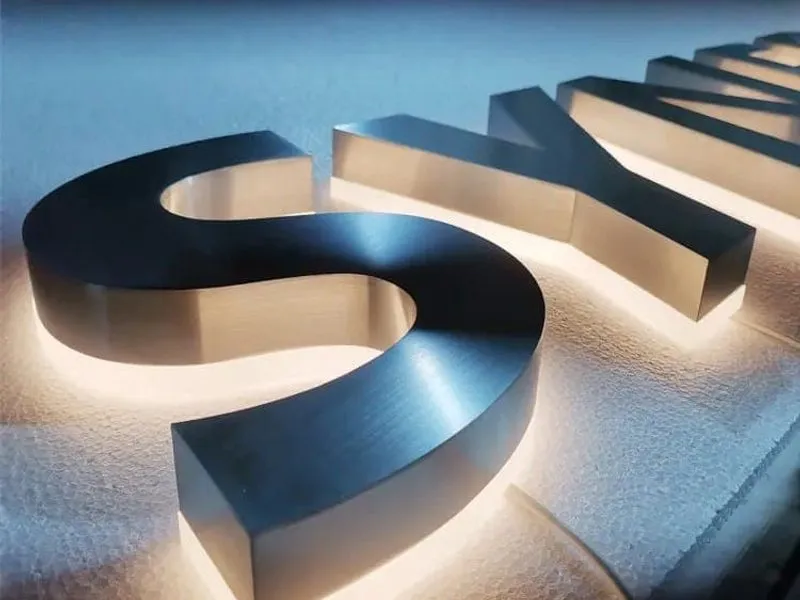
The sign industry's dirtiest secret? Half the "custom" work you're paying for isn't custom at all. It's a stock catalog piece with your client's logo slapped on. And that's not necessarily a bad thing — but you need to know what you're actually paying for before you write the PO.
I've been on this factory floor since 2010. I've watched importers pay $800 for a front-lit letter that we ship for $120. I've also watched contractors buy cheap ready-made signs that failed within 18 months and ruined their reputation. Both paths can work. Both can bankrupt you. Let me break down exactly what the difference is, what it costs, and when you should choose which.
Here's what nobody tells you: the "cost" of a sign isn't the invoice price. It's the invoice plus shipping, plus tariffs, plus installation hours, plus the service calls when something fails, plus the 2 AM phone call when a letter burns out mid-holiday-season. That's the real number.
---
WHAT'S ACTUALLY DIFFERENT?
Ready-made signs are essentially catalog products. Fixed sizes, standard materials, common LED configurations. They're mass-produced on a schedule, which means you're buying whatever's in stock or whatever comes off the line this week. Think of it like buying a suit off the rack.
Custom fabrication means the sign is built to your exact specifications. Your dimensions, your materials, your lighting layout, your mounting requirements. Like a tailored suit — better fit, but you're paying for the pattern cutter's time.
**The ready-made route:**
- Lower upfront cost (we're talking 30-50% less than custom)
- Faster shipping — it's already built, just needs packing
- Predictable quality — same product, same process, every time
- Limited to whatever the factory offers
- No engineering or design work required from you
**The custom route:**
- Higher cost — you're paying for design, engineering, and manufacturing time
- about 5-15 days lead time minimum, usually more
- Exact fit for your application
- Every sign is a prototype — which means every sign comes with surprises
- Total design control
The ugly truth is neither option is universally better. I've seen a $4,000 custom halo letter sign fail in two years because the installer didn't seal the conduit properly. I've also seen $200 ready-made
light boxes run flawlessly for a decade in a dry climate.
---
THE COST BREAKDOWN — NUMBERS YOU CAN ACTUALLY USE
Let's talk real numbers. These are factory-direct prices from our floor in Lu'an, Anhui. Your costs will vary by country, tariffs, and freight, but this gives you a baseline.
For custom fabricated letters, here's what you're looking at:
- Front-lit
channel letters (stainless steel back, acrylic face): $20-80 per letter
- Back-lit halo letters: $35-120 per letter
- Stainless steel non-lit letters: $15-40 per letter
- 3D fabricated letters: $40-120 per letter
- Aluminum letters: $10-25 per letter
For ready-made options, prices shift depending on what you're buying. Our acrylic light boxes run $80-250 per square meter. Neon flex signs go $30-200 per sign depending on complexity and size.
Now, here's the comparison that matters. A typical storefront with 10 letters of custom, front-lit channel letters runs $200-800 total from our factory. The same sign from a US sign shop runs $2,000-7,000 installed — and that's before you factor in that most of those shops are ordering from factories like ours anyway. That 50-65% savings isn't marketing hype. It's the reality of the markup chain.
But before you order, here's the hidden cost trap nobody warns you about: the 30% US Section 301 tariff on Chinese-made signs. That's not optional, not negotiable, and it changes your math significantly. A $500 factory quote becomes $650 before shipping.
---
WHEN READY-MADE MAKES SENSE
Here's what nobody tells you: ready-made signs aren't cheaper because they're lower quality. They're cheaper because the factory doesn't have to stop the line, redesign the tooling, and retrain workers for a one-off product.
If your client needs a basic storefront sign, a menu board, or standard window lettering — and it's not going into a hurricane zone or a salt-air coastal environment — ready-made is probably your smartest play. The margins are better, the lead times are faster, and the quality is consistent.
I've seen this go wrong so many times: a contractor gets a fancy custom job, pays a premium, then discovers the install location has a power issue that kills the LEDs in six months. The $120 cheap sign would've done the same job for a fraction of the price.
Here's a practical breakdown of when to buy off the rack:
- Franchise locations with uniform signage requirements
- Temporary promotions or seasonal displays
- Standard-sized window signs for retail
- Interior signage where durability isn't critical
- Budget-constrained projects where aesthetics matter more than longevity
For these jobs, our
acrylic light boxes or
neon flex signs are the workhorses. They're proven, they're fast, and they're cheap enough to replace if something goes wrong.
---
WHEN YOU NEED CUSTOM FABRICATION
Let me be blunt about the custom side because that's where we make our real margin, and I want you to understand why you should pay for it.
Ready-made signs fail in three situations. First, when your dimensions don't match what's in the catalog. Second, when you need materials that handle specific environmental conditions. Third, when the sign needs to carry your client's brand identity without looking like every other storefront on the block.
Custom fabrication is non-negotiable for:
- Oversized signage over 2.5 meters (any bezel over that length requires 5mm+ acrylic, which is a custom build)
- Coastal or industrial environments where you need 316 marine-grade stainless steel — that 20-30% premium over 304 is what separates a 15-year sign from a sign that corrodes in 5.
- Back-lit halo letters that have to match a corporate brand color exactly
- Architectural projects where the sign must integrate with the building design
- Any sign that needs to meet ADA guidelines — tactile letters at 48-60" mounting with Grade 2 Braille, non-glare finishes. That's never a stock item.
For these applications, custom isn't a luxury. It's the only option that doesn't end in a lawsuit or a failed project.
Our
stainless steel letters and
back-lit halo letters are the workhorses for this tier. They're not cheap. They're not fast. But they're built to last a decade or more, and they'll look like it.
---
THE QUALITY QUESTION — WHAT YOU'RE ACTUALLY PAYING FOR
Let's kill a myth right now: cheap doesn't automatically mean bad. Expensive doesn't automatically mean good.
Here's what I mean. We sell SMD 2835 LED modules that are the industry standard — 100-150 lumens per watt, L70 rated for 50,000 hours. These are the same LEDs that go into $800 letters and $200 letters. The difference is the power supply and the heat management.
When you buy a cheap sign, you're usually getting one of two things. Either the factory cheaped out on the LED driver, or they skipped the aging test that burns in the components before shipping. That's why cheap signs fail in 12-18 months when quality modules should last 5+ years.
Here's the tell: ask any factory about their aging test. A proper facility runs every sign for 8-12 hours before packing. That's part of our 10-step process — and it's non-negotiable. If a factory can't show you an aging test station on their floor, you're gambling on every single order.
Now for the material side. Acrylic is where I see the most corner-cutting. Our import acrylic (Mitsubishi or Degussa) has 90-92% light transmittance and UV resistance that holds for 5-8 years. Domestic Chinese acrylic costs less but starts yellowing in 1-2 years. That's the difference between a $150 letter and a $100 letter. The customer won't notice for about 18 months, and then they'll blame you.
The same logic applies to stainless steel. 304 stainless (18% chromium, 8% nickel) gives you a solid 10+ year outdoor life in normal conditions. 316 stainless (with 2-3% molybdenum) handles marine environments for 15+ years. For a strip mall in Ohio, 304 is fine. For Miami Beach, pay for 316 or you'll be replacing it before the loan is paid off.
---
RED FLAGS AND LIES — HOW FACTORIES SCREW YOU
I've been in this business long enough to know exactly how my competitors operate, and let me tell you, some of it is shameful.
First lie: "We have UL certification." Do you? UL 48 certification costs $4,000-15,000 and takes 4-9 months with quarterly audits. Many factories claim they have it because they once passed a UL inspection on a single product line. Ask to see the certificate with your product model on it. Ask to see the date. If they can't produce it, they're lying.
Second lie: "CE certified." CE marking costs 20,000-50,000 RMB and takes 2-8 weeks. It's not the gold standard, but it's something. Most factories say they have it. Ask to see the certificate with today's date. A laminated PDF from 2018 doesn't cover your 2025 order.
Third lie: "IP65 is waterproof." No. IP65 means dust-tight and protected against water jets from any direction. It does NOT mean your sign survives a Florida hurricane. For coastal or extreme weather, you need IP66 (powerful water jets) or IP68 (submersible, for the truly insane locations). Check the actual specification, not the marketing language.
Fourth lie: "Factory direct pricing." Everyone says they're factory direct. An actual factory has a production floor, a laser cutter, a bending brake, a welding station. If you're dealing with a trading company that outsources to three different workshops, you're not factory direct. You're paying a middleman premium and getting zero quality control.
---
MORE THAN EXTRA CREDIT — A CUSTOMER DECISION MAP
Here's how I'd route you based on who you are:
**If you're a sign shop owner:**
You already know what your client needs. The question is whether your margins are better with ready-made or custom. For standard projects, buy ready-made and mark it up 30-50%. For anything with architectural requirements or a brand-critical application, go custom and charge accordingly. Your clients won't blink at a 100% markup on custom, but they'll fight you on a 30% markup for something they think is off-the-shelf.
**If you're a contractor:**
You've got scheduling constraints and installation responsibilities. Ready-made gives you predictable timelines. Custom gives you fewer callbacks. If you're installing a sign on a salt-air coastal property, you don't want yourself going back in 3 years to replace corroded letters. Custom with 316 stainless and proper IP66-rated LED modules is worth the wait.
**If you're an importer:**
You're looking for margins and volume. Ready-made signs that pass inspection consistently are your bread and butter. Price is your main lever. But please, for the love of everything holy, don't compare our factory pricing against a Bangladesh or Vietnam quote without checking their material quality. We have CE, RoHS, ISO 9001 certifications and we stand behind them. You get what you pay for.
**If you're a business buyer:**
You're reading this because you don't want to overpay. Don't. But also don't under-buy. A $200 ready-made light box will do the job. A $2,000 custom halo-lit sign will make your storefront look like a million bucks. Know which one your business needs before you order.
---
THE HONEST BREAKDOWN OF EVERYTHING ELSE
Let's talk lead times because that's where the real disappointment lives.
Custom fabrication from our factory: about 5-15 days total production time. That's after we confirm your design files. The process goes: design confirmation (day 1), laser cutting to ±0.1mm precision (1-2 days), TIG welding and bending (1-2 days), grinding and polishing (1-2 days), CNC acrylic face cutting (1 day), LED assembly (1-2 days), sealing with neutral silicone (1 day), 8-12 hour aging test, 100% QC inspection, and finally export packaging with foam, carton, and plywood crate.
The fastest way to ruin your timeline is to send a vague spec and expect the factory to read your mind. Send us your exact dimensions, your material preferences, your LED color temperature (3000-3500K for hospitality, 4000-5000K for corporate, 6000-6500K for industrial), your mounting method, your power supply requirements. Every missing detail is a day of back-and-forth email that delays your shipment.
Now shipping. This is the part that surprises everyone.
Express shipping (DHL, FedEx, UPS): about 5-15 days, $30-100 for small packages.
Air freight: about 10 days, $4-12 per kilogram.
Sea freight (LCL - less than container load): about 65 days, $80-200 per cubic meter.
Full container load (FCL): $1,200-3,000 depending on destination.
For a quick reference: a typical 10-letter channel letter sign weighs about 40-60 kg and takes up roughly 0.5 cubic meter when crated. Your sea freight cost is around $40-100. Your air freight is $200-700. You do the math on whether a 2-week lead time is worth $600 extra. For most projects, sea freight is the right answer. For that one client who's opening next month and just realized they forgot to order signage, you'll pay the air freight and hate every minute of it.
---
HOW TO ORDER SMART — EVEN FROM US
Here's what nobody tells you about ordering custom signs: the factory doesn't want to screw you over. We want repeat business. But we also can't read your mind.
Let me give you the questions you should ask any factory before you send money:
**1. Can I see your UL/ETL certificate?**
Not a photo of one. The actual certificate with your product model listed. If they say "we're working on it," run. If they say "we can get it," ask how long and how much. ETL is a legitimate UL alternative that's 10-30% cheaper. That might be your play if UL is required in your jurisdiction.
**2. What's your exact material specification?**
We'll tell you "3mm acrylic" and "SMD 2835 LEDs." Why 3mm? Because that's the standard for letters under 2.5 meters. Why 2835? Because they're 100-150 lm/W and last 50,000 hours to L70. If a factory can't explain why they use the components they use, they're just piecing together the cheapest thing they can find.
**3. What's your warranty, exactly?**
We offer 2 years on LEDs and 1 year on power supplies. That's honest. If someone offers you a 10-year warranty on a sign, ask them to put it in writing and explain what it actually covers. A warranty is only as good as the company backing it. A factory in another country isn't going to fly a technician to your site to fix a dead LED. They're going to ship a replacement part. Make sure that's acceptable for your project.
**4. What's your minimum order quantity?**
Ours is 1 piece. That's rare in this industry and we're proud of it. But if a factory has a high MOQ, that's not automatically a red flag — it means their process is set up for volume, not bespoke work. Figure out whether you're a 1-piece customer or a 500-piece customer before you start shopping.
**5. Do you do a burn-in test before shipping?**
Every sign from our factory runs 8-12 hours before packing. That's not just QC theater — it catches the 2% of LEDs that are going to fail in the first week. The ones that make it through the aging test tend to last for years. The ones that don't, fail fast, usually on the customer's wall.
---
THE FINAL VERDICT
Look, here's the bottom line. If you're buying signs, you need to stop thinking of it as "cheap vs. expensive" and start thinking of it as "right tool vs. wrong tool."
A ready-made sign is the right tool for 60% of commercial applications. It's cheaper, it's faster, and honestly, for a dry climate and a standard storefront, it'll last just as long as a custom sign.
A custom sign is the right tool when the environment demands specific materials, the dimensions don't fit a standard catalog, or the brand identity requires something that looks intentional rather than catalog-ordered.
What you shouldn't do is pay custom prices for catalog quality. That's the real scam in this industry — the US sign shop that marks up a $120 Chinese letter to $800 and calls it "bespoke fabrication." And what you shouldn't do is buy the cheapest option you can find without checking the material quality, the certification dates, and the warranty terms.
If you've been burned by cheap imports before, I get it. That's why we run every sign through a 10-step quality process and put our name on the result. We've shipped worldwide from our 3,000 square meter facility in Anhui, and we've learned what happens when you cut corners. That's why we don't.
For your next project, look at our
front-lit channel letters if you need the storefront standard. Check out
back-lit halo letters if you're after the premium architectural look that gets noticed from across the street. And if you need something that works day and night without looking washed out, our
dual-lit channel letters handle both modes without compromise.
The only wrong move is ordering in a panic without knowing what you need. Get your specifications right, ask the hard questions, and you'll get a sign that does its job for years. That's not just good business. That's the whole game.