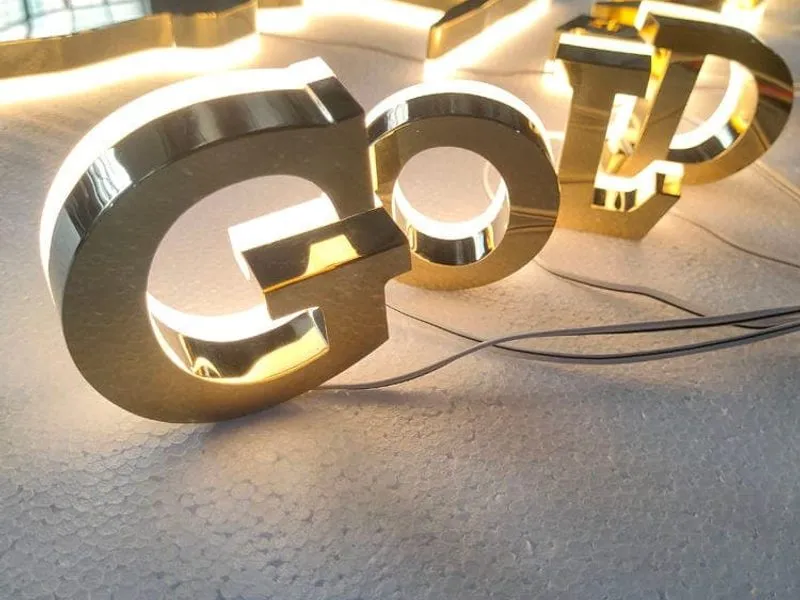
The Installer's Guide to Custom Sign Buying: What I Learned Importing from China Factory Direct
Choosing the Right Material: Acrylic vs. Stainless Steel vs. Aluminum
When you're choosing a sign material, you're really deciding between acrylic, stainless steel, and aluminum. Each one has its place. Here's how I look at it.
Acrylic transmits light well, usually 90-92%. Good UV-stable acrylic, like Mitsubishi or Degussa, holds up 5-8 years outdoors. Cheap acrylic can yellow. Standard thickness runs 2mm to 5mm; if the sign is over 2.5 meters, use at least 5mm.
Stainless steel Type 304 lasts 10+ years outdoors because of its 18% chromium and 8% nickel content. Thickness runs from 1.0mm to 3.0mm. Common finishes are brushed #4, mirror #8, PVD, and powder coating. For coastal or industrial environments, use 316 stainless even though it costs 20-30% more. Aluminum is light, about one-third the weight of steel, and lasts 8-12 years outdoors. It doesn't rust, so it's a good choice when weight matters.
Stainless steel isn't indestructible, no matter what people assume. The right material depends on where the sign goes, how it's mounted, and your budget.
Decoding LED Sign Prices: What You Need to Know Before Buying
LED signs are a practical choice for most installers. The key is knowing what a fair factory price looks like before you order.
Factory-direct pricing is usually 50-65% lower than US retail. Front-lit channel letters run $20-80 per letter. Neon signs now run $30-200 per sign. US retail installed prices are much higher: $200-700 per letter for front-lit and $400-1,000 for halo-lit.
Pay close attention to LED modules. The cheapest modules often fail in 12-18 months. Samsung, Osram, or Blueview modules usually last 5+ years. They cost more up front, but you won't be swapping them out every year.
The cheapest sign is rarely the best deal. Quality, lifespan, and factory-direct pricing are what actually matter.
Understanding Custom Sign Dimensions: How to Get the Right Fit
Design is only half the job. If you get the dimensions wrong, the sign won't look right or last.
Acrylic and stainless steel signs come in standard thicknesses and can be cut to size. But anything over 2.5 meters needs at least 5mm acrylic. The same principle applies to stainless steel. Going thicker keeps the sign from flexing or failing.
LED signs are more forgiving on size. The industry standard SMD 2835 LEDs offer 100-150 lm/W, and SMD 5730 chips run brighter at 40-60 lm/chip. For color temperature, warm white (3000-3500K) fits hospitality, neutral white (4000-5000K) fits corporate and retail, and cool white (6000-6500K) fits industrial and highway work.
Double-check measurements before you approve a drawing. Wrong size costs money and looks bad.
The Art of Channel Letters: Designing and Installing Backlit Halos
Channel letters are the bulk of most sign work, and backlit halos are a clean upgrade. The acrylic face on these letters transmits 90-92% of light. If a halo letter is over 2.5 meters, use 5mm or thicker acrylic. Thinner material flexes and cracks over time.
Installing them is straightforward if you respect the material. These letters are light, especially in 3mm and 5mm acrylic, but you still need proper tools. A TIG welder is standard for the bending and welding steps. I've seen new installers waste material by trying to get by without one.
After installation, the LED modules decide how often you'll be back. Samsung, Osram, or Blueview modules last 5 years or more. Cheap modules fail in 12-18 months. That means callbacks and ladder time. Use decent modules from the start.
Neon Signs vs. LED Signs: A Comparative Analysis for Installers
Neon looks good, but it has real trade-offs. Stainless 304 holds up 10+ years outdoors, and you can get brushed, mirror, PVD, or powder-coated finishes. LED signs use SMD 2835 chips with 100-150 lm/W. Good LED modules have an L70 rating over 50,000 hours, so you are not constantly replacing them.
On cost, neon can run 20-30% more than a comparable stainless steel sign. Power draw is higher too, which means higher electric bills for your customers. LED costs more up front, but power savings usually make up for it over time.
Installation is different as well. Neon is heavier and takes more skill to handle. LED signs are lighter and easier to mount, so labor time goes down. Maintenance favors LED, too. Neon is harder to repair in the field, while LED modules are usually quick to swap. For most installers, LED is the simpler call.
Navigating the Production Process: What to Expect from a Chinese Factory
The production process at a Chinese
sign factory like Aochuang Sign is straightforward, not magic. Here's the rundown. First, confirm the design. That can take as little as a day. Then laser cutting starts, with tolerances as tight as ±0.1mm. Bending and welding follow, using TIG. After that, grinding and polishing take about two days. Next, the acrylic face gets CNC work. LED assembly is a two-day process, and sealing with neutral silicone takes a day. An 8-12 hour aging test runs, followed by a 100% QC inspection. Finally, the sign is packed for export. Total lead time is about about 5-15 days from drawing approval to packing.
Don't assume Chinese factories have long delays or poor quality control. Many with ISO 9001 certification run efficient, quality-focused operations. It's a 10-step process, but it's streamlined and fast. Materials matter too. Acrylic has 90-92% light transmittance and UV resistance for 5-8 years. Stainless steel, especially 316 grade for marine use, lasts 15+ years. LED modules from Samsung or Osram usually last 5+ years. The result depends on the material quality and the precision of the manufacturing process.
One note from experience: the "Made in China" label doesn't automatically mean poor quality. Many Chinese sign factories run tight quality control and efficient lines. There are bad shops, but a reputable factory is usually a solid choice.
Frequently Asked Questions
What's the minimum order quantity for custom signs from China?
The minimum order at Aochuang Sign is 1 piece. There is no order minimum, so smaller shops can import without buying a full container.
How long does it take to receive custom signs from China?
Lead time at Aochuang Sign is about 5-15 days, depending on the complexity of the sign and current production load.
Do I need to pay for certifications like UL or CE for my signs?
Yes, certifications can be expensive. For UL 48, you're looking at $4,000-15,000, and the process takes 4-9 months with quarterly audits. CE certification usually costs a few thousand dollars and takes 2-8 weeks. It's worth it for market access, but it's a significant upfront cost.