UL 48 is a safety standard for electric signs. It covers wiring, LEDs, power supplies, enclosures, and heat. If your sign burns a building down, UL 48 is what the insurer asks about.
Look, I've shipped signs to 40+ countries since 2010. A US buyer once asked me for a UL 48 certificate on a 12-piece channel letter order. I told him the truth: a UL 48 listing costs $4,000-15,000 and takes 4-9 months. He didn't like that. But he ordered anyway after I explained how to get the same safety without the sticker.
Here's the deal. You don't need UL 48 for every sign. You need it when the local code says "listed sign" or when your client's insurance demands it. I'll break the process down in plain English.
The ugly truth is most sign buyers think UL 48 is a piece of paper. It's not. It's a contract with Underwriters Laboratories. They test your sign's electrical system under load, heat, and fault conditions. They check the acrylic face, the metal enclosure, the knockout spacing, the wire gauge. They also show up at your factory four times a year, unannounced, for inspections.
UL 48 covers channel letters, light boxes, cabinet signs, neon, and anything with a power supply. If your sign is low-voltage LED with a Class 2 power supply, some inspectors let it slide. But if it's hardwired to 120V or 277V, you'll probably need a listing.
Here's what nobody tells you: UL 48 isn't a one-time test. It's an ongoing quarterly audit. You pay every year. If you stop paying, the listing dies.
Let's skip the consultant jargon. Here's the actual flow.
1. Determine product category. UL 48 covers signs with electric components. If you're importing pre-assembled signs, you need a sign listed by a UL-certified shop.
2. Submit samples and technical drawings. You send UL two production samples plus your wiring diagrams, LED spec sheets, power supply data sheets, and material list.
3. UL engineer tests. They overvolt the sign, run it for 8-12 hours at max ambient, spray it with water, check for arcing, ground continuity, and temperature rise.
4. Factory inspection. UL visits your manufacturing site. They check your assembly line, your wire crimping, your solder joints, your QC records. They look for deviations from the tested sample.
5. Listing issued. If everything passes, you get a UL file number and the right to apply the UL label. Cost: $4,000-15,000 depending on product complexity. Time: 4-9 months.
6. Quarterly audits. UL shows up four times a year. You pay for each visit. If you change a component—say, switch from Samsung to a cheaper LED—you need to re-test or get a variance.
7. Renewal. The listing is annual. Miss a payment and you're dead to UL.
UL 48 isn't a paper review. It's a beatdown. They run the sign hotter than it will ever run in Phoenix in July. They spray it with water from a jet nozzle. They short the output and look for smoke.
I've seen this go wrong: a client ordered front-lit channel letters with cheap LED modules rated at 12-18 months real lifespan. The UL inspector caught the temperature rise on a 100°F day. The letters passed the paper review but failed the thermal test. He replaced every module with Samsung LEDs at double the cost.
Here's what nobody tells you: quality LED modules—Samsung, Osram, Blueview—last 5+ years real lifespan. Cheap ones die in 12-18 months. UL 48 doesn't care about lifespan; it cares about fire. But a module

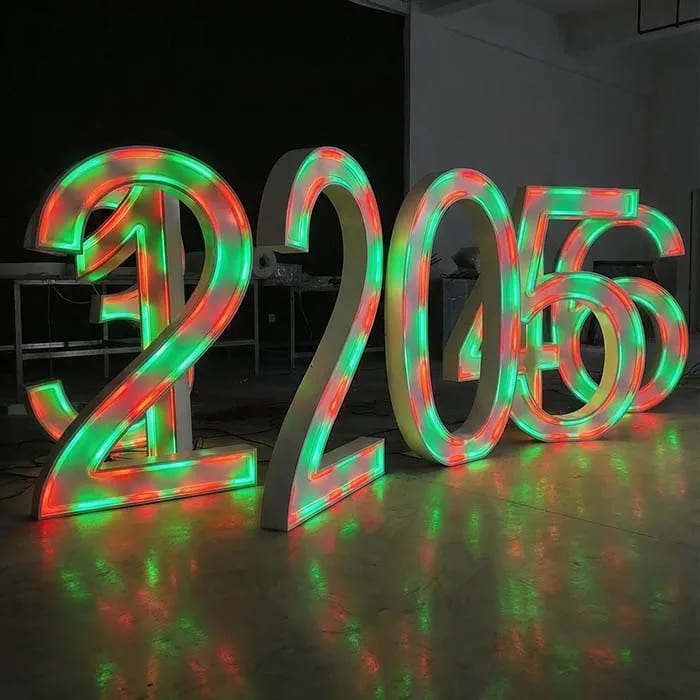
Real photo from our production floor — every sign we ship is made here.
From $24/letter · MOQ 1 piece · Flexible lead time · CE & UL certified · ships to 20+ countries
Custom sizes, colors, and finishes. Get a factory price in 24 hours.
Get a Free Quote Copy EmailWhatsApp +86 13865703472 · business@aochuangsign.cn
See pricing, specs, and get a free quote for the sign type you need. Built in our factory, shipped worldwide.