Here's what nobody tells you: most "UL 48 certified" sign factories you'll find on Alibaba aren't. They've got a logo stolen from a Google image search and a sales pitch that sounds good over WhatsApp. I've been in this industry 16 years, and I can count on one hand the Chinese sign factories that actually hold a valid UL 48 listing.
So before you order a truckload of front-lit channel letters from someone who claims UL 48 "certification", let's talk about what that actually means, how the process works, and why it might not even matter for your project. And I'll be straight with you about what our factory can and can't do — because that's the only way you'll trust me.
UL 48 is the standard for electric signs. It covers the construction, performance, and safety of signage — channel letters, light boxes, neon, all of it. When a sign is UL 48 listed, it means a third-party inspector (from UL) has tested it to make sure it won't catch fire, shock someone, or fall apart when it's mounted on a building.
The ugly truth is that UL 48 is not a "one-time certificate". It's an ongoing program. You don't get a piece of paper and move on. You get a listing agreement, and UL sends an inspector to your factory at least quarterly. They pull random units off the line, cut them open, check the wiring, the LEDs, the grounding, the label placement. If you change your materials without telling them, they can pull your listing.
That's why so many factories don't do it. It's not just the $4,000–15,000 initial cost. It's the hassle of having an inspector show up every three months and actually checking your work.
Here's the reality: if you're buying signs for a U.S. building that has a fire inspection or a local electrical permit, you need UL 48 (or ETL, which is a similar approval). Inspectors won't sign off on unlisted signs. Big chain stores, franchises, and most commercial landlords will also require it.
But if you're a small shop owner buying one sign for your own storefront, and your city inspector doesn't care about UL, you might be fine without it. That's not me being sloppy — that's me telling you to spend your money where it matters.
I've seen this go wrong: a restaurant owner in Texas imported 20 custom acrylic light boxes from a Chinese factory that claimed UL. When the city inspector showed up, he asked to see the UL mark on each sign. There wasn't one. The factory had a photo of someone else's label. The owner had to rip down every sign and rewire them with UL-listed components locally. He paid double.
If you think you can just ask a factory to "get UL 48" and wait two weeks, you're dreaming. Here's the actual timeline:
That whole process takes 4–9 months and costs $4,000–15,000. That's not including the cost of upgrading your components to UL-listed ones, which can add 10–30% to your bill of materials.
Let's get specific. The $4,000–15,000 range isn't just a flat fee. Here's what you're paying for:
And if your sign uses cheap non-UL components, you'll pay to replace them. I've seen projects where the component upgrade alone cost $10,000.
Look, I'm not saying this to scare you. I'm saying it because a factory quoting you "UL 48 included" in a $20 per letter price is lying to you. That math doesn't work.
Here's the part your instinct will get wrong. A factory showing you a scanned "UL Certificate" is not proof. That certificate might be from a different company name, a different product category, or it might be expired. I've seen factories use a UL logo for a hair dryer and claim it covers channel letters.
Do this instead:
Here's what nobody tells you: even if a factory has UL 48, it only covers their factory assembly. If you import back-lit halo letters and then alter them — change the power supply, reconnect the wiring, add a switch — you're building a new sign in the eyes of the inspector. Your modifications require their own listing. That's the part importers forget until they're red-tagged.
ETL is another certification from Intertek, a different testing lab. It's not a "lesser" certification — it's the same safety standards, just a different logo, and it's usually 10–30% cheaper and faster. Many U.S. jurisdictions accept ETL and UL equally. If your city says "UL approved", they usually mean "listed by a Nationally Recognized Testing Laboratory (NRTL)" — and both UL and Intertek qualify.
For a production factory, ETL can be a smarter choice. But the same rules apply: verify the file number, check the product scope, don't trust the logo.
I'm not going to pretend we have UL 48 at Aochuang Sign. We don't. We've got CE, RoHS, and ISO 9001, which are real for the EU and for quality management, but they are not UL 48. If you're buying signs for a U.S. project that requires UL, we can't hand you a UL-listed sign out of the factory.
But here's what we can do:
That third option — our factory makes the components, a local shop lists the sign — is what a lot of smart importers do. It's the honest middle path. We've served worldwide, and when customers need UL, we coordinate with their local licensed sign company. It costs them more than buying directly, but less than buying a fully assembled sign from a U.S. factory.
The ugly truth is this: if you want one-click, fully certified, ready-to-install UL 48 signs shipped from China, you'll pay a premium — and you'll probably get a fake anyway. I'd rather lose a deal than tell you something that gets you red-tagged by an inspector.
Don't obsess over a certificate. Obsess over materials. UL 48 doesn't make a sign good — it makes it safe. It doesn't tell you whether the acrylic will yellow in 12 months or whether the LED modules will still be running at 50,000 hours.
If you're buying dual-lit channel letters for a gas station, you want to ask about the acrylic grade. Mitsubishi or Degussa acrylic gives you 5–8 years of UV resistance. Domestic acrylic yellows in 1–2 years. That's a bigger deal than a UL sticker.
Ask about the LEDs. SMD 2835 at 100–150 lm/W with L70 rating of 50,000 hours — that's the industry standard. Cheap modules die in 12–18 months. We use quality modules from Samsung or Osram in our front-lit channel letters because I've seen too many signs look like a broken slot machine at night.
If your project requires UL 48, don't chase a factory that claims to have it. Ask them for the file number and verify it. If they can't provide a verifiable file, move on or plan to do the final listing locally.
If you don't require UL, or you're willing to work with a U.S.-based shop for the final assembly, we can save you real money. We'll be upfront about what we can't do, and we'll build your signs with components that make the listing process painless.
Send us your specs. Ask us for the UL recognition numbers on everything we use. If we can't meet the requirement, we'll tell you — and point you to someone who can. That's not a sales pitch. That's how a 16-year industry veteran treats a customer who wants to buy a sign, not a lie.
Factory-direct since 2010. Free quote within 24 hours — no obligation.
Get a Free Quote → Copy EmailMOQ: 1 piece · Flexible lead time · 2-year warranty · Worldwide shipping
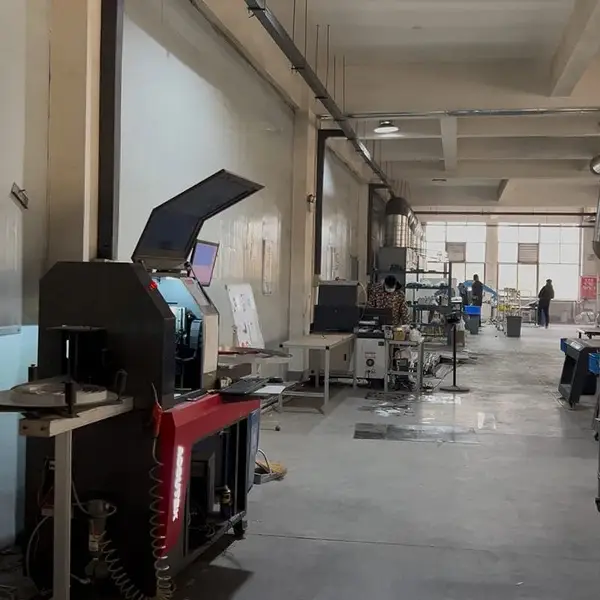
Real photo from our production floor — every sign we ship is made here.
See pricing, specs, and get a free quote for the sign type you need. Built in our factory, shipped worldwide.