Look, I've watched contractors pay 30% more for a UL sticker on a sign that would've passed inspection with an ETL mark. It happens all the time.
And I've watched importers slap a CE mark on light boxes headed to a Texas strip mall, thinking it means something. It doesn't. The inspector didn't even glance at it.
Here's what nobody tells you: certification is about who's asking, not about how good the sign is.
I've been on a factory floor in Lu'an, Anhui for 16 years. We build signs. We ship worldwide. I've argued with inspectors, suppliers, and one very stubborn contractor from Ohio who refused to believe ETL was legal. It is.
We run a 3,000m² production facility with 50+ workers. MOQ is 1 piece. Lead time is 7-15 days. Warranty is 2 years on LED, 1 year on power supply. I tell you this so you know I'm not a broker in a co-working space.
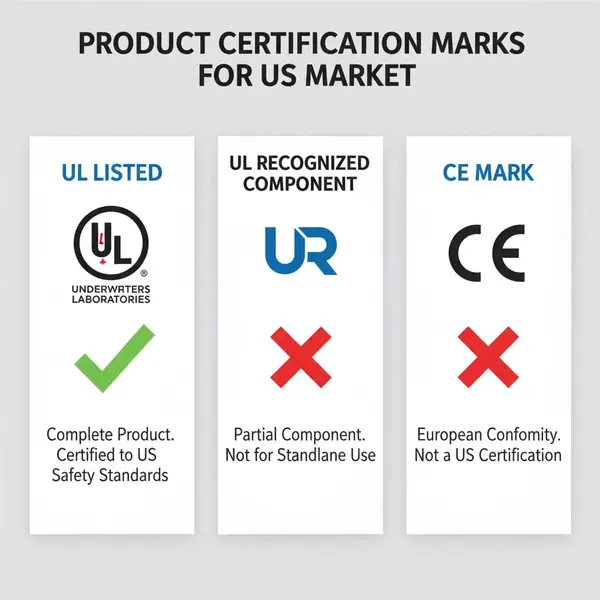
UL stands for Underwriters Laboratories. For signage, UL 48 is the standard for electric signs in the US. It's the gold standard in a lot of inspectors' heads.
ETL is from Intertek. It's a Nationally Recognized Testing Laboratory, same as UL. Your local inspector accepts it, and it's typically 10-30% cheaper and faster to get.
CE is European. It means the product meets EU safety and EMC standards. It is not an electrical listing for the US market.
I've seen this go wrong: a sign shop printed "CE certified" on a quote for a bank in Florida. The AHJ showed up, saw no UL or ETL on the sign, and red-tagged it on the spot. The shop had to rewire the whole thing. It cost them double the original quote.
RoHS means no lead or hazardous materials. ISO 9001 means we have a documented quality management system. Neither one will pass an electrical inspection in Chicago.
We hold CE, RoHS, and ISO 9001. I'm not going to tell you that makes your sign legal in Chicago. It doesn't.
If you're installing in the US or Canada, forget CE. For hardwired electric signs, you need a listing mark from an OSHA-recognized NRTL. UL or ETL are the two big ones. CSA is the Canadian equivalent.
Here's the ugly truth: many inspectors accept ETL, but some big accounts write "UL only" into the spec because they don't know better. You can fight it, or you can charge them for the longer timeline and higher cost.
If you're shipping to Europe, CE is mandatory. But CE marking for signage costs 20,000-50,000 RMB to do legitimately, and it takes 2-8 weeks. Most factories that say they have CE are showing you a PDF from 2019 with someone else's name on it.
Ask to see the certificate with today's date. Better yet, ask for the test report. I've seen suppliers forge those too.
If you're in the Middle East, Southeast Asia, or Africa, you often don't need UL or ETL. CE or even factory test reports can be enough. Check with your local municipality before you spend a cent.
For front-lit channel letters going to a US storefront, the LED modules and power supplies need UL or ETL listing. The whole sign doesn't always need a listing if it's under 600V and wired per NEC Article 600. But some inspectors still want it. That's just the reality.
And don't forget the 30% Section 301 tariff on imports from China. That's on top of the product cost, not the certification.
This is where most people get burned.
A UL-listed LED module means the module itself passed. A UL-listed power supply means the power supply passed. That does not make the whole assembled sign UL-listed.
UL 48 covers the complete sign: wiring, connections, enclosure, everything. Getting a factory UL 48 listing costs $4,000-15,000 and takes 4-9 months, with quarterly audits after.
ETL certification for the same sign is 10-30% cheaper and often faster. That's why ETL has gained real ground in the last decade.
I've seen this go wrong: a contractor bought 50 stainless steel letters with UL-listed modules and assumed the sign was UL-listed. The inspector asked for the label. There was no label. The contractor had to pay for a field evaluation on top of the sign cost.
If your job spec says "UL-listed sign," ask one question: "Listed as a complete assembly, or made with listed components?" The price difference is huge, and the first one isn't happening in 7-15 days.
I'm not going to lie to you to get an order. Our factory in Lu'an holds CE, RoHS, and ISO 9001. We build to UL/ETL standards every day, but we are not a UL-listed factory for complete custom signs.
Why? Because every custom channel letter changes dimensions, LED layout, and internal wiring. A UL 48 listing applies to a specific sign design, not a category. One tweak and the listing is invalid.
Can we build with UL-listed Samsung or Osram LED modules and Mean Well or equivalent UL-listed power supplies? Yes. We do it daily. Those components carry their own marks.
Can we help you get a whole-sign UL or ETL certification? Yes, but be ready for the timeline. Certification takes 4-9 months, plus quarterly audits. It is not a 7-15 day lead time item, and anyone who promises you that is lying.
If you need a listed sign yesterday, the honest path is this: buy a sign built with listed components and hire a local NRTL to do a field evaluation. That's often faster and cheaper than factory certification for a one-off job.
Look, I'd rather lose an order than ship you a sign that fails inspection and costs you a pile in rework and delay. That's not bragging. That's how you stay in business since 2010.
First, read the job spec. If it says "UL 48 listed sign" and you're bidding against local shops, ask the client if ETL is acceptable. It often is, and it can save 10-30% on the certification side.
Second, if you're importing from China, don't assume the factory's CE certificate means anything in North America. It doesn't. Ask for UL or ETL listings on the specific components: LED modules, power supplies, and any LED drivers.
Third, if you're in a coastal area, pay more attention to stainless steel grade and IP rating than to certification stickers. 316 stainless costs 20-30% more than 304. For Miami Beach, pay for 316. For a strip mall in Ohio, 304 is fine.
IP65 sounds impressive. It means water jets from any direction. It does NOT mean your sign survives a Florida hurricane. That's a common industry lie.
Fourth, if you're buying back-lit halo letters for an architectural job, spec IP66 or better and make sure the driver is remote and accessible. Inspectors love to see clean wiring.
And if you're buying acrylic light boxes for a restaurant in Europe or the Middle East, CE is fine. But if that light box is going to Los Angeles, you'd better have ETL or a field evaluation lined up.
Here's what nobody tells you: certification is a snapshot, not a promise. A factory can pass an audit in March and ship junk in July. I've seen it happen with suppliers more times than I can count.
So when you're comparing quotes, look at three things: the component list, the material thickness, and the factory's actual track record. Ask for photos of recent custom work. Ask for a video call of the production floor.
If a supplier gets defensive about those questions, walk away. A real factory that's been doing this since 2010 will show you everything.
We build stainless steel letters, front-lit channel letters, and back-lit halo letters every week. We use Samsung and Osram LEDs. We can tell you exactly which components have which marks, and which don't.
That's the only honest way to buy a sign.
Factory-direct since 2010. Free quote within 24 hours — no obligation.
Get a Free Quote →MOQ: 1 piece · 7-15 days · 2-year warranty · Worldwide shipping
See pricing, specs, and get a free quote for the sign type you need. Built in our factory, shipped worldwide.