For a butcher shop, you want a front-lit stainless channel letter with a 4000K LED and an IP65-sealed face. Budget $1.05–$1.35 per centimeter of letter height. A 30cm-tall "BEEF" set means four letters at $31.50–$40.50 apiece — $126–$162 total before freight.
That's the short answer.
Look, a butcher shop isn't a boutique. Cold cases spit condensation, grease vapor hangs in the air, and the manager hoses down the storefront every closing shift. Standard painted steel signs bubble in six months under those conditions.
Condensation beats rain every time. It pools inside the letter cavity, drips onto the LED modules, and corrodes the solder joints. I've pulled apart channel letters from a butcher shop where the modules looked like they'd been dipped in saltwater after 14 months. Cheap LEDs die in 12–18 months. Good modules — Bluesky or Rishang, SMD 2835, L70 50,000 hours — last 5+ years.
Here's the ugly truth: 90% of sign shops spec a standard storefront letter because it's easy. Don't do it. Butcher shops need materials that shrug off bleach wipe-downs without pitting, and LEDs that don't shift color when the temperature drops next to a walk-in cooler.
304 stainless is your default—18% chromium, 8% nickel, 10+ years outdoors. Grease, bleach, a pressure washer from six inches away? It doesn't flinch. Standard thickness runs 1.2–1.5mm for letter returns. Go thinner and a customer bumping it with a cart dents it. We'll sell you 201 if you ask. Don't take it for a butcher shop unless you like rust streaks after one winter. Coastal site? Pay the 20–30% premium for 316—2–3% molybdenum, 15+ years in marine air.
Acrylic faces? Use 5mm UV-resistant acrylic. Mitsubishi or Degussa grades stay clear 5–8 years. Domestic acrylic starts yellowing in 1–2 years. Add window-glass UV and heat from case lighting, and it looks like a smoker's teeth by year three.
Aluminum's fine for the backer panel or raceway. A third the weight of steel, naturally rust-proof, lasts 8–12 years outdoors. Use it for lightbox housings or monument sign bases—not letters that get scrubbed daily.
Nobody tells you this, but the finish matters more than the material. Brushed #4 stainless hides grease smears. Mirror #8 shows every fingerprint. Client wants polished? Tell them to budget for weekly wiping or spec baked paint instead.
Color temperature makes or breaks a butcher shop sign. 4000K neutral is the only number that works for raw meat. 3000K warm turns marbling muddy. 6000K cool makes steak look gray. High-CRI LEDs matter too—cheap modules make beef look brown before it leaves the case. Spec SMD 2835 at 100–150 lm/W. The Bluesky and Rishang modules we run? 5+ years real lifespan.
Channel letters win for butcher shops almost every time. They're dimensional, readable from a moving car, and you can seal them to IP65. Front-lit channel letters with stainless trim and acrylic face cost $1.05–$1.35/cm. Back-lit halo letters look prettier for an architectural client, but they run $1.50–$1.95/cm for the same size—and the halo effect disappears when the storefront glass fogs up at 6 a.m.
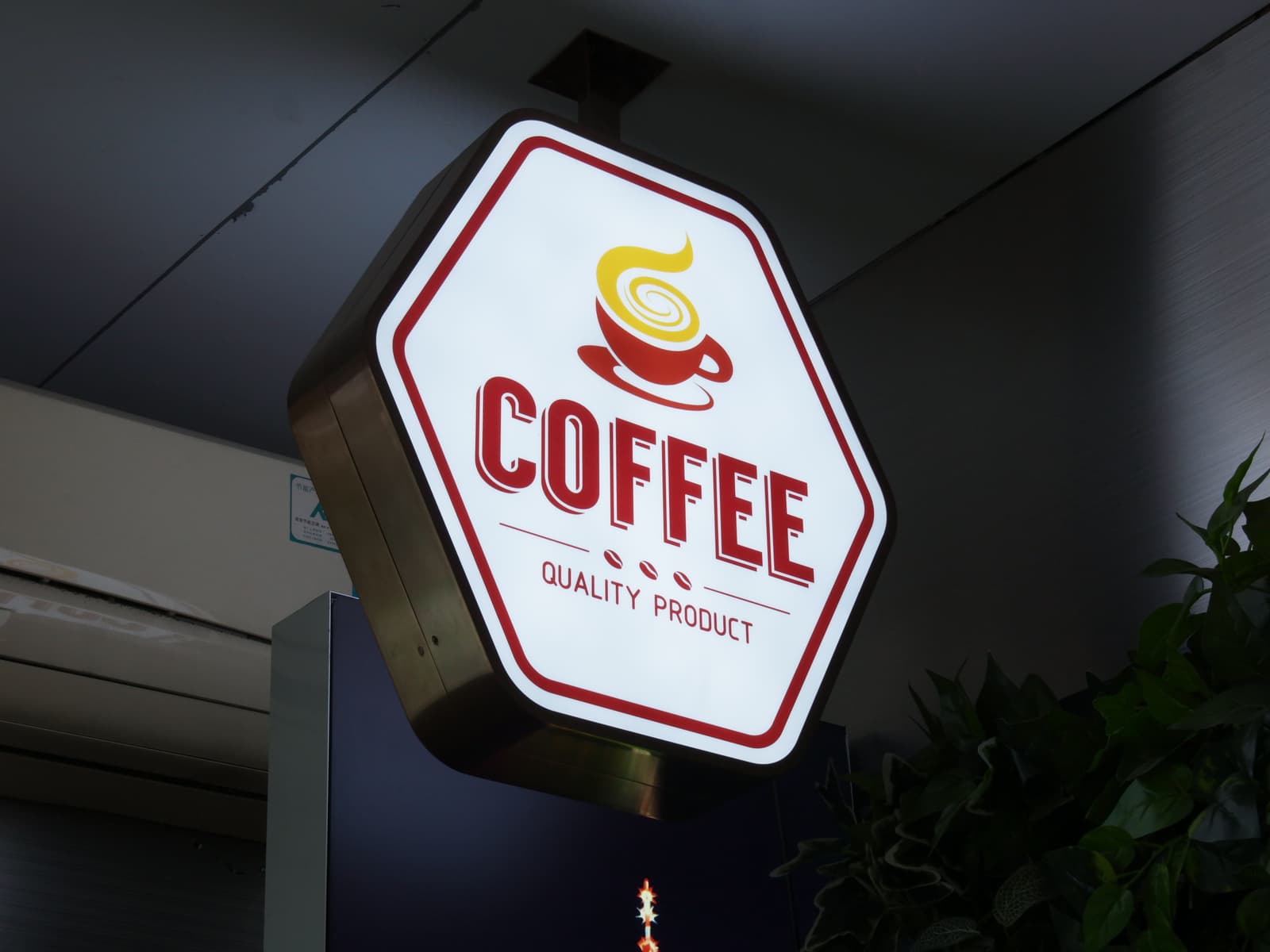
Lightboxes work fine as a secondary sign. Double-sided side lightbox by diameter: 40cm $75, 50cm $90, 60cm $105, 70cm $180. But a lightbox face is just a printed graphic. Grease and UV kill it in 3–4 years. Replace the face once and you've spent more than a good channel letter would have cost.
Monument signs work for a stand-alone butcher shop with parking. But they're heavy, need a concrete pad, and cost more than a storefront's worth of channel letters. Strip mall? Skip the monument. The landlord's pylon sign gets the visibility. Your job is to own the storefront.
Window graphics are a rookie recommendation for a butcher shop. They'll peel in the condensation and get scraped by a squeegee. Health department doesn't care about them. Use them only for hours and payment stickers. Not the main sign.
Letter height drives visibility. For a 30cm channel letter, you pay $1.05–$1.35/cm. Shop faces a road with real speed or a deep setback? Go 60cm. Cost scales linearly—a 60cm letter at $63–$81 grabs eyes from a block away.
Mounting a double-sided sign by the street? A 60cm round lightbox runs $105. Anything below 60cm and drivers at city speed won't read it before the turn-in. Not worth the bolt holes.
Interior restroom or accessible signs? ADA says mount them 48–60 inches to center, non-glare face, Grade 2 Braille. That's code, not design. Don't let a health inspector find a missing restroom sign and start looking at your meat case lights.
Health department doesn't care if your sign is pretty. They care about surfaces that can be sanitized. Spec letters with open returns, crevices, or exposed wiring channels and they'll flag it. Use sealed channel letters with a smooth acrylic face and stainless return.
Permitting isn't as hard as people think—if you submit the right spec. In the US, NEC Article 600 applies to electric signs. UL 48 or ETL listing matters for electrical. UL 48 costs $4,000–$15,000 and takes 4–9 months, with quarterly audits. ETL runs 10–30% cheaper and works just as well. Factory claims UL listed but won't give you the file number? That's a lie.
CE marking costs 20,000–50,000 RMB. Most Chinese factories will claim they have it. Ask to see the certificate with today's date. Watch them sweat. I've had suppliers suddenly "check with the factory" and never call back.
Landlord requirements: most strip mall leases require your sign to match the building's sign band and use specified raceway colors. Get the landlord's sign criteria before you quote. Skip that and you'll repaint the raceway on your dime.
Typical butcher shop storefront: a set of front-lit stainless trim acrylic letters in 30cm height runs $1.05–$1.35/cm. That's $31.50–$40.50 per letter. Four letters "BEEF" = $126–$162. Full name "BUTCHER'S BLOCK" in 30cm letters = 14 letters at $441–$567. That's the real number, before freight.
Hard number: I've watched sign shops pay $800 for a 30cm front-lit letter from a domestic fabricator. Same 304 stainless, same LED modules. We quote $31.50–$40.50 at $1.05–$1.35/cm. Not a typo. That's factory-direct pricing from Anhui, China, where 50+ workers push out signs every month.
Ugly truth: most of your client's budget goes to local fabrication labor and middlemen. A factory-direct order—3,000m² production facility, MOQ of 1 piece—kills both. Sample in roughly 5 days production, bulk in about 15 days.
Check the material certs. 304 stainless is 18% chromium, 8% nickel. 201? Cheaper. It rusts. Ask for the mill test report. No cert, no quote. Simple.
Check the LED brand. We run Bluesky and Rishang modules—SMD 2835, 100–150 lm/W, L70 50,000 hours. Cheap modules die in 12–18 months. When a butcher shop has to re-letter at year two, your name's on the job. Don't be that sign guy.
Check the warranty. We back LEDs 2 years and power supplies 1 year. Factory won't stand behind that? Don't stand behind them. A butcher shop sign that fails at month 14 is a phone call you don't want.
Check the IP rating. IP65 is dust-tight and handles water jets from any direction—minimum outdoor. IP66 handles coastal salt spray or pressure-washer abuse. IP68 is submersible—overkill unless the sign's getting flooded. Factory says "weatherproof" but won't state an IP number? They're guessing.
Check the aging test. We run every sign through 8–12 hours of aging before it ships. Factory skips that? You'll get dead LEDs on arrival. I've seen it. From laser cutting (±0.1mm) to export packaging, it takes 10 steps with plywood crate and foam. Skip the silicone sealing step and condensate kills your sign in one season.
Nobody tells you this: LCL sea freight means your crate gets handled 6–8 times between our dock and yours. Every touch is a chance for damage. That's not in the brochure. Pack it like someone's going to drop-kick it—because they will.
Q: Can I use a painted MDF sign for a butcher shop?
A: Sure, if you enjoy replacing it every time the health inspector walks in. MDF swells in humidity. Painted steel rusts behind the acrylic face. Use stainless or aluminum only.
Q: Why are channel letters so expensive? They're just letters.
A: Channel letters aren't cut from a board. They're laser-cut, bent, welded, polished, sealed, wired, and aged 8–12 hours. A 30cm letter at $31.50 beats replacing a $400 domestic letter every five years.
Q: What color temperature is best for a butcher shop sign?
A: 4000K neutral. 3000K is too warm and makes marbling look muddy. 6000K is too cool and turns steak gray. High-CRI modules matter—cheap ones make raw meat brown. Ask for SMD 2835 at 100–150 lm/W.
Q: How long will the LEDs last?
A: Good modules hit L70 at 50,000 hours—5+ years of real use. Cheap modules die in 12–18 months. Supplier won't tell you the LED brand? That's your answer.
Products mentioned or relevant to this topic — factory-direct, custom built.
From $24/letter · MOQ 1 piece · Flexible lead time · CE & UL certified · ships to 20+ countries
Custom sizes, colors, and finishes. Get a factory price in 24 hours.
Get a Free QuoteWhatsApp +86 13865703472 · cairuisheng@aochuangsign.cn