Let’s cut the fluff. The best sign for a car wash is a pylon sign with an LED message center. The lightbox core runs $50 for a 40cm double-sided unit, up to $200 for a 120cm unit—before you ever touch a concrete truck.
That's straight from someone who's burned his hands on hot acrylic and argued with LED suppliers.
Car wash customers don’t read fine print. They make a three-second decision at 45 mph. If your sign doesn’t grab them from 500 feet back, they’re already in the next guy’s lot. The sign isn’t a design accessory. The single highest-ROI piece of equipment on your property? It drives every car that enters your wash. Cheap out here and you’ll have a beautiful building, an empty lot, and a lease you can’t pay.
Look, I've watched sign shops pay $800 for a front-lit letter from a domestic fabricator. Same 304 stainless, same Samsung LEDs. We ship that letter for $120. That markup exists because most buyers don't know what actually makes a car wash sign work.
A car wash sign has one job: get cars off the road and into the wash bay. That's not branding fluff. The LED modules in a properly spec'd sign have an L70 of at least 50,000 hours. That's straight off the datasheet, not marketing. Cheap LED modules die in 12 to 18 months. Half your sign dark? You look out of business, and no driver pulls into a dead sign.
Here's what nobody tells you: the quickest way to spot bad LED modules is to look at the solder joints. Dull gray joints mean the modules won't last 18 months. Shiny silver joints mean proper lead-free solder. I've pulled apart enough failed signs to know this in my sleep.
The ugly truth? Most car wash signs fail because the buyer treated the sign as an afterthought. They spent $50,000 on tunnel equipment and then tried to save $500 on a sign face. Backwards. The sign is the first thing a customer sees and the last thing they remember.
If your car wash sits on a road with a speed limit over 35 mph, you need height. A low monument sign won't cut it. A pylon sign gets your brand above the visual clutter of power lines, parked trucks, and the gas station next door. The lightbox core starts at $50 for a 40cm double-sided unit and runs $200 for a 120cm unit. That's factory pricing for a double-sided lightbox, not installed cost.
Here's what nobody tells you: the sign face is the cheap part. A 20-foot pylon needs wind-load engineering, a concrete footing, and probably a crane. Those costs dwarf the factory price of the cabinet. If a contractor quotes you a pylon without mentioning wind-load calcs, walk away. You're dealing with a rookie who's never had a sign blow over in a storm.
For the cabinet itself, use aluminum. Aluminum weighs one-third of steel, lasts 8 to 12 years outdoors, and is naturally rust-proof. At a car wash, soap, wax, and reclaim water spray everything—so that matters. Use stainless steel hardware and a properly sealed cabinet. A 304 stainless steel letter or trim piece will last 10+ years outdoors, but don't use 201 stainless to save 10%. It'll rust in 18 months and your client will find you.
A static pylon sign is fine. A pylon sign with an LED message center is a money printer. You can change pricing based on weather, run a Tuesday special, or flash "free vacuum with any wash" during slow hours. That flexibility pays back the extra cost.
LED module quality matters here more than anywhere. SMD 2835 modules run 100 to 150 lumens per watt and are the industry standard for white signage. SMD 5050 modules give you RGB color. If you're buying a message center, make sure the modules come from a real brand like Bluesky or Rishang. Cheap modules look bright for six months, then they start flickering like a cheap motel sign.
I've seen this go wrong: a car wash owner ordered a digital message center without an IP66 rating because IP65 sounded impressive. IP65 means water jets from any direction. That doesn't mean your sign survives a Florida hurricane. For a car wash in a coastal market, pay for IP66 or plan on replacing the display after the first real storm.
Most digital display quotes hide the electrical certification.
CE marking costs 20,000 to 50,000 RMB, and most factories will say they have it. Ask to see the certificate with today's date. Watch them sweat. They can't produce it? Your local inspector rejects the sign, and you're stuck with a 40-foot pylon you can't power.
If your car wash also has a storefront or a detail bay, you need something on the building itself. Front-lit channel letters are the bread and butter for this. Stainless trim with an acrylic face runs $0.7 to $0.9 per centimeter of letter height at factory pricing—standard stainless trim. Electroplated gold or chrome runs $1.0 to $1.2 per centimeter.
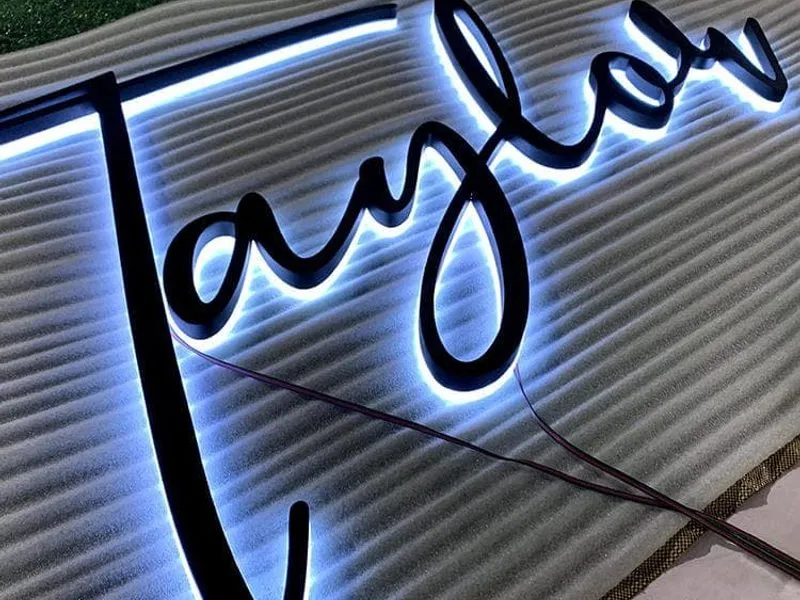
For a premium architectural look, go with halo-lit letters. Back-lit halo letters give you that soft glow on the wall at night—the kind that makes a car wash look like a bank instead of a concrete box. The tradeoff is cost. Stainless trim with acrylic front and back lit letters runs $1.0 to $1.3 per centimeter, and electroplated versions run $1.2 to $1.5. Worth it if you're targeting high-end detail customers, less so if you're the only wash in a 10-mile radius.
Rookie mistake: using domestic acrylic to save a buck. Standard domestic acrylic yellows in 1 to 2 years outdoors. UV-resistant acrylic from Mitsubishi or Degussa lasts 5 to 8 years. The cost difference is real, but replacing yellowed faces on a 30-foot sign costs more than the acrylic ever did.
Use 2mm or 3mm acrylic. A 3mm face cuts 92% light output, and a 2mm face cuts 90%. Your customer won't notice the 2% difference, but they will notice the 40% cost bump if you order thicker than you need.
Some municipalities won't let you put a pylon sign within 50 feet of the road. Others cap sign height at 6 feet. Then you go monument. A monument sign sits low and wide, and the permit is usually easier because no tall steel pole to fight over. But don't mistake low-profile for cheap. A solid monument sign still needs a concrete footing, a heavy-gauge aluminum or steel cabinet, and proper drainage.
For monument signs, use aluminum or 304 stainless. Aluminum is light and rust-proof. Stainless is dense—7.93 grams per cubic centimeter—and gives you that premium brushed or mirror finish. Standard stainless thickness is 1.2 to 1.5mm. If the monument is near the wash exit where it gets constant chemical spray, 304 stainless is the floor. If you're on the coast, step up to 316 stainless for the marine-grade molybdenum content and a 15+ year lifespan. It costs 20 to 30 percent more, but it's cheaper than replacing the sign twice.
Look, a pylon sign gets cars onto the lot. But if the menu board is a muddy mess, cars stack into the road and you lose revenue. Every car wash needs a clear wayfinding and directional system from the road to the pay station to the wash tunnel. Not optional. That's the difference between a line that moves and a line that blocks the street.
Menu boards need to be readable at a glance. A double-sided lightbox works well for a car wash menu because it's visible from both directions as cars queue. At factory pricing, a 40cm double-sided lightbox costs $50 and a 120cm unit costs $200. Add stainless steel menu board letters or digital pricing displays, and you've got a system that converts visibility into throughput.
Here's what nobody tells you: most car wash bottlenecks aren't the wash tunnel. They're the pay station. If the menu board is sun-faded, bird-stained, or half-lit, drivers hesitate. Hesitation kills throughput. Spend the money on a clean, readable menu board and the whole line moves faster.
The best sign for a car wash isn't the prettiest one. You want the one that survives wet, chemical-heavy conditions, gets approved by the local permit office, and pays for itself in added cars per day. Here's our factory pricing, straight up: a front-lit channel letter starts at $0.7 per centimeter, a stainless steel backlit letter runs $1.0 to $1.5 per centimeter, and a double-sided lightbox runs $50 to $200 depending on diameter. MOQ is one piece. Sample lead time is about 5 days; bulk production is about 15 days, confirmed case by case.
When you're budgeting, don't forget the compliance costs. UL 48 certification runs $4,000 to $15,000 and takes 4 to 9 months with quarterly audits. CE marking is cheaper—20,000 to 50,000 RMB—but it's also the most lied-about cert in this industry. Ask for the certificate. They hesitate? Walk away.
Shipping is another hidden cost. Express runs 7 to 10 days, air about 10 days, fast sea 40 to 50 days, and standard sea about 65 days. Freight cost gets quoted per destination and volume, so don't trust anyone who gives you a freight price without knowing your port. LCL sea freight means your crate gets handled 6 to 8 times between our dock and yours. Every touch is a chance for damage. Pack it right or eat the claim.
Most car wash owners replace cheap signs within three years. They save $1,000 on the front end and spend $4,000 on a crane and a new face before the loan is paid off.
Buy 304 stainless or aluminum, use real LED modules from Bluesky or Rishang, and get a pylon with a message center if the road speed justifies it. If the city says no pylon, get a monument. If you've got a storefront, add front-lit or halo-lit channel letters. And for the love of god, get the menu board right.
That's how you build a car wash sign system that actually makes money.
"Can't I just use a vinyl banner?" No. Not if you want the sign to survive more than one season, and not if you want the city to approve it. Car wash chemicals and wind will shred a banner in months. Build a real sign.
"Why is the installed price so much higher than the factory price?" Because the factory price is the cabinet, the letters, and the LED modules. The installed price adds wind-load engineering, concrete, steel pole, permits, crane, and an electrician. If you thought a $200 lightbox was going to self-install, you haven't done this before.
"How long will the LED last?" Real modules from Bluesky or Rishang have an L70 of 50,000 hours and a real-world lifespan of 5+ years. Cheap modules last 12 to 18 months. You get what you pay for.
"Do I need UL listing?" In the US, yes. NEC Article 600 governs electric signs. If your sign doesn't have a UL 48 or ETL listing, the inspector won't pass it. Don't argue with me—argue with the codebook.
Products mentioned or relevant to this topic — factory-direct, custom built.
From $16/letter · MOQ 1 piece · 7–15 day production · CE & UL certified · ships to 20+ countries
Custom sizes, colors, and finishes. Get a factory price in 24 hours.
Get a Free QuoteWhatsApp +86 13865703472 · cairuisheng@aochuangsign.cn