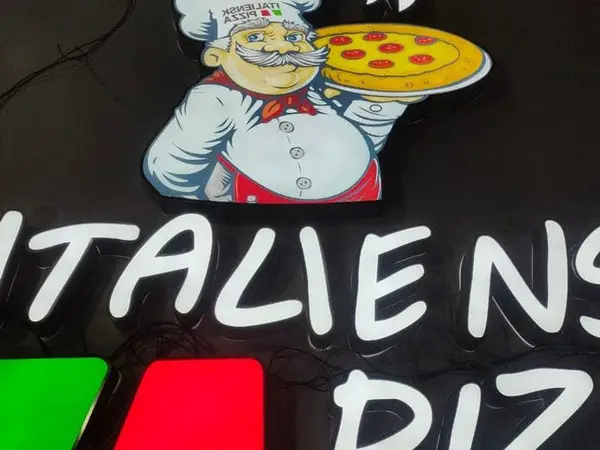
The best sign for a chiropractor is front-lit LED channel letters—not a cabinet, not a banner, not a monument sign. Budget $1.05–$1.35 per centimeter of letter height for stainless steel trim with an acrylic face. A 40cm-tall wordmark with 10 letters runs $42–$54 per letter before installation, so the whole sign face lands around $420–$540. That's the part patients actually read, and it's the best marketing money you'll spend this year.
I've watched strip mall chiropractors dump $800 a month into Google ads and still wonder why new patients don't know they exist. Skip it.
Look, a chiropractor doesn't get walk-in impulse traffic like a coffee shop. Patients pick you because you're close, because someone referred them, or because they drove past your sign six times before their neck locked up. That last one? You control it for less than a dollar a day.
A set of front-lit channel letters with proper LED modules has an L70 lifespan of at least 50,000 hours. That's over 11 years at 12 hours a night. Spread a $3,000 sign over 4,000 nights and you're paying $0.75 a night to be the only lit sign in a dark medical plaza. Try getting a Facebook ad to do that.
Banners fade in 18 months. Cheap cabinets with off-brand LEDs start losing diodes in 12–18 months. Neither builds the trust a chiropractor sells. Nobody trusts a flickering sign.
Chiropractic isn't an emergency-purchase decision. People drive by your sign for weeks, months, even years before they walk in. You need a sign that looks the same on day 2,900 as it did on day one. 304 stainless steel letters with a 5mm UV-resistant acrylic face will do exactly that. I've watched them sit on Florida storefronts for a decade with nothing but a pressure wash.
A monument sign says “institution.” A cabinet sign says “1978 dental office.” An A-frame says “we're not allowed to put anything permanent up.” Digital displays say “I had money left over and bought a TV.”
For a chiropractor, the sign has to do three jobs: get noticed from a moving car, read as professional and clinical, and survive 10+ years outdoors without looking worse than your competition's. Front-lit channel letters win on all three. They're dimensional, they light up, and they don't trap water like a cabinet box.
The ugly truth is most cabinet signs I've pulled off old medical plazas were full of water, dead transformers, and enough insect nests to start a biology study. Channel letters have individual returns and faces. If an LED module fails, you replace one module, not the whole face. That's why I tell every chiropractor to skip the cabinet and go with front-lit letters.
Monument signs work if you're a standalone clinic on a highway with a 45mph speed limit and a 60-foot setback. But they're pricey, require concrete footings, and don't do much for a patient who's already in the parking lot. For a storefront, monument signs are a waste. For a destination clinic, pair a small monument with building-mounted channel letters.
A-frame signs are fine for sidewalk-level promotions—new patient specials, walk-in hours. But they get stolen, blown over, and make you look temporary. I've had chiropractors love them for the first month, then leave them outside until the plastic yellows and the hinges rust. If you use one, bring it inside every night.
Digital displays? My problem is a chiropractor's message doesn't change hourly like a restaurant's special. You're not selling $5 footlongs. You sell trust, pain relief, and consistency. A static, well-lit sign does that better than an animated screen that screams “urgent care clinic.”
Strip mall. You've got a landlord, a sign band, and usually a sign code that says direct-mount or raceway only. The answer is almost always front-lit channel letters with an acrylic face, mounted on a painted aluminum raceway that matches the building trim. You want 4000K neutral white LEDs—stainless steel trim, no exposed fasteners. If the sign band is shallow, go with a raceway and wire through the back.
Standalone clinic. You're allowed a monument sign and building-mounted letters. Do both. The monument gets your name at the road; the building letters confirm it as they pull up. I've seen this go wrong: a chiropractor orders a 6-foot-tall monument with 20 words on it. By the time patients can read the list of services, they've driven past. Keep the monument to your clinic name and “CHIROPRACTIC.” That's it.
Downtown office. This is where rimless channel letters shine—clean, modern, no visible trim. They look like the logo was cut straight out of the sign. You'll probably have strict sign codes, maybe a design review board. Go with backlit halo letters if the building has an architectural look. They read premium, and they don't scream like a bright storefront sign.
I've watched sign shops in medical office parks install whatever they want and then get fined when the property manager sees it. Don't be that guy. Call the city planning department before you buy anything.
Most chiropractic sign buyers spend two weeks choosing fonts and colors, and zero minutes checking the municipal sign code overlay. Then they order a beautiful 8-foot channel letter set and discover the medical office park has a 12-square-foot maximum sign area. Now they need a variance, which takes 6 to 12 weeks and costs more than the sign. They don't.
Before you design anything, pull the landlord's sign criteria and the city's sign table. Look for maximum area, projection limit, illumination restrictions, and whether channel letters need to be flush-mounted or raceway-mounted. I've seen sign codes that allow only backlit halo letters on second-floor suites, and front-lit letters only on ground-floor retail. Ignore that and you're re-ordering in eight weeks.
Colors: warm white 3000–3500K says boutique hospitality. Cool white 6000–6500K says industrial highway. For chiropractic, you want 4000–5000K neutral white—clinical, clean, and bright without being blue. Blue faces might look cool in a render, but they read as “nightclub” at 9 p.m. and make older patients squint.
Fonts matter. Skip the script fonts. Chiropractic is about alignment, structure, and relief—a clean sans-serif in all caps with proper letter spacing works. Avoid thin strokes that disappear when backlit. Use a 5mm acrylic face; a 3mm face cuts 92% of light output, a 2mm cuts 90%, but the 3mm face costs 40% more. Your patients won't see that 2% difference, but you'll feel the cost bump.
Certifications: CE marking costs 20,000–50,000 RMB for a factory. Most factories will say they have it. Ask to see the certificate with today's date. Watch them sweat. UL 48 costs $4,000–15,000 and takes 4–9 months with quarterly audits. If a supplier claims they're “UL certified equivalent” on a $2,000 order, they're lying. For outdoor signs, demand IP65 minimum—that's dust-tight and protected from water jets. IP65 does not mean your sign survives a Florida hurricane. That means it handles rain from a hose.
Front-lit channel letters are the workhorse. SMD 2835 LEDs at 100–150 lumens per watt, driven properly, will run 50,000+ hours to L70. That's over a decade of nights. Our factory uses Bluesky or Rishang modules—real 5+ year lifespan on the street. Cheap no-name modules with dull gray solder joints won't last 18 months. The solder alone tells you everything you need to know.
Back-lit halo letters are the premium architectural look. They cast light onto the wall behind the letter, so the sign looks like it floats. They work best on stone, brick, or dark facades. Cost is $1.50–$1.95 per centimeter for stainless trim with front and back lit acrylic, up to $2.25 per centimeter for electroplated. Halo-lit doesn't punch through bright daylight as hard as front-lit, but at night it's the classiest sign on the block.
Backlit cabinets—the big plastic boxes—are for supermarkets and laundromats. They're cheaper up front, but the face yellows in 3–5 years, the LEDs fail in clusters, and the whole thing looks dated. I've rebuilt enough cabinets with water pooled inside to tell any chiropractor: don't.
Digital displays are for urgent care and pizza joints. A chiropractor's message—your name, your hours, your phone number—doesn't need to change every 30 seconds. Unless you're running rotating patient testimonials and doing it well, a static lit sign builds more trust. And digital panels have a 5–7 year lifespan before the brightness drops enough that you're replacing modules at $300–$500 a pop.
Real costs, from our factory floor. Per centimeter of letter height, stainless steel baked-paint channel letters run $0.90–$1.05. Electroplated runs $1.05–$1.20. Antique stainless runs $1.05–$1.20. Front-lit stainless trim with acrylic face runs $1.05–$1.35, and electroplated front-lit runs $1.50–$1.80. Backlit halo runs $1.50–$1.95 baked-paint and $1.80–$2.25 electroplated. A 40cm wordmark at 10 letters in front-lit baked-paint costs $420–$540 for the faces. Add a power supply, mounting pattern, and installation, and you're still under $2,000 for a sign that lasts 10 years.
Maintenance is simple if you build it right. Our default is a 2-year warranty on LEDs and 1-year on the power supply. Real-life lifespan on Bluesky and Rishang modules is 5+ years, then you replace individual modules, not the whole sign. A failed power supply is a $50 part and 20 minutes of labor. A face that's UV-resistant from Mitsubishi or Degussa acrylic lasts 5–8 years before it looks hazy. Domestic acrylic yellows in 1–2 years. Ask your supplier which acrylic they're using. If they can't answer, that's your red flag.
ROI math: a $2,000 sign over 10 years is $200 a year. If that sign brings in three new patients a year—just three—you've covered it. One patient with a treatment plan pays for the whole thing. The sign is the only marketing you own that keeps working while you sleep.
Shipping matters too. We ship express in 7–10 days, air in around 10 days, fast sea in 40–50 days, standard sea around 65 days. Freight cost is quoted per destination and volume—never let a supplier guess it over the phone. LCL sea freight gets handled 6–8 times between our dock and yours. Every touch is a chance for damage. That's not in the brochure.
I've seen this go wrong more times than I can count. A chiropractor orders the biggest cabinet the landlord will allow, lights it with cheap modules, and calls it done. Two years later the face is yellow, the left side is dead, and the city sent a code violation because it's flickering. That's not a sign. That's a liability.
The biggest mistake isn't picking the wrong LED color. Not checking the sign code before falling in love with a design? That's the one. Second biggest mistake: buying from a local fabricator who charges $800 for a front-lit letter that we ship for $120. Same 304 stainless, same LEDs, same 5mm acrylic. They're just paying for a showroom and a sales rep with a golf habit.
Third mistake: assuming a backlit cabinet is “classic” and safe. Cabinets trap water, insects, and heat. I've watched sign shops push them because they're easier to install. Rookie move. If a supplier suggests a cabinet for a chiropractor, ask them why they hate LED modules.
How to choose a sign partner: ask for photos of installed signs from three years ago. Not renders—actual photos of signs that have been in the field for three winters. Ask which LED modules they use. Ask to see their CE certificate with today's date. Ask for the acrylic brand. If they hesitate, walk away.
Now, the FAQ section, because I still get these questions after 14 years on the factory floor:
Should I get a lit sign or a non-lit sign for my chiropractor office?
Lit. Always lit. You close at 6 p.m., but your best marketing happens at 9 p.m. when someone drives by with a stiff neck and a smartphone. Non-lit signs disappear after dark. If your sign code allows illumination, use it.
What color temperature is best for a chiropractor sign?
4000–5000K neutral white. Not warm 3000K—that's for restaurants. Not cool 6500K—that looks like a car dealership. Neutral white says clean, clinical, and trustworthy. I've argued with designers about this for years. Neutral white wins.
Can I just use a printed banner while I save up for a real sign?
Yes, and for maybe six weeks it might work. Then the wind tears it, the sun bleaches it, and your clinic looks like a temporary tax office. Banners are a band-aid. If money is tight, start with front-lit channel letters at a smaller size—MOQ is 1 piece from us—and grow from there. Don't buy two banners and call it branding.
How long does it actually take to get a chiropractor sign made?
A sample takes around 5 days. Bulk production runs around 15 days, but it depends on quantity, size, and complexity. If you're in a rush, express shipping is 7–10 days. Sea freight is 40–65 days. Plan ahead or pay for air.
Bottom line: the best sign for a chiropractor is the one that's still there, fully lit, looking the same in 2035 as it did on install day. Front-lit channel letters with 304 stainless trim, a 5mm UV-resistant acrylic face, and real LED modules do that. Everything else is a gamble.
Products mentioned or relevant to this topic — factory-direct, custom built.
From $24/letter · MOQ 1 piece · Flexible lead time · CE & UL certified · ships to 20+ countries
Custom sizes, colors, and finishes. Get a factory price in 24 hours.
Get a Free QuoteWhatsApp +86 13865703472 · cairuisheng@aochuangsign.cn