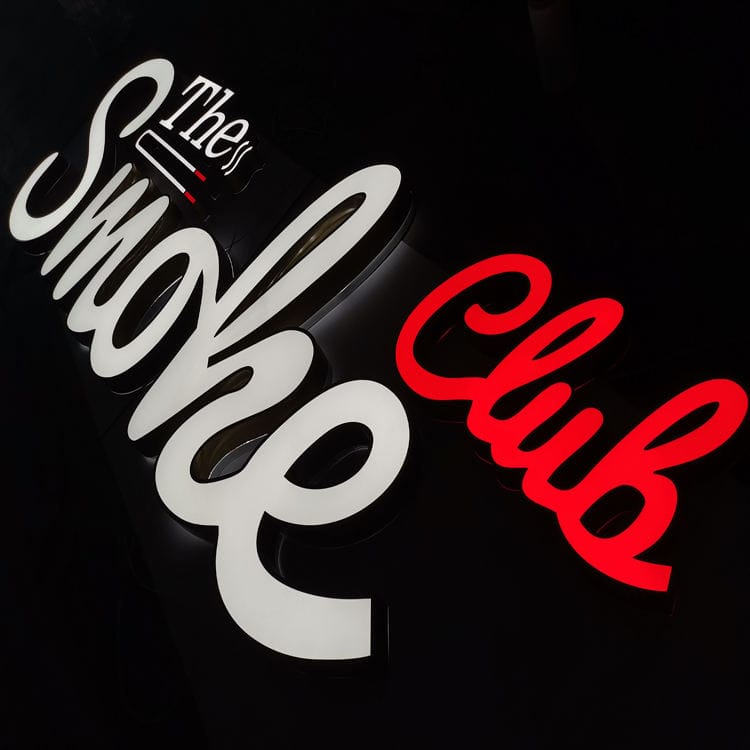
Backlit halo letters in 304 stainless run $1.0–$1.2 per centimeter of letter height. So a 40cm “SPA” sign face costs under $500 factory direct. That’s the best sign for most spas I’ve ever built.
Now, if you want cheap that’ll look like a strip mall nail salon in two years, go buy a 201 stainless front-lit box. I won’t stop you. But you sell calm, cleanliness, and luxury. The sign is the first impression. A spa that can’t be read from 50 feet at night doesn’t exist. You’re invisible to the woman driving home after work, already stressed and looking for a reason to pull over.
Since 2010, I’ve built signs for dozens of spas. The ones that call me back for a second location all use the same thing: halo-lit stainless letters, neutral white 4000K LED, and a 5mm acrylic face with 90-92% light transmittance. That’s not a coincidence.
Look, most spa owners treat signage like an afterthought to the interior design. That’s a rookie mistake. You spend $8,000 on a Himalayan salt wall and then put a $200 acrylic panel by the door? The client hasn’t even walked in yet. Your sign is the only piece of your brand that a passing car sees at 35 mph.
Here’s the ugly truth: a spa without a legible, illuminated sign loses walk-in traffic to the massage chain next door with the bright white channel letters. I’ve stood outside our own factory at night comparing signs. A 5mm acrylic face with 90-92% light transmittance makes your logo legible from 50 feet. A cheap 2mm domestic acrylic face? It looks like a smeared glow stick by month 18.
The real ROI isn’t some made-up foot traffic number. Ask yourself whether a woman on a Tuesday evening sees “SPA” or sees nothing. I’ve never had a client complain their sign was too visible.
Here’s what nobody tells you: for a standard storefront spa, front-lit channel letters are the workhorse. They run $0.7–$0.9 per centimeter from a factory like mine. A 30cm face costs around $24-27. That’s real money, but it’s the difference between “open” and “abandoned.”
Monument signs are for resort spas with a driveway and a gate. They cost more to engineer and permit, but they anchor a property. Blade signs mounted perpendicular to the building catch foot traffic on a sidewalk. Window graphics are only good if you have zero budget and you’re okay looking like a pop-up. Wayfinding signs? Those are for the inside hallways after you’ve already got them in the door. I don’t build a spa’s wayfinding until the exterior sign is locked in.
I watched a day spa in a strip mall order a $600 blade sign and skip the channel letters entirely. Their front door was 15 feet back from the parking lot. You couldn’t see the blade until you were already parked. Three months later they called me for front-lit letters. Paid twice.
If you’re in a strip mall or a single-story retail front, front-lit channel letters are the default. If you’re a med spa with architectural ambitions, backlit halo letters signal high-end without screaming.
304 stainless steel is the floor for any outdoor spa sign. That’s 18% chromium and 8% nickel. It won’t rust for 10+ years in normal weather. Brushed #4 finish hides fingerprints and reads calm. Mirror #8 is for a more glamorous, high-contrast look. Don’t use 201 stainless outdoors unless you want orange streaks after 2 years. I’ve scraped that off letters and it’s not pretty.
316 stainless has 2-3% molybdenum. That’s the marine grade. For a spa 200 feet from salt water, you pay 20-30% more and you forget about it. For a spa in Scottsdale, 304 is fine. Ugly truth: some importers quote you 304 and ship 201. You can’t tell until it rusts. Ask for a material cert or buy from a factory that stamps the alloy on the back.
Acrylic is the face material. UV-resistant acrylic from Mitsubishi or Degussa lasts 5-8 years before yellowing. Domestic acrylic? 1-2 years, sometimes less if it’s near a window with afternoon sun. I’ve replaced dozens of faces that looked like nicotine-stained teeth. Standard thickness for us is 5mm. A thin 2mm face kills 90% of light output. 3mm kills 92%. Your customer won’t notice the 2% but they will notice the 40% cost bump on the upgrade. Stick with 5mm.
Aluminum is an option for indoor or backer panels. It weighs one third of steel and doesn’t rust. But for a spa’s primary exterior lettering, the weight and solidity of stainless reads more permanent. You want permanent when you’re charging $150 for a facial.
For a spa, don’t save pennies on the LED module. Cheap modules fail in 12-18 months. I’ve opened letters where half the modules were dead and the rest flickered blue because the solder joints were dull gray. Proper lead-free solder is shiny silver. That’s the quickest quality check you’ll ever do.
Use SMD 2835 modules at 100-150 lumens per watt. L70 lifespan is 50,000 hours minimum. Our factory installs Bluesky or Rishang modules. Those last 5+ years real-world. Color temperature matters more than brightness. For a spa, 4000-5000K neutral white reads clean and clinical without feeling like a hospital. Warm 3000K is better for a cozy boutique. Cool 6000K is for gas stations and highway signs. Don’t put 6000K on a spa unless you want clients to think you do oil changes.
Backlit halo lighting is the premium look. It throws a soft glow onto the wall behind the letters. In low light, that halo draws the eye without glaring. RGB is an option but I’ve only sold color-changing backlit letters to a couple of Vegas day spas. For most real businesses, single-color neutral white is less gimmick, more revenue. Neon flex is fine for an interior accent wall. Not for an exterior primary sign. It fades and gets brittle in UV faster than acrylic.
Here’s what nobody tells you: the sign code will eat your budget before the sign does. In the US, any electric sign falls under NEC Article 600. You need a UL 48 listing for the electrical assembly, which costs $4,000-15,000 and takes 4-9 months. If your sign supplier can’t show you a current UL certificate, your local inspector can reject the sign on sight. I’ve watched that happen. That gets expensive and embarrassing.
CE marking is the European equivalent, but it’s cheaper and faster: 20,000-50,000 RMB and 2-8 weeks. Ugly truth: most factories claim they have CE. Ask to see the certificate with today’s date on it. Watch them sweat. If they hesitate, walk.
For outdoor spa signs, IP65 is the minimum. Dust-tight and protected against water jets. That doesn’t mean your sign survives a Florida hurricane. IP66 is for coastal spray. IP68 is submersible, which you don’t need unless the spa has a waterfall directly on the letters. If you’re mounting near a steam room exhaust or a pool, bump to IP66.
ADA applies if you have tactile letters or a second sign at the entrance. Mounting height is 48-60 inches to the tactile text. Non-glare finish, Grade 2 Braille. Most spa exterior channel letters don’t need Braille, but if the inspector asks for an accessible entrance sign, don’t argue. That’s a $150 add-on, not a hill to die on.
I’ve seen this go wrong: a local sign shop charges $800 for a single front-lit letter. Same 304 stainless, same Samsung LEDs. I ship that letter factory direct for $120. That’s not a typo. The middleman markup on custom signs is insane because the local shop has rent, a salesperson, and a designer who’s never touched a TIG welder.
Our MOQ is one piece. Yes, one. We don’t care if you’re a one-spa owner or an importer stocking 50 locations. Pricing per centimeter of letter height: front-lit channel letters run $0.7–$0.9. Backlit halo electroplated runs $1.0–$1.2. A full set of 40cm letters could be under $1,500 including shipping to a US port. The same from a domestic fabricator? Triple it.
Lead time is 5 days for a sample. Bulk production around 15 days, confirmed after we see your quantity and size. Shipping is where people get burned. Express is 7-10 days. Fast sea is 40-50 days. Standard sea is about 65 days. LCL sea freight means dockworkers handle your crate 6-8 times between our dock and yours. Every touch is a chance for damage. That’s not in the brochure. Pay for the plywood crate and foam wrap. That’s cheap insurance compared to re-bending a stainless letter.
The brutal truth: if you’re ordering a spa sign in June and expect it installed by July, you should have ordered in April. I’m not Amazon. We cut, weld, polish, assemble, and test each order. Rushing leads to bad silicone seals and cracked acrylic. I’d rather you be upset about a longer lead time than upset about a failed sign.
Look, I’m not a graphic designer, but after 14 years of cutting letters I can tell you what works and what makes me cringe. Thin script fonts on a backlit halo? They disappear. Use a font with at least 2cm stroke width at 30cm height. That’s not an opinion; that’s what keeps the LED modules from showing through as hot spots.
Color contrast is simple. Dark bronze or brushed stainless face with white halo light reads calm. Bright gold mirror with warm white reads “I charge extra for everything.” If you want luxury without looking like a jewelry store, go brushed #4 stainless with a 4000K halo. Stay away from red and green. They fight the spa message and they’re impossible to read at dusk.
Here’s the one thing nobody tells you: your spa sign doesn’t need to match your logo exactly. It needs to be legible from the street. A logo with a lotus flower and a silhouette is fine for the website. On a sign 20 feet up, that’s visual noise. Keep it to the spa name and maybe a short descriptor like “MED SPA” or “DAY SPA.”
And don’t mount the sign too high. 48-60 inches from the ground to the bottom of the letters is the ADA tactile range, but for visual signage above the door, you want the center of the letters around eye level for someone standing 10 feet away. That’s usually 5-6 feet off the ground. Higher doesn’t mean classier. It means people crane their necks and give up.
Can I use a cheap acrylic sign indoors to save money?Look, indoor spas have humidity and essential oils in the air. Cheap domestic acrylic yellows and warps in 12-18 months. Pay for UV-resistant acrylic or you'll replace it before the lease is up.
Do I really need UL listing for a spa sign in the US?Yes. If the inspector asks and you don't have it, the sign comes down. UL 48 listing costs $4,000-15,000 and takes 4-9 months. That's not something you fake. Demand a copy of the certificate with today's date.
How long does production and shipping actually take?Sample: 5 days. Bulk: about 15 days. Sea freight to the US: 40-65 days. Express: 7-10 days. If you need it for a grand opening, plan backwards from the opening date. I've never once had a sign arrive early.
What's the cheapest spa sign that doesn't look like a corner store?Front-lit channel letters with baked-paint stainless at $0.7–$0.9/cm. A 30cm face is under $30. Not cheap, but it reads professional. The cheap look comes from using domestic acrylic and cool white 6000K LEDs. Don't do that.
Products mentioned or relevant to this topic — factory-direct, custom built.
From $16/letter · MOQ 1 piece · 7–15 day production · CE & UL certified · ships to 20+ countries
Custom sizes, colors, and finishes. Get a factory price in 24 hours.
Get a Free QuoteWhatsApp +86 13865703472 · cairuisheng@aochuangsign.cn