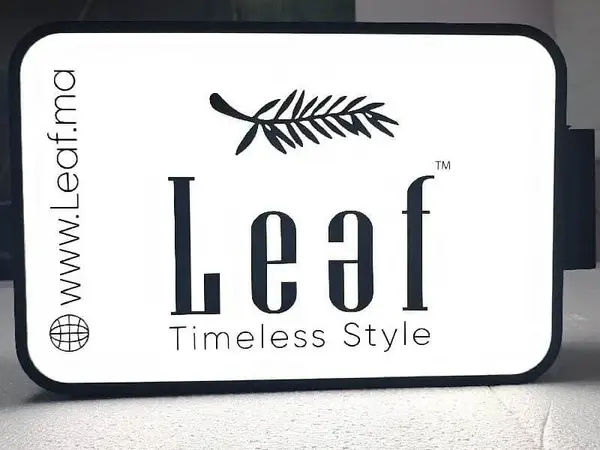
Your best bet for a bubble tea shop is custom front-lit channel letters with a stainless trim and acrylic face. They run $1.05–$1.35 per centimeter of letter height. A typical 30cm-tall, eight-letter storefront sign? That's about $250–$325 for the letters themselves, before install and freight.
I've built enough of these to skip the fluff. Front-lit channel letters are the workhorse because they're three-dimensional, visible from down the block, and they survive the humidity that bubble tea shops pump out all day. Real talk.
Look, a bubble tea shop isn't a museum. Nobody plans a pilgrimage to your storefront unless you've already got TikTok fame, and even then, people still need to find the door from the sidewalk. Your sign is your first employee working the street.
I've watched sign shops shell out $800 for a front-lit letter from a domestic fabricator. Same 304 stainless, same LED modules. We ship that letter for $120. That margin eats your profit before you pour the first tea.
Here's the deal: a $300 storefront sign that's legible from 50 feet will outsell a $3,000 art piece that only reads from 10 feet. Bubble tea buyers decide in seconds. If they can't read "BUBBLE TEA" while walking past, they won't stop.
Flat acrylic panels and lightboxes look cheap, and cheap reads as "low-quality tea." Neon flex has a fun retro vibe, but it gets finicky in high-traffic storefronts. Digital displays? You're buying a maintenance contract, not a sign.
Channel letters win because the letters themselves are the lightbox. Each letter is a sealed unit with its own LED modules, so one dead module won't black out the whole sign. At Aochuang, we run SMD 2835 LEDs at 100–150 lumens per watt. That's the industry standard, not some overpriced gimmick.
Here's the spec that matters for a bubble tea shop: acrylic faces transmit 90–92% of light. You want that face on a trim cap, because a flat acrylic panel lightbox cuts too much shine and fogs up from internal condensation faster than a teenager's phone screen.
Here's the thing nobody says: bubble tea shops are humid as a swamp. Boiling tapioca, steam tables, ice shavers, fridges running full blast—all that moisture hits your sign every single shift. Skimp on materials, and the sign will yellow, rust, or trap water.
Use 304 stainless for most locations. That steel runs 18% chromium and 8% nickel, and it'll give you 10+ years outdoors. 304 stainless steel letters resist the daily steam that turns cheap powder-coated steel into flaky junk. If you're within a few miles of the coast, step up to 316 stainless—it carries 2–3% molybdenum and adds 20–30% to cost, but you get 15+ years of marine-grade life.
For the faces, buy UV-resistant acrylic from Mitsubishi or Degussa. That stuff stays clear for 5–8 years. Domestic acrylic goes yellow in 1–2 years, and your bubble tea sign will look like it's been vaping for a decade. A standard 5mm face is plenty.
For LEDs, don't chase the brightest chip. SMD 2835 at 100–150 lm/W is the standard. Cheap modules die in 12–18 months. At Aochuang, we run Bluesky and Rishang modules rated L70 ≥50,000 hours and real-world 5+ years. If you're inspecting a supplier, look at the solder joints—dull gray means bad lead-free solder and a module that won't last 18 months. You want shiny silver.
Weatherproofing: IP65 is the minimum outdoor rating. That rating is dust-tight and handles water jets from any direction. It won't make the sign survive a Florida hurricane. For coastal or storm-prone areas, IP66 buys you stronger jets, but it still won't float.
I've seen this go wrong: a shop owner falls in love with a skinny script font and pastel pink on a white background. Then they wonder why nobody stops. If people can't read your sign from across the parking lot, you don't have a sign.
Use bold sans-serif letterforms. Bubble tea is a young, quick-service product, so your sign should look like it's moving fast. Keep the main lettering white—warm 3000–3500K if you want cozy hospitality, 4000–5000K if you're after clean, modern retail. A bubble tea shop leans fun but legible, so 4000K neutral usually hits the sweet spot.
Contrast is non-negotiable. White acrylic faces on a stainless trim pop hard against any storefront. If you're using acrylic LED letters for accent colors, keep the main text high contrast and save the color-changing stuff for accents or sidewalk signs.
The ugly truth? Your landlord's sign band will dictate more than your brand guide ever will. Before you order, get the sign band specs in writing. Then get the electrical permit requirements. If the landlord shrugs, they haven't read their own lease.
For the US market, you'll deal with UL 48 certification. That'll run you $4,000–$15,000 and takes 4–9 months, with quarterly audits. ETL is a legitimate alternative and runs 10–30% cheaper. Don't let anyone tell you "it's the same as UL"—it's an alternative listing, not a carbon copy.
Here's the lie I hear every week: "We have CE certification." CE marking costs 20,000–50,000 RMB and takes 2–8 weeks. Plenty of factories will say they have it. Ask to see the certificate with today's date. Watch them sweat. For any outdoor sign, IP65 is the floor, not the ceiling. NEC Article 600 covers electrical signs in the US—make sure your installer isn't winging it.
Let's talk real numbers. Front-lit stainless-trim acrylic channel letters run $1.05–$1.35 per centimeter of letter height. That's your storefront anchor. If you want the backlit halo look, budget $1.50–$1.80 per centimeter for electroplated stainless. The front-lit version gives you better ROI for a bubble tea shop because it's readable day and night without needing a separate light source.
For the sidewalk, a double-sided lightbox pulls impulse foot traffic. A 60cm diameter double-sided lightbox costs $105. That's stupid cheap for the number of eyes it catches from the sidewalk. Add a floor neon sign if you've got space—single-color floor neon letters start at $105 for a 3ft set.
Here's the part most sign shops won't tell you: that $800 domestic channel letter I mentioned earlier is one letter. Our factory-direct pricing puts the same 304 stainless with quality LEDs at $120. You don't need to charge your customer less—you can keep the difference. That's how sign shops become profitable instead of just busy.
Look, I've been on the factory floor since 2010. You can't rush a quality build, but you can cut out the middlemen who tack on 40% and a week of "coordinating." At Aochuang, we run a 3,000m² production facility with 50+ skilled workers, and we ship worldwide straight to your dock or installer.
Our process has 10 steps: design confirmation, laser cutting at ±0.1mm, TIG welding, grinding and polishing, CNC acrylic faces, LED assembly, neutral silicone sealing, an 8–12 hour aging test, 100% QC inspection, and export packaging with foam, carton, and plywood crate. Sample lead time runs about 5 days. Bulk production runs around 15 days, confirmed case by case because quantity, size, and complexity all move it.
Minimum order is 1 piece. You read that right—we'll make one letter if that's all you need. Freight times vary: express 7–10 days, air about 10 days, fast sea 40–50 days, standard sea about 65 days. LCL sea freight means your crate gets handled 6–8 times between our dock and yours. Every touch is a chance for damage. That's not in the brochure.
If you're specifying a bubble tea shop package, order the front-lit channel letters as the anchor, add one double-sided sidewalk lightbox, and skip the digital screen. Use the savings to buy better acrylic and 304 stainless. The tea will sell itself if people can find the damn door.
"Can't I just use a vinyl banner?" No. You're opening a storefront, not a car wash. A vinyl banner tells people you're temporary. Bubble tea shops live on repeat customers and Instagram check-ins. Put up a real sign.
"Is neon better than LED?" No. LED neon flex gives you the look without glass tubes that break and transformers that hum. If you want the retro vibe, buy LED neon flex—it's energy efficient and actually survives a door slam.
"Do I need IP65 if my sign is under an awning?" Yes. Steam from your own shop will get inside the sign anyway. I've replaced too many "indoor only" signs that died from bubble tea humidity. IP65 is the minimum, not a luxury.
"Why is your quote cheaper than my local sign shop?" Because we're the factory. We don't outsource to a middleman who outsources to another middleman. You're paying for steel, acrylic, and LEDs—not someone's storefront rent on a strip mall.
Products mentioned or relevant to this topic — factory-direct, custom built.
From $24/letter · MOQ 1 piece · Flexible lead time · CE & UL certified · ships to 20+ countries
Custom sizes, colors, and finishes. Get a factory price in 24 hours.
Get a Free QuoteWhatsApp +86 13865703472 · cairuisheng@aochuangsign.cn