I spent fourteen hours today cutting 3mm acrylic for a hotel lobby sign. You want to know why most acrylic letters fail? Not the acrylic.
Look, acrylic is just thermoplastic. What separates a five-year sign from an eighteen-month replacement job is the grade of sheet your factory runs and the LED modules they solder inside it. We stock Mitsubishi and Degussa UV-resistant acrylic in 2mm, 3mm, and 5mm. That imported sheet holds 90-92% light transmittance and won't yellow for 5-8 years outdoors. Domestic acrylic? Cheaper by weight, but it starts yellowing in 1-2 years. I've seen a strip mall in Phoenix where every letter looked like a smoker's teeth because the contractor saved $3 a letter on domestic sheet.
You've got flat-cut acrylic letters, front-lit channel letters with an acrylic face, back-lit halo letters where light spills soft onto the wall, and edge-lit acrylic that glows from the sides. If you're quoting a storefront, know the difference before your customer asks.
Material grade drives everything outdoor. UV-resistant Mitsubishi or Degussa sheet lasts 5-8 years. Domestic acrylic yellowing starts at 12-24 months. The price difference per letter might be a couple bucks. The reinstallation cost? Huge.
Flat cut acrylic letters are the cheapest and cleanest for interior lobby walls. They're just 3mm or 5mm sheet routed to shape, painted or clear. No LEDs, no face, no halo. If the client wants dimensional but budget is tight, that's where you start.
Here's what nobody tells you: thickness isn't about toughness, it's about light output and sag. A 2mm face cuts 90% light output. A 3mm face cuts 92%. Your customer won't notice that 2%, but they'll definitely notice the 40% cost bump when you step up to 5mm for no reason.
Over 2.5 meters in height, you run 5mm minimum or the face bows like a screen door. Most standard channel letters run 2mm or 3mm acrylic faces. If a fabricator quotes you 5mm for a 12-inch letter, they're padding the material charge.
I've seen sign shops quote 2mm for a 4-meter building sign because it was cheaper. The face bowed within six months. Then they paid me to cut 5mm replacements and do the job twice. That's a rookie mistake that costs you more than the material ever did.
Readability isn't a factory spec. Sight lines rule here. If your client puts a 6-inch acrylic letter above a storefront and expects it readable from the parking lot, they're wrong.
We run both CNC and laser. Laser cutting holds ±0.1mm and takes 1-2 days for most letter sets. CNC routing the acrylic face takes another day. For tight production, that's the difference between hitting a 7-day lead time and blowing it.
CNC routing leaves a matte edge and works better on 5mm sheet. Laser gives you a polished edge but can micro-crack if the operator rushes the power settings. I've seen this go wrong: a shop laser cut 5mm cast acrylic with too much heat and every edge cracked on the first cold night.
Laser is faster, but CNC is the only sane choice for acrylic over 5mm. The heat from a laser on thick sheet causes internal stress. You won't see it until the temperature drops.
Edge finishing matters because that's where light leaks and dirt collects. We flame polish or diamond polish edges after cutting. A sloppy edge shows up real fast on an acrylic LED letter once it's backlit.
If it lights up, the LED module matters more than the acrylic. We standardize on SMD 2835 running 100-150 lumens per watt. That's the industry workhorse. SMD 5050 is for RGB color-changing jobs, and SMD 5730 gives you 40-60 lumens per chip when you need the brightest face.
Quality modules from Samsung, Osram, or Blueview will run 5+ years real lifespan. Cheap no-name modules? 12-18 months before sections start flickering. The quickest way to spot bad LED modules: look at the solder joints. Dull gray = won't last 18 months. Shiny silver = proper lead-free solder.
Color temperature sets the mood. 3000-3500K for hospitality, 4000-5000K for corporate and retail, 6000-6500K for industrial or highway. Get this wrong and a steakhouse looks like a hospital corridor.
Edge-lit acrylic uses side-mounted LEDs and a routered face. Pretty in dark lobbies, sure. But it doesn't read from the road. Don't sell it as a replacement for front-lit channel letters.
Pricing? Front-lit channel letters run $20-80 per letter factory direct. Back-lit halo runs $35-120. If you're buying from a US retail shop, you're paying $200-700 for that front-lit letter installed.
Look, mounting fails more often than acrylic. I've re-mounted signs where the face was perfect but the studs were cheap zinc and snapped off in the wall.
For exterior acrylic letters I spec stainless studs, never adhesive-only. 304 stainless hardware is 18% chromium, 8% nickel, density 7.93g/cm³. That'll still be solid when the acrylic face gets replaced in five years.
Stud mounting is the standard for exterior. Pad mounting with VHB tape works for small interior letters under 6 inches, but I won't warranty exterior tape mounts. One hot summer and the adhesive fails.
If it's accessible signage, ADA requires tactile signs mounted 48-60 inches, non-glare, and Grade 2 Braille. Acrylic letters with raised faces can meet that if you're not cutting corners.
Seal every penetration with neutral silicone. Water gets behind letters, freezes, and pops the face off. I've seen it happen on a north-facing wall in Chicago.
Front-lit channel letters run $20-80 per letter factory direct. Back-lit halo letters run $35-120. 3D fabricated acrylic can hit $40-120. Add US retail installation and you're at $200-700 per letter front-lit, $400-1,000 for halo.
Factory-direct savings run 50-65% on product. I've watched sign shops pay $800 for a front-lit letter from a domestic fabricator. Same 304 stainless, same Samsung LEDs. We ship that letter for $120.
Cost drivers: acrylic grade, LED brand, thickness, and finish. Shipping adds on: express is about 5-15 days at $30-100 for small parcels, air is about 10 days at $4-12/kg, sea is about 65 days at $80-200/m³ LCL. Add the US Section 301 tariff of roughly 30% on top of product cost if you're importing.
One thing drives price more than people expect: the LED brand. Samsung modules cost more than no-name, but they're the reason we offer a 2-year LED warranty. Cheap modules fail at 12-18 months. Your customer will call you, not the factory.
Lead time from our factory is about 5-15 days after drawing approval. MOQ is 1 piece. Anyone quoting you a 50-piece minimum is padding their production run. Walk away.
The ugly truth? Most domestic acrylic is fine indoors and garbage outdoors. You save $2 per letter and replace the whole job in 18 months. Imported UV-resistant Mitsubishi or Degussa sheet gives you 5-8 years before yellowing.
Acrylic vs. stainless steel letters: stainless 304 gives 10+ years outdoors. 316 gives 15+ in marine environments because it contains 2-3% molybdenum. That's a 20-30% cost premium over 304. For a strip mall in Ohio, 304 is fine. For Miami Beach, pay for 316 or you're replacing letters in 3 years.
Aluminum weighs one-third of steel and lasts 8-12 years outdoors. Decent budget alternative, sure, but it doesn't have the same rigidity as acrylic. Actually, acrylic can crack. Aluminum dents. For high-traffic areas, I'll take a dent over a crack any day.
Don't compare acrylic to aluminum if you want light transmission. Aluminum sheets block 100% of light. Acrylic transmits 90-92%. That's why illuminated signs use acrylic faces and aluminum backs.
One more thing: IP65 sounds impressive. It means water jets from any direction. It does NOT mean your sign survives a Florida hurricane. I've had clients ask for IP68 because they read a spec sheet once. If you're not submerging the sign, you're paying for a test you don't need.
Q: Can I order one piece? I can't believe I still have to explain this, but yes. Our factory MOQ is 1 piece. Anyone quoting you a 50-piece minimum is padding their production run.
Q: What's the real lead time? about 5-15 days after drawing approval. Not including sea freight. If you're on the US East Coast and you choose sea freight, add about 65 days. Plan ahead or pay for air.
Q: Why are some acrylic letters so cheap? Because they use domestic acrylic that yellows in 1-2 years and cheap LEDs that die at 12-18 months. The price isn't lower. You just deferred it.
Q: Do I need UL certification? For the US, NEC Article 600 applies. UL 48 costs $4,000-15,000 and takes 4-9 months. If a factory claims they have it, ask to see the certificate with today's date. CE marking costs 20,000-50,000 RMB and most places will say they have it. Make them prove it.

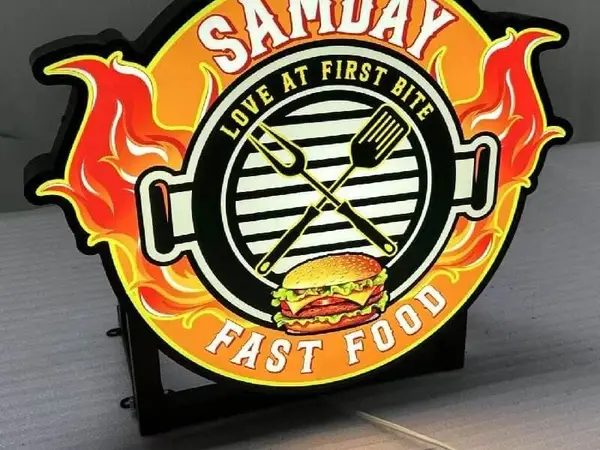
Real photo from our production floor — every sign we ship is made here.
Products mentioned or relevant to this topic — factory-direct, custom built.
From $24/letter · MOQ 1 piece · Flexible lead time · CE & UL certified · ships to 20+ countries
Custom sizes, colors, and finishes. Get a factory price in 24 hours.
Get a Free Quote Copy EmailWhatsApp +86 13865703472 · business@aochuangsign.cn