You've got a building that needs ADA signs, and you're tired of getting vague answers from people who've never touched a router bit.
So let's cut through the crap. I've spent 16 years in this industry, and I've watched contractors pay for signs that failed inspection because someone on the internet "thought it looked right."
Here's what nobody tells you: ADA signage compliance isn't about being fancy. It's about meeting exact specs — down to the millimeter — or you're ripping those letters off the wall and starting over. And that costs you twice.
---
I'm going to walk you through exactly what your signs need, what the inspectors actually check, and what we at Aochuang Sign can — and absolutely cannot — do for you from our factory floor in Lu'an, China.
---
The Core Rules Everyone Gets Wrong
The ADA (Americans with Disabilities Act) has specific requirements for permanent room signs, directional signage, and identification signs. These are the ones that matter:
- Mounting height: 48 to 60 inches from the finished floor to the centerline of the tactile characters. This is measured to the baseline of the braille, not the top of the letter.
- Tactile characters: Must be raised 1/32 inch minimum off the surface.
- Character height: Between 5/8 inch and 2 inches, based on viewing distance.
- Braille: Grade 2 Braille, placed directly below the corresponding text.
- Contrast: Characters must contrast with their background — 70% contrast is the safe number everyone aims for.
The ugly truth is most sign shops don't own a contrast measuring device. They eyeball it. And then their client fails inspection.
---
Braille Rules Kill More Signs Than Anything Else
If I had a dollar for every sign I've seen with braille in the wrong position, I'd retire and buy a boat.
Here's the spec you need to memorize: Braille must be located 3/8 inch minimum below the tactile text. The dots must be domed, with a base diameter of 0.059 to 0.063 inches and a height of 0.025 to 0.037 inches. Spacing between dots in the same cell is 0.090 to 0.100 inches.
Most importers — and I mean most — ignore this entirely.
I've seen this go wrong: A hotel chain ordered 500 room signs from a factory in Guangdong. The braille was perfectly translated. But it was placed 2 inches to the right of the text. Every single sign was non-compliant. That's a $15,000 mistake, and the factory wouldn't refund a dime.
When you're shopping for
aluminum letters or any sign that needs braille, ask exactly how they position it. If they can't tell you "3/8 inch below the tactile text" without hesitating, walk away.
---
What Materials Actually Pass Inspection
Now let's talk about the physical signs themselves, because that's where you're spending real money.
Here's what nobody tells you: The substrate and the finishing matter, but the mounting system matters just as much. If the sign can be rotated, shifted, or moved after installation, it's non-compliant.
For the face material, you've got options:
-
Acrylic: Clean, affordable, and easy to route. Common thicknesses are 2mm, 3mm, and 5mm. For ADA signs, you'll want at least 3mm so it doesn't flex. UV-resistant acrylic (Mitsubishi or Degussa) holds up 5-8 years outdoors. Cheap domestic stuff starts yellowing in 1-2 years. That yellowing kills your contrast ratio, which kills your compliance.
-
Stainless steel: The premium choice. 304 stainless is fine for indoor and most outdoor. 316 costs 20-30% more, and you'll only need it for coastal or industrial environments where salt and chemicals eat regular steel.
-
Channel letters: For exterior building signage, these are the standard. But remember — ADA applies to the built environment. Exterior signs need the same contrast and character height rules, but they don't need tactile characters unless they identify a permanent room or space.
The industry standard for ADA interior signs is usually a 3mm acrylic face with routed, raised letters, painted satin to avoid glare. Non-glare finishes are mandatory. That shiny, glossy sign your client thinks looks "premium"? Fail.
---
Contrast: The Battle Nobody Wins Without Math
Contrast is the difference between the light reflectance of the characters and their background. Visual contrast must be at least 70%.
That sounds simple until you realize paint finishes change reflectance by 10-20% depending on how they're applied.
I've seen this go wrong: A customer ordered beautiful white
stainless steel letters on a black laminate background. Visually, it seemed obvious — high contrast. But after clear coating, the stainless reflected so much light that the measured contrast dropped to 62%. Inspection failed.
If you're ordering metal letters, ask what the actual reflectance measurements are. We use a colorimeter on every custom ADA job. And if a factory can't tell you what the reflectance of that finish is, they're guessing, and you're paying for the gamble.
---
What Your Sign Shop Needs to Know Before Ordering
The ugly truth is that over 60% of ADA non-compliance issues come from improper installation, not manufacturing.
The sign needs to be installed so the tactile characters are 48-60 inches above the finished floor. But here's what they don't tell you in the code: The finished floor. If you're installing before the flooring is done, or if the floor height changes — which happens constantly in commercial build-outs — you'll be off by an inch or two.
You want to know if the door opens into the room? Then the signage needs to be on the latch side of the door, not the hinge side.
These aren't factory problems. These are contractor problems. But any factory that claims to be an ADA expert should be able to walk you through them, because they've either seen it all work or watched it all fail.
At Aochuang, we'll tell you exactly how to mount it, and we'll include the mounting templates in the crate. But we're not coming to your jobsite to hold a level.
---
The Certification Question Every Buyer Gets Wrong
Let's talk certifications, because this is where you'll get lied to the most.
The ADA doesn't certify signs. There's no official "ADA Approved" label from the government. Third-party labs test against the standards, but many of them are doing it with outdated tolerance measurements.
What you actually need to ask about:
- UL 48: This is for electric signs. If your signs are illuminated, many US municipalities require it. It costs $4,000-15,000 and takes 4-9 months with quarterly audits. Not every factory can do this.
- CE marking: This costs 20,000-50,000 RMB and takes 2-8 weeks. It's the European standard, not American. It's useful but doesn't cover ADA compliance.
- IP65 vs IP66 vs IP68: For outdoor signs, IP65 (dust-tight and water jets) is the minimum. IP66 adds powerful water jets. IP68 is submersible. If a factory tells you a sign is "waterproof" without an IP number, that's marketing, not engineering.
For ADA specifically, the certification isn't the point. The point is whether the finished product meets the 2010 ADA Standards for Accessible Design. Ask for photos of completed jobs, not certificates.
---
What We Can AND Can't Do For You
I've been in this business long enough to know what to sell you and what to tell you to buy elsewhere.
**What we CAN do:**
- Manufacture ADA-compliant signs to exact ADA specs, including Grade 2 Braille, correct spacing, and proper contrast ratios.
- Route, laser cut, and fabricate aluminum, stainless steel, and
acrylic signs with ±0.1mm accuracy. That's tighter than ADA requires.
- Provide photometric measurements for contrast on custom jobs.
- Package and ship worldwide with CE, RoHS, and ISO 9001 certified processes.
- 2-year warranty on LEDs, 1-year on power supplies. We back that up because our
rimless channel letters and architectural signs don't fail.
**What we CAN'T do:**
- Install your signs. We're a factory, not an installation crew.
- Guarantee approval from a local inspector. Every county and city has its own quirks on top of the federal ADA standards. What passes in Texas might get flagged in California. We'll build it right, but the inspector's mood is not in our control.
- Certify UL 48 quickly. We can do it, but it takes time and money. If you need a UL stamp on your order, you need to tell us now, not after we've already built 200 signs.
That's the honest line. We've been at this since 2010, we've got 50+ skilled workers in a 3,000 square meter facility, we export worldwide, and we've made our mistakes too. But we're not miracle workers.
---
Buying Checklist: What To Ask Before You Order
Here's the thing about buying ADA signs from overseas: you're saving 50-65% on the product cost, but the savings evaporate if you order from a factory that doesn't know the rules.
Before you spend a dollar, ask these five questions:
1. What is the exact tactile character height you manufacture? (Must be between 5/8" and 2".)
2. What is the braille dot height? (Must be 0.025" to 0.037".)
3. Can you provide a photometric contrast measurement? (Should be 70% or better.)
4. Do you use Samsung or Osram LEDs for illuminated signs? (Quality modules last 5+ years. Cheap ones die in 12-18 months.)
5. Will you provide a mounting template and installation instructions? (They should, free.)
If they dodged any of these, they're not really an ADA manufacturer. They're a sign shop that'll take your money and hope you don't check.
---
Lead Times and Shipping: Real Numbers
If you're buying direct from China, you need a realistic timeline.
Production takes about 5-15 days for most sign orders. That includes laser cutting, welding, grinding, acrylic fabrication, LED assembly, a full 8-12 hour aging test on illuminated signs, and 100% QC inspection before packaging.
Shipping then depends on your patience and budget:
- Express (DHL/UPS/FedEx): 7-10 days, costs $30-100 for small orders.
- Air freight: about 10 days, runs $4-12 per kilogram.
- Sea freight: about 65 days, $80-200 per cubic meter for LCL. Full containers run $1,200-3,000.
Don't forget the US Section 301 tariff — that's about 30% on top for imports from China. Good importers factor this into their pricing upfront. But if you're comparing factory quotes and they don't mention tariffs, they're either new or they're hiding the total landed cost.
---
A Final Word From Someone Who's Done the Work
Look, I've been burned by factories. I've been burned by inspectors. I've been burned by clients who changed the door hardware after the sign was mounted and blamed me for the sign being in the wrong spot. It comes with the job.
But here's what I know for dead certain: If you follow the measurements I gave you, if you ask the hard questions, and if you work with a factory that can prove their precision with numbers — not promises — your signs will pass. Maybe not on the first try every time, because inspectors are human too. But you'll have the documentation and the quality to fight back.
We make ADA signs every week. We've shipped worldwide, and we know the code as well as any American sign shop. We'll build your
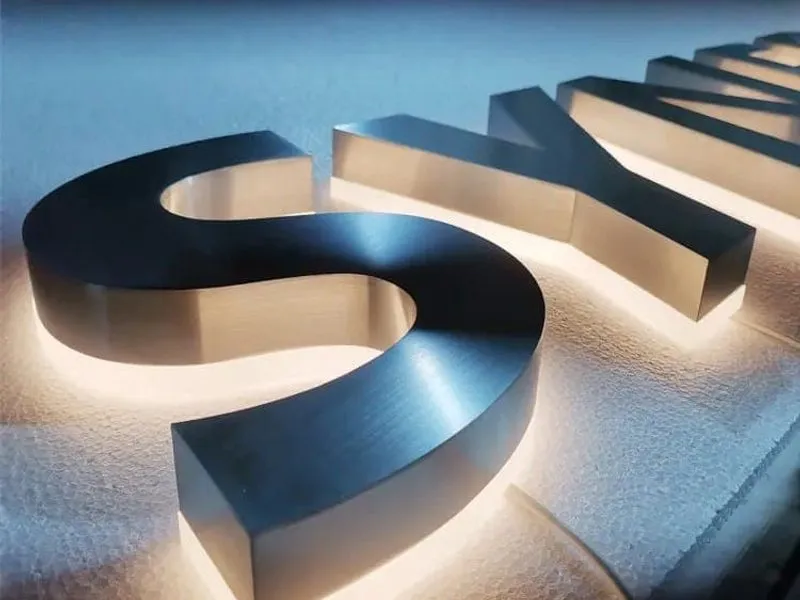
back-lit halo letters to be beautiful and compliant, and we'll tell you straight when something on your request is a bad idea.
That's the difference between a vendor and a partner. After 16 years, I don't have time to waste with one-off orders. You either want it done right, or you want it done twice.
The choice is yours.