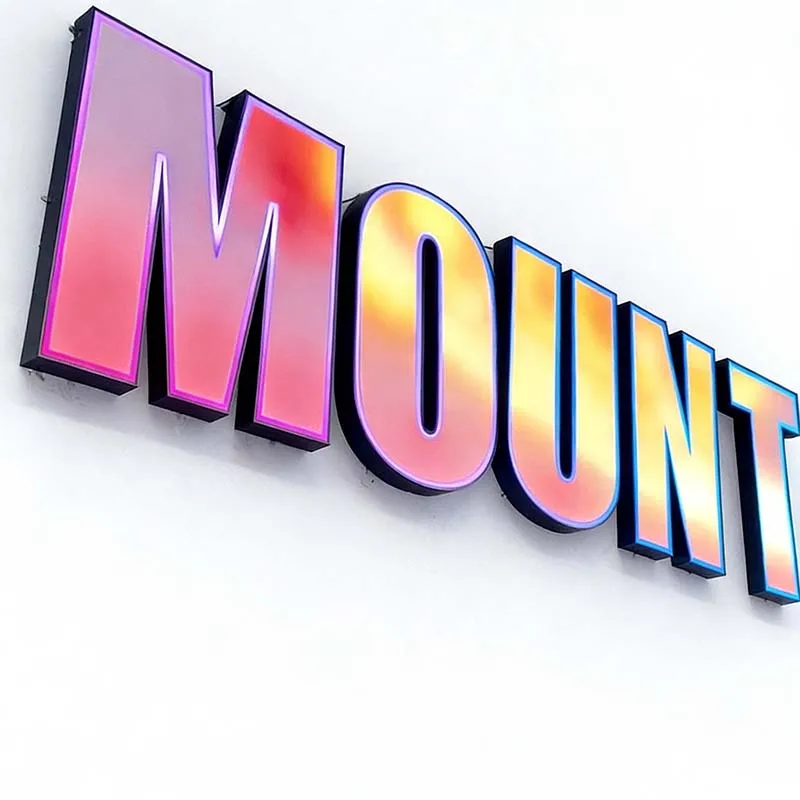
I’ve seen the good, the bad, and the utterly stupid. I’ve watched contractors blow $12,000 on a storefront that looked sun-bleached in 14 months because the factory swapped in domestic acrylic and called it “UV-resistant.” I’ve seen shipping crates so pathetic that five out of 40 letters arrived bashed in. And I’ve fielded the same frantic calls every spring when a new client realizes their cheap LEDs are already half dead before the one-year warranty expires.
So if you’re a sign shop owner, contractor, or importer ready to pull the trigger on a bulk order of channel letters, you need straight talk — not another polished sales page. You need to know what you’re actually buying, what corners skeevy factories cut, and where our own shop in Lu’an draws the line. Here it is.
The price gap isn’t magic. A front-lit channel letter that costs you $500–$700 installed from a domestic manufacturer often carries $25 in raw materials and $120 in labor. When you buy bulk from a Chinese factory like ours — 50+ workers, 3,000m² of floor space, ISO 9001 — you’re paying nearer to that factory cost. Our standard front-lit channel letters run $20–$80 per letter FOB depending on size, finish, and LED spec. Compare that to US retail of $200–$700 per letter installed, and you’re saving 50–65% on product even before you mark it up. But. And this is a big but. That same beautiful pricing structure gets destroyed if the factory uses mystery-grade stainless steel or LED modules that fizzle out in 18 months. The cheap quote isn’t the problem. The cheap materials behind it are.
You choose. I’ll tell you what both look like. Our baseline bulk order for a 14-inch front-lit letter uses 2mm 304 stainless steel returns, a 3mm acrylic face with 90%+ light transmittance, and SMD 2835 LED modules pushing 100–150 lm/W from a name-brand supplier like Samsung or Osram. That letter’s L70 lifespan sits around 50,000 hours. Real-world, that means five-plus years of crisp, even lighting before any noticeable dimming. The $22 version — and yes, there are factories that’ll quote that — comes with 1mm “430” steel that rusts at the welds, 2mm domestic acrylic that yellows in under 24 months, and unbranded LEDs that sometimes lose 30% brightness in the first year. I’ve seen this go wrong: a dentist office in Denver had to replace their entire facade after 18 months because the halo-lit letters looked like rancid butter. The ugly truth is that some importers shop price alone and get exactly what they paid for.
Forget marketing fluff. Here’s the raw data from our shop floor.
Here’s another thing nobody tells you: “IP65” sounds waterproof. It means the enclosure handles low-pressure water jets from any direction. It does not mean your sign survives a Florida hurricane or a pressure washer held six inches away. For extreme coastal weather, we can build to IP66, but the real weak point is always the electrical connection at the jobsite. I’ve watched perfectly sealed letters flood because the installer left a conduit entry open to the sky.
We hold CE, RoHS, and ISO 9001:2015. That costs us real money — CE marking alone runs 20,000–50,000 RMB to test and document, and ISO requires annual audits. We keep the certs current. Many shops in China flash a CE logo on their website without a valid certificate. When a client asks, I send them a PDF with today’s date within the hour. If the supplier delays, you know why. For US work, the elephant in the room is UL 48. Getting a sign listed costs $4,000–15,000, takes 4–9 months, and ties you to quarterly factory inspections. We can do it for a project — we’ve built UL-listed runs — but it’s not an off-the-shelf stamp. ETL is a cheaper alternative, about 10–30% less. If your local inspector insists on a field evaluation, budget for that before you order. Our sign won’t magically carry UL just because you asked nicely. Honest talk.
Let’s run a real scenario. You’re fitting out a strip mall — 40 front-lit channel letters, 18" tall, 304 stainless, warm white Samsung LEDs. Our price per letter: ~$62. Total product: $2,480 FOB Shanghai. Now the freight. Express (7-10 days) would be insane — $30–$100 per small box, maybe $2,400 total if split into multiple cartons. Air freight (about 10 days) at roughly $6/kg: total around $1,100. Sea freight (about 65 days) LCL at $100/m³: maybe $400. Add a sturdy plywood crate for $60. Now Section 301 tariffs on Chinese aluminum and steel signs are roughly 30% — that’s $744 on the product value. Door-to-door, your 40 letters land at about $3,600. US made? Those same letters professionally installed often invoice $9,000–$14,000. Even after your labor and markup, you’re crushing the domestic bid. And your margin widens with volume. The sweet spot: orders of 30–200 letters where consolidation makes sense. Under 15 letters, the freight per unit hurts. Over 300 letters, we negotiate even tighter on material costs.
One rookie mistake I see constantly: not factoring voltage drop across a long run of letters. NEC Article 600 limits a 20-amp circuit to 16 amps of continuous sign load. If you’re wiring a 50-foot sign bank, feed it from the middle or run a heavy-gauge power lead. Poor planning causes dim letters at the end of the string and a very red-faced electrician.
I’ve walked thousands of visitors through our floor. It’s not fancy, but it works. Design confirmation happens within 24 hours of deposit. Laser cutting holds ±0.1mm, TIG welding gets solid fillets, and the grinding/polishing crew finishes to a brushed #4 or mirror #8 as you spec. Acrylic faces are CNC cut and push-fitted. LED assembly and wiring take 1–2 days, then we seal everything with neutral silicone and throw the signs on an aging test rack for 8–12 hours. After that, every single letter gets a full QC inspection — not a spot check, 100% — before going into foam-lined cartons and a plywood crate. Total lead time: 7–15 working days, not 3. I can’t produce a bulk order of 80 letters in 4 days without skipping those QC steps, and I won’t do it.
We’re bloody good at standard channel letters: front-lit, back-lit halo, rimless, dual-lit. We also fabricate dimensional metal letters in aluminum, brass, and stainless. Custom logos and flex neon signs are right in our wheelhouse. Our back-lit halo letters run $35–$120 per letter and deliver that premium architectural glow without the premium architectural ego. Our light box orders average $120/sqm, fully assembled with printed graphics if you provide the art. We’ll match Pantone powder coat colors across a batch with near-zero drift.
Now the hard no’s. We don’t provide installation or on-site measurement. You send us accurate templates and vector artwork (AI, CDR, EPS), and we fabricate to dimensional specifications. If your site survey is off, that’s not on us. We don’t handle building permits or variance hearings — we’re a factory, not a US sign contractor. We can supply mounting templates and structural specs, but local codes are your responsibility.
About eight years back, a contractor ordered 60 large outdoor letters for a car dealership grand opening. He wired the deposit, then asked for delivery in 4 days because the event had moved up. We pulled a weekend shift, skipped extended aging, and air-freighted the lot. On install, three letters were dead on arrival — cold solder joints we’d have caught in a full bench test. It cost me $1,800 in freight and replacements, and it cost him a client relationship. Now I insist on the full 7-day floor for any order over 20 pieces, and if you’re in a screaming hurry, I’ll tell you to find another shop. The $400 you save in air freight isn’t worth a single failed letter on opening day.
First, a vector file with exact stroke widths and mounting hole locations. Second, material grades — say “304 stainless, brushed finish, 3mm acrylic face” not just “nice metal.” Third, LED color temp and brand preference. Fourth, whether you need an external power supply box per letter or if you’ll do a remote setup. Fifth, delivery address for a real freight quote. When you give me those five things, I can turn a binding quote in under eight hours. Skip any of them, and we’ll be trading emails for a week.
One last brutally honest fact: our letters don’t arrive with a magic “Made in USA” label. If that matters to your customer, I’ll tell you up front. We’ve had contractors powder coat over our backplate stamp and pass inspections. I’m not telling you to do that. I’m telling you it happens.
We’re not the cheapest factory in Anhui. But we use the materials we list, we stand behind our 2-year LED warranty, and we don’t vanish when a crate shows up delayed. If you’re ready to order 20+ channel letters and want a partner who’ll send photos from the welding bay, not a stock catalogue, you’ve found us. Just don’t ask for a 4-day miracle.

Real photo from our production floor — every sign we ship is made here.
Products mentioned or relevant to this topic — factory-direct, custom built.
From $24/letter · MOQ 1 piece · Flexible lead time · CE & UL certified · ships to 20+ countries
Custom sizes, colors, and finishes. Get a factory price in 24 hours.
Get a Free Quote Copy EmailWhatsApp +86 13865703472 · business@aochuangsign.cn
See pricing, specs, and get a free quote for the sign type you need. Built in our factory, shipped worldwide.