Twelve years on this factory floor, and I can tell within thirty seconds if a channel letter quote is going to bite somebody.
A contractor in Tampa called last week. He'd been paying $850 a letter installed for standard front-lit channel letters — stainless returns, acrylic faces, Samsung LEDs. He thought he was getting a deal. He wasn't. I pulled up our price sheet and said, "Buddy, that same letter costs $120 from our dock in Anhui." Long silence. Then he asked about shipping.
Let's talk about what actually matters when you're buying or importing channel letters.
Look, you'll only ever quote, install, or import four channel letter configurations for commercial work. Everything else is just a variation on those bones.
Front-lit channel letters are the workhorse. Acrylic face, aluminum or stainless returns, internal LED modules. SMD 2835 chips running 100-150 lumens per watt are the industry standard. You want 90-92% light transmittance from the acrylic face. If your client is a dentist's office or a pizza joint, this is the sign. We build front-lit channel letters every single week for people who just need the thing to work.
Back-lit halo letters are where the money is.
They light the wall behind the letter, not the face. Architectural firms love them because they look expensive — and they should, at $35-120 factory price per letter before shipping. The acrylic face is opaque, usually 3mm, and the LED pushes light backward against a standoff. Back-lit halo letters cost more because they need a second return and a rear mounting panel. I've watched a designer quote $1,000 a letter retail for these and gotten it.
Dual-lit? That's the same letter with LEDs firing both directions. You get face glow plus halo. Your client will ask for it after seeing one on Instagram. Then they'll see the price and go back to front-lit.
Rimless channel letters — no visible return — and side-lit acrylic are for clients who want that clean modern look. They're not harder to build. They're harder to sell because the customer thinks "simple design" means "cheaper," and that's wrong.
Color temperature matters more than most people think. 3000-3500K is warm, good for hospitality. 4000-5000K is neutral, right for corporate and retail. 6000-6500K is cool, usually industrial or highway work. Pick the wrong temp and the sign looks fine in the render but weird in real life.
Ugly truth: fabrication price is maybe half your total landed cost.
Our factory prices run $20-80 per letter for front-lit, $35-120 for halo, $15-40 for non-lit stainless, and $40-120 for 3D fabricated. That's the product. Then add express shipping at $30-100 for a small sample or air freight at $4-12 per kilogram. Ordering a big storefront package? Sea freight runs $80-200 per cubic meter LCL or $1,200-3,000 for a full container. And the US Section 301 tariff tacks on about 30%.
And we haven't touched permits.
A typical US sign shop installs a front-lit channel letter for $200-700. Halo letters go for $400-1,000. That's per letter, installed, with a raceway, electric hookup, and a service call-back included. I've seen sign shops pay $800 for a front-lit letter from a domestic fabricator. Same 304 stainless, same Samsung LEDs. We ship that letter for $120. You can do the math on 50-65% product savings, but don't forget the time and risk you're absorbing.
Here's what nobody tells you: import channel letters without a UL listing, and you might be standing next to an electrical inspector explaining why your sign doesn't have a sticker.
UL 48 certification costs $4,000-15,000 and takes 4-9 months, plus quarterly audits. Most Chinese factories don't have it unless they're big. We don't claim to. We have CE, RoHS, and ISO 9001, which works fine for most of the world, but the US is a different beast. Your local inspector might accept an ETL label — that's 10-30% cheaper than UL — or they might need a field inspection. Field inspection means an electrician signs off after install, which adds $200-500 and a day of your life, if they're feeling friendly.
NEC Article 600 governs electric signs. If your imported letters don't meet it, you're not saving money. You're buying a problem that bites six months later when the inspector comes back.
I've seen this go wrong: a sign shop in Phoenix ordered 40 imported halo letters with no UL sticker, no ETL, no nothing. They saved $7,000 upfront. The inspector tagged every single letter because the power supplies weren't listed. They ended up paying a local UL field evaluation company $4,800 and waiting three weeks. Their client missed a grand opening. The sign shop ate the cost. I didn't laugh because it wasn't funny. It was predictable.
Domestic fabricators aren't saints either. But at least when their letters fail, you can call them and they're in the same time zone.
Look, acrylic isn't just acrylic. UV-resistant acrylic from Mitsubishi or Degussa will go 5-8 years outdoors before it yellows. Cheap domestic acrylic? 1-2 years, maybe 18 months in direct sun. The light transmittance difference between a 2mm face and a 3mm face is about 2% — 90% vs 92%. But the cost difference is 40%. I've watched customers demand 3mm because "thicker is better." They're paying for a myth. For faces over 2.5 meters, fine, you need 5mm. Otherwise, use 2mm and spend the savings on better LEDs.
If you're buying acrylic LED letters for an interior lobby, the material choice matters less than the LED module quality. Solder joints are the tell. Dull gray joints mean cheap lead-based solder — those modules won't last 18 months. Shiny silver joints are proper lead-free solder and they'll run 5+ years, especially Samsung, Osram, or Blueview brands. Cheap LED modules kill more signs early than anything else, and your client won't notice until half the sign is dark.
Stainless steel letters are another place people get lied to. 304 stainless has 18% chromium and 8% nickel, and it'll do 10+ years outdoors in most places. 316 adds 2-3% molybdenum and costs 20-30% more, but it's for coastal or industrial air. A strip mall in Ohio doesn't need 316. A restaurant in Miami Beach does. 304/316 stainless steel letters with mirror or brushed finish are a premium look, but rust is rust. Don't buy "stainless" that's actually 201 grade because a supplier won't show you the spec sheet.
Aluminum returns are one-third the weight of steel and rust-proof out of the box, with an 8-12 year outdoor life. For big letters, that weight savings saves your install crew's back.
IP65 is the minimum for outdoor. It means dust-tight and protected from water jets. It does not mean your sign survives a Florida hurricane. I've had a customer in Pensacola argue that IP65 meant storm-proof. No. Read the spec.
Our factory in Lu'an, Anhui runs 3,000 square meters with 50+ workers. We've been at it since 2010. MOQ is one piece, lead time about 5-15 days. That's not a factory estimate. That's the actual production line.
Design confirmation takes a day if you answer the email. Then: laser cutting at ±0.1mm tolerance, bending and TIG welding, grinding and polishing, CNC routing the acrylic face, LED assembly, sealing with neutral silicone, and an 8-12 hour aging test. Every letter gets a 100% QC inspection before packaging — foam, carton, then plywood crate. I've seen factories skip the aging test to hit a deadline. Don't. That's how you ship a letter with a dead LED module to a client 7,000 miles away.
LCL sea freight means your crate gets handled 6-8 times between our dock and yours. Every touch risks damage. That's not in the brochure, but it's in our packaging specs because we've seen what a forklift can do to a crate of channel letters.
Q: What's the difference between front-lit and halo-lit?
Front-lit lights the face. Halo lights the wall behind. If you don't know which one your client wants, ask if they want to see the letters glow or see a glow around the letters. If they say "both," quote dual-lit and watch them flinch.
Q: How long do channel letters actually last?
Quality LED modules — Samsung, Osram, Blueview — will give you 5+ years of real lifespan, L70 at 50,000 hours. Cheap modules: 12-18 months. We warranty LEDs for 2 years and power supplies for 1. A sign shop offering a lifetime warranty on LEDs is either lying or charging you double and hoping you forget.
Q: Do I need UL certification to import channel letters into the US?
You need a listed sign or a field inspection. UL 48 costs $4,000-15,000 and takes 4-9 months. If the factory says they have UL, ask to see the certificate with today's date. Watch them sweat. Nine times out of ten they have a CE certificate and think that's the same thing. It's not.
Q: Why is shipping so expensive for a few letters?
Because plywood crates are heavy, and freight companies don't care about your profit margin. A small express package runs $30-100 and arrives in about 5-15 days. Air freight is $4-12/kg, about 10 days. Sea freight is cheap per cubic meter but takes about 65 days. Pick two: fast, cheap, careful. You can't have all three.
Next time you're quoting channel letters, do the math on the whole landed cost, not just the fabrication price. And don't buy cheap LED modules. Your client will remember whose sign went dark.

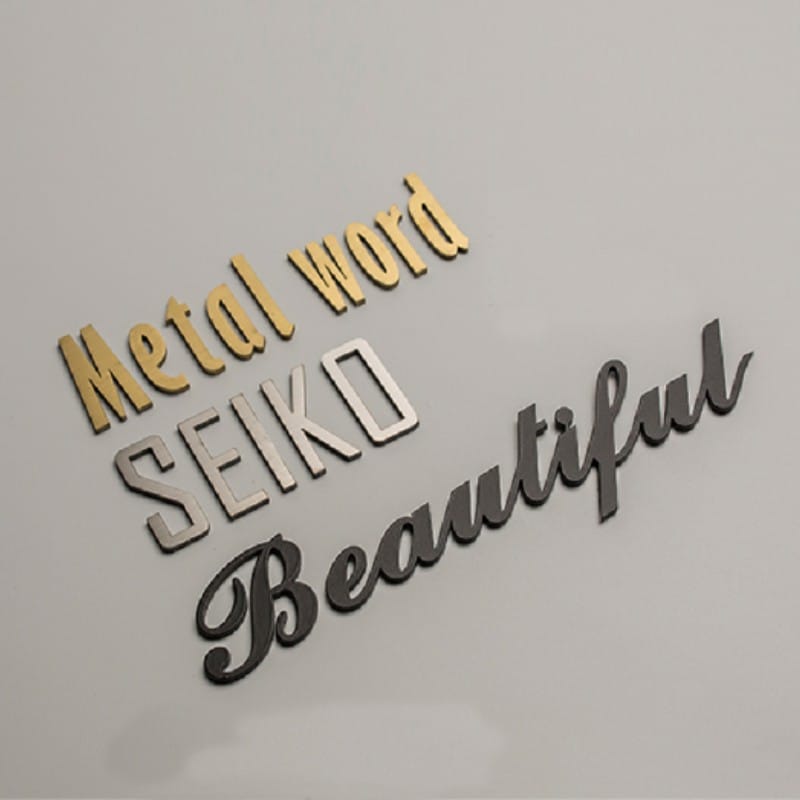
Real photo from our production floor — every sign we ship is made here.
Products mentioned or relevant to this topic — factory-direct, custom built.
From $24/letter · MOQ 1 piece · Flexible lead time · CE & UL certified · ships to 20+ countries
Custom sizes, colors, and finishes. Get a factory price in 24 hours.
Get a Free Quote Copy EmailWhatsApp +86 13865703472 · business@aochuangsign.cn