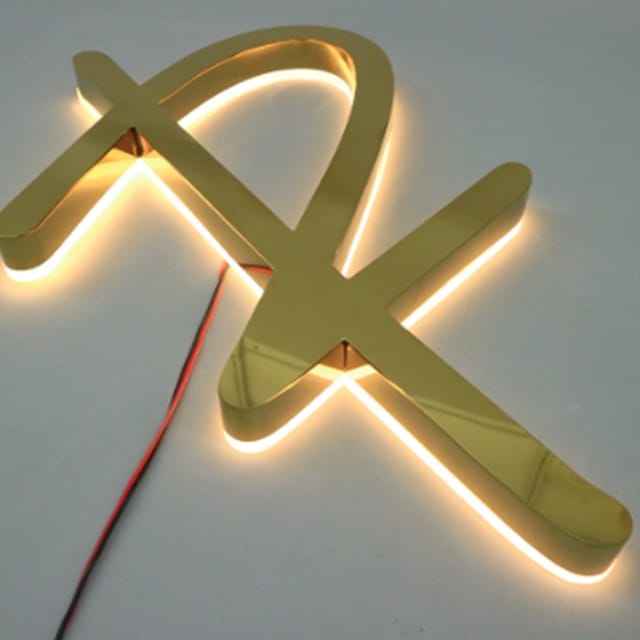
You're being lied to about channel letter pricing.
I've watched sign shops pay $800 for a front-lit letter from a domestic fabricator. Same 304 stainless, same Samsung LEDs, same 3mm acrylic face. We ship that letter for $120 from our factory floor in Lu'an. The difference isn't quality — it's layers of markup and a supply chain that forgot who's doing the actual work.
Here's what nobody tells you: the fabricated letter is maybe 40% of your total project cost. Permits, lifts, electricians, freight, and a 30% Section 301 tariff stack up fast. If you're pricing jobs using only the per-letter factory price, you're setting yourself up for a 30-50% quote surprise before the first anchor bolt goes in.
Letter size, return depth, and face material set the floor. But the real cost drivers are the ones rookies ignore: LED module quality, finish spec, and how far the sign travels.
Material matters more than you think. Acrylic faces from Mitsubishi or Degussa hold 90-92% light transmittance and resist UV for 5-8 years. Domestic acrylic? 1-2 years before yellowing, and your customer will call you about it. Stainless 304 gives you 10+ years outdoor life; 316 contains 2-3% molybdenum and is the only honest choice for coastal or industrial air. That 316 upgrade runs 20-30% more, and in Miami Beach it pays for itself in 3 years.
Look, I've seen this go wrong: a shop in Ohio ordered 316 for a strip mall because the salesman said "marine grade." Total waste of money. 304 would have outlived the lease.
LED choice is the hidden budget killer. Cheap modules with dull gray solder joints die in 12-18 months. Quality SMD 2835 modules from Samsung, Osram, or Blueview hit 100-150 lumens per watt and carry a real L70 lifespan of 50,000 hours plus. Shiny silver solder joints? That's proper lead-free work. Dull gray? You're buying a warranty claim.
Finish and complexity come next. Brushed #4 is standard. Mirror #8 adds labor. PVD and powder coated add cost. Every bend, every weld, every polish pass is shop time. We run a 10-step process — laser cutting at ±0.1mm, TIG welding, grinding, polishing, CNC acrylic, LED assembly, neutral silicone sealing, an 8-12 hour aging test, and 100% QC before export packaging. That's the difference between a $20 letter and an $80 letter.
If you're ordering front-lit channel letters for a storefront, ask your fabricator what acrylic brand they're using. If they can't answer, walk.
Here's the factory price sheet, straight from our floor. Front-lit channel letters: $20-80 each. Back-lit halo letters: $35-120 each. Stainless non-lit: $15-40. 3D fabricated: $40-120. Aluminum: $10-25. Light boxes run $80-250 per square meter; neon flex $30-200 per sign.
Those are single-piece MOQ prices. We don't do the "minimum 50 letters" nonsense. One piece, about 5-15 days, shipped anywhere.
Retail installed numbers will make your eyes water. US sign shops quote $200-700 per front-lit letter and $400-1,000 per halo letter, installed. That's product plus install labor, lift rental, permits, and their overhead. The product maybe 20-30% of that. The rest is access and paperwork.
If you need acrylic LED letters for indoor or outdoor, same factory ranges apply, but indoor mini letters can drop lower depending on size and LED count.
Let's break a typical front-lit letter. Material maybe 30-40% of factory cost: acrylic face, aluminum or stainless return, LED modules, power supply, wiring, silicone. Labor another 30-40%. The rest is packaging and overhead.
But that's not what lands in your yard. Freight is a line item nobody volunteers. Small sample? Express $30-100. Air freight $4-12/kg. Sea LCL $80-200 per cubic meter, and full container $1,200-3,000. Then add the US Section 301 tariff — roughly 30% on top of the landed cost. That $120 letter is now $156 before a truck touches it.
The ugly truth is most "channel letters price" guides online omit permits entirely. In US jurisdictions, you're dealing with NEC Article 600 for electrical, plus local sign codes. A UL 48 listing costs a factory $4,000-15,000 and 4-9 months of work with quarterly audits. ETL is a cheaper alternative, 10-30% less. CE marking? 20,000-50,000 RMB and 2-8 weeks. Most factories will say they have it. Ask to see the certificate with today's date. Watch them sweat.
Permits aren't free. Depending on your city, you're paying for electrical permits, sign permits, maybe a structural stamp if the sign is over a sidewalk. I can't give a universal number because every municipality has its own racket. But figure permits and inspections add 5-15% to a commercial install, and they'll delay you a week if your drawings aren't right.
Here's what nobody tells you: sealing matters as much as LEDs. We seal every letter with neutral silicone, then run an 8-12 hour aging test. Skip the silicone and your IP65 rating is a joke. IP65 means dust-tight and water jets from any direction. That doesn't mean your sign survives a Florida hurricane. For coastal, you need IP66 or better, and even then, salt air eats cheap metal in 3 years.
If you want stainless steel letters that survive coastal salt, pay the 20-30% premium for 316. Otherwise don't complain when the pitting starts.
Installation is where sign shops make their margin or lose their shirt. You've got lift rental, a bucket truck, or a crane for high fascia work. You've got an electrician to tie into a circuit. You've got a two-man crew standing around waiting on the permit inspector.
I've seen this go wrong: a shop quoted a storefront install assuming a ladder would do. The letters were 18 feet up, over a sidewalk. By the time they rented a scissor lift and paid a licensed electrician, the install ate 60% of the job profit. They didn't check access before quoting.
Mounting method changes cost. Direct-to-fascia with studs and a pattern is cheapest. Raceway mount adds a metal box and wiring raceway but simplifies installation. Backer panels cost more but give a clean architectural look. If you're installing halo letters, plan for standoff mounts and LED power supplies accessible inside the building — not buried in the wall.
Here's the math from the price sheet. A front-lit letter costs $20-80 ex-factory. US retail installed runs $200-700. That's a 2.5x to 8.75x multiplier, depending on access and municipality. Halo letters? $35-120 factory, $400-1,000 installed. The product is rarely the expensive part.
Regional pricing in the US is mostly about labor and permitting, not the sign. A small-market install might land at the low end of $200-700 per front-lit letter. A downtown high-rise could hit the top end, not because the letters are better, but because you're paying for a lift over a sidewalk, a structural engineer's stamp, and 316 stainless because the salt air eats 304 in three years.
When you compare quotes, force the fabricator to break out product, freight, installation, permits, and electrical. If they won't, they're hiding something. I've quoted factory-direct against domestic shops and seen the same letter spec quoted at $120 vs $800. The difference wasn't quality — it was three layers of reseller markup.
The ugly truth is the sign industry thrives on opaque pricing. "Per inch" quotes are a trap because they don't account for stroke width, return depth, LED type, or finish. A 24" letter in a thin font is not the same as a 24" letter in a bold font with 5" returns. Ask for a detailed material list.
Factory-direct isn't about "cheap." You're cutting out the middleman. We sell front-lit channel letters at $20-80 per letter, MOQ one piece, 7-15 day lead time. A domestic shop reselling the same thing might mark it up 3-4x before installation. That's why factory-direct savings run 50-65% on product.
Here's what nobody tells you: the real savings are in total cost of ownership, not first cost. A quality LED module with a real L70 of 50,000 hours and a 2-year LED warranty means you're not rolling a truck back in 18 months to swap a $12 module. The warranty is 2 years on LEDs, 1 year on power supply. Cheap modules die at 12-18 months. You do the math on labor.
Look, I've been building signs on this floor since 2010. We've shipped to every market that'll have us. We're ISO 9001, CE, RoHS certified. Our acrylic faces come from Mitsubishi or Degussa when UV resistance matters. Our stainless is real 304 or 316, not mystery alloy. Our laser cutter holds ±0.1mm. We run every sign through an 8-12 hour aging test before it goes in a foam-lined carton and plywood crate.
If you're pricing front-lit channel letters for a storefront or a whole shopping center, get the factory quote first. Then add freight, tariff, installation, and permits. That's the number your customer should see. Not the $800-per-letter fantasy that keeps domestic fabricators in new trucks.
Aluminum non-lit, $10-25 per letter. But cheap letters look cheap. If you want lit, front-lit at $20-80 factory. Don't come back crying when the $10 letter fades or the paint peels.
You can't ask that without the job site. Installed front-lit letters in the US run $200-700 per letter. That includes labor, lift, permits, and electrical. If someone quotes you $50 installed, they're doing it unpermitted on a ladder. Good luck.
Because you're buying from the floor that makes the sign, not a reseller with a showroom and a sales rep's boat payment. MOQ is one piece. Lead time about 5-15 days. Add 30% tariff and freight, and it's still less than half of US retail on product.
Depends on your city and electrician. UL 48 costs a factory $4,000-15,000 and takes 4-9 months. ETL is 10-30% cheaper and often accepted. CE is not UL. If a factory claims "UL equivalent," ask for the certificate with today's date. I'll wait.

Real photo from our production floor — every sign we ship is made here.
Products mentioned or relevant to this topic — factory-direct, custom built.
From $24/letter · MOQ 1 piece · Flexible lead time · CE & UL certified · ships to 20+ countries
Custom sizes, colors, and finishes. Get a factory price in 24 hours.
Get a Free Quote Copy EmailWhatsApp +86 13865703472 · business@aochuangsign.cn