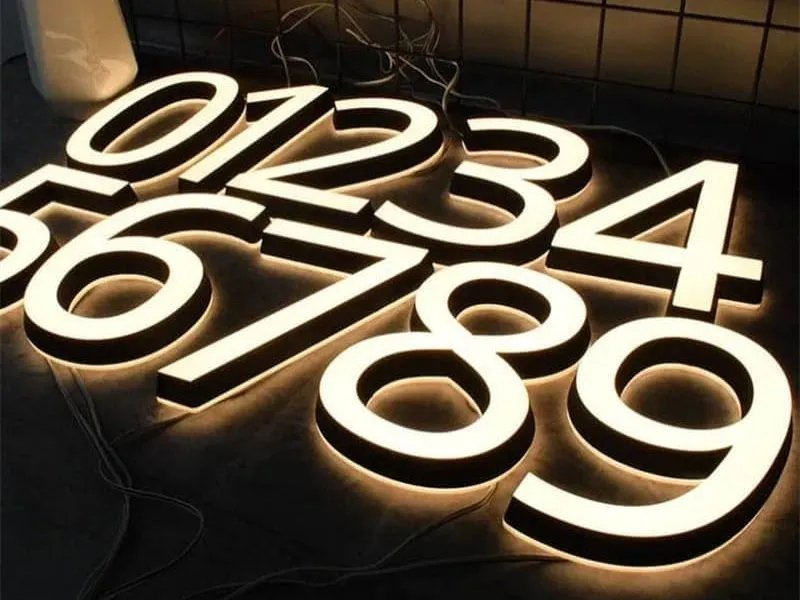
The LED question that's wasting everyone's time
Every week, an importer sends me a spec sheet asking if they should switch their whole order to COB LEDs. They've read three blog posts written by people who've never opened a
channel letter. They're about to overpay for a solution to a problem they don't have.
Here's what nobody tells you: the LED chip is maybe 15% of what makes a sign last. The other 85% is the power supply, the sealing, the weld quality, and whether your installer wired it to code. I've watched a $12,000 sign die in 14 months because someone used a $4 power supply from a brand that ceased to exist.
So let's settle this properly, with numbers and bench experience instead of hype.
What these two actually are
SMD stands for surface-mounted diode. Those little square dots on a strip? That's them. SMD 2835 is the industry workhorse, spec'd at 100-150 lumens per watt. On a real test bench with decent modules, you'll measure 90-120. Millions of channel letters on Earth run on these things, and most of them run fine for years.
COB is a different animal. Multiple chips mount directly onto one board, then a single phosphor dome covers the whole array. Instead of a row of dots, you get one solid rectangle of light. The uniformity is genuinely better — no spotting, no hot dots reflecting through an acrylic face.
Now, the part nobody selling you COB wants to admit: it costs more, it runs hotter, and it makes retrofits harder. Whether it's worth it depends entirely on what you're building.
Brightness: the numbers I'll defend
Let's talk real numbers, not the ones on the fancy brochure.
SMD 2835: 100-150 lm/W on paper. On our bench, quality modules from Samsung, Osram, or Blueview land at 90-120 lm/W under real operating conditions. SMD 5730 is your brute-force option at 40-60 lumens per chip — fewer chips needed for raw punch, but you pay for it in power draw and heat.
COB packs more die into one spot, which means higher luminous flux per board area. For tight-pitch letters — short, stubby letters where an SMD strip can't fit enough diodes — COB wins. You get consistent brightness without crunched-together dots.
But here's a hard truth: your sign's perceived brightness isn't just the LED. It's the acrylic, the distance between the face and the diodes, and the color temperature. A 3mm domestic acrylic that yellows after 18 months will dim your $500 LED upgrade. Mitsubishi acrylic — 90-92% light transmittance and 5-8 year UV resistance — does more for perceived brightness than switching chip types.
I've seen this go wrong: a shop owner swapped SMD for COB, paid 40% more, and the sign looked dimmer because they also switched to thicker acrylic. The chip wasn't the problem. The system was.
Cost: what this really costs you
Factory pricing on a
front-lit channel letter runs $20-80 per letter. That's stainless, acrylic, LED, wiring, and export packaging. US retail installed runs $200-700 per letter. The gap is your margin — if you're a shop or contractor importing, you're looking at 50-65% savings on product alone.
COB adds roughly 15-30% to the LED cost in our experience. That's modules, not the whole sign. For a typical storefront with 10 letters, you're talking $40-80 more in materials. Not nothing, but not the deciding factor either.
The bigger cost trap is the power supply and the modules. Quality modules from Samsung, Osram, or Blueview carry an L70 rating — the point where output drops to 70% — at 50,000-plus hours. That's 5+ years real-world. Cheap modules, the ones at $6 per meter on Alibaba, die in 12-18 months. We see the corpses on our service bench.
The ugly truth is: the markup on "premium LED" at retail is where money goes sideways. If you buy through a middleman, you're paying $800 for a letter we ship for $120. The LED inside that $800 letter? SMD 2835. Same one that goes in the $120 letter.
And if you're importing into the US, factor in the Section 301 tariff at roughly 30%. Anyone who quotes you a landed cost without mentioning tariffs is either new or hoping you won't ask.
Efficiency: lumens per watt is only part of it
COB generally delivers more lumens per watt at the chip level, especially at higher drive currents. But chip efficiency isn't sign efficiency.
Here's what none of the comparison charts show: system efficiency. Your power supply, your wiring gauge, your drive current, your heat management. COB runs hotter in a confined channel letter. Heat is the enemy — every 10°C over spec chips away at that L70 lifetime.
That's why we route COB modules with proper thermal management: aluminum backing, airflow, correct drive current. If you buy COB from a factory that slaps them into a steel channel with zero thermal thought, the lifetime advantage vanishes. You're paying more for a shorter life.
SMD 2835 is the efficiency champion in real channel letter conditions because it's the most understood, most tested package on Earth. Millions of signs run it. The failure modes are documented. Installers know how to wire it. That's worth real money on a job site.
Where COB genuinely wins
I'll be straight with you. COB has real jobs, and I'll recommend it when the job calls for it.
Uniform illumination on shallow letters. Halo lighting where you want a clean, continuous glow with no dots. Any sign with a tight radius where SMD strips create hot spots against the face. For architectural work, that even glow is what customers notice first.
Neon flex is a separate world entirely — our
neon flex signs run $30-200 depending on size, with the LED embedded in the tube so there are no dots at all. Continuous light, modern look, but again, it's the right tool for the right job.
But here's the thing: SMD does 90% of the signage jobs on Earth better for the money. The 2835 is the industry standard for a reason. Spec'ing COB for a standard strip-mall storefront is like buying a race car to go grocery shopping.
The honesty section: what we can and can't do
I run a 3,000 square meter factory in Lu'an, Anhui. We've been at it since 2010. 50-plus skilled workers, exports worldwide, CE, RoHS, ISO 9001. MOQ of 1 piece — I don't care if you need one letter or a thousand, you get the same production line.
What we can do: build your sign with either LED type, run every module through an 8-12 hour aging test, seal with neutral silicone, do 100% QC inspection, and crate it so it survives the ocean. We quote honestly, and we build what we quote. Lead time runs about 5-15 days.
What we can't do: We can't get you a UL listing for $3,000. That's real — UL 48 runs $4,000-15,000 and takes 4-9 months with quarterly audits. Some factories tell you they have UL and show you a dated piece of paper. Ask to see the certificate with today's date on it. We won't fake that for you.
We also can't make cheap LEDs last. If your price point demands $6-per-meter modules, we'll install them, but you'll be replacing them within two years. That's physics, not a sales pitch.
And we can't promise IP68 for everything. IP65 — dust-tight and water jets — is the minimum for outdoor signage. IP66 for coastal heavy weather. IP68 is submersible territory for extreme conditions. Anyone who tells you every sign needs IP68 is selling you fear.
How to actually decide: a buyer's checklist
Stop asking "COB or SMD" and start asking these questions:
- What's the viewing distance? More than 50 feet? SMD 2835 or 5730 handles it. Close-up — storefront, restaurant window — COB's uniformity shows its worth.
- What's the letter depth? Shallow letters need COB's light spread. Deep channel letters give SMD room to do its job.
- What's your climate? Coastal? Specify 316 stainless, not 304. The LED is the cheap part. The metal is the long-term cost.
- What's the color temperature spec? 3000-3500K for hospitality, 4000-5000K for corporate and retail, 6000-6500K for industrial and highway. Don't let chip type override a color decision.
- Who's installing it? More signs die from bad installation than bad chips. Verify your electrician has done LED signage before.
My recommendation after 16 years
For most sign shop owners, contractors, and importers reading this: buy SMD 2835 from a factory that uses quality modules. It's the best cost-to-performance ratio in the industry, and it will be for years.
For the customer who needs statement signage — halo-lit architectural letters with a clean, premium glow — consider COB on our
dual-lit channel letters. Face and halo from one system, with the chip type matched to the job.
The single most important piece of advice I can give you: buy from a factory willing to tell you when you're wasting money. If a sales rep says "we can do anything," run. A good factory says "yes, and here's the trade-off."
We'll take your order — one sign, fifty signs, a hundred. But we'll tell you first which LED type doesn't matter for your specific job. That's how you build a relationship that survives the shipping container.
Even if it means you buy fewer LEDs from us.