Walk into any big venue and you'll see it within thirty seconds. A clusterfuck of signs that lead you in circles. Arrows pointing to "Hall C" that dead-end at a restroom. Temporary banners that look like they were printed on a home inkjet. I've been fixing this mess for almost three decades, and it never gets less frustrating. The problem isn't the architect. It's that signage gets treated like an afterthought – budget gets slashed, deadlines get tight, and you end up with a 10-foot-tall "Welcome" sign that tells nobody where the hell they're supposed to go.
Let me be clear about one thing: convention centers are unique beasts. They handle everything from a 50-person board meeting to a 20,000-attendee trade show. Your signage has to flex between permanent wayfinding and temporary event-specific directions. Get it wrong, and you'll have exhibitors screaming at your front desk while attendees wander into the loading dock.
Here's what nobody tells you: The permanent directional system is your foundation. It's the steel framework. The temporary stuff is just paint. If your permanent signs suck, no temporary banner in the world will fix it.
I've seen venue managers spend $15,000 on a lobby sign that starts peeling in two years. Why? They bought 316 stainless for a building in downtown Chicago. That's marine-grade metal for a landlocked trade show. Total overkill. For a convention center in a normal urban environment, 304 stainless with a brushed #4 finish will go ten-plus years without a problem. Save the 316 for Miami Beach or anywhere within three miles of salt spray.
The ugly truth is most permanent directional signs are way overbuilt. You don't need 5mm acrylic for a sign that's ten feet up and never touched. Stick with 3mm – 92% light transmittance, plenty sturdy. The only time you need 5mm is if the sign is over 2.5 meters wide or in a hallway where people might lean on it. And for the love of God, don't use domestic acrylic. It yellows in 18 months. Mitsubishi or Degussa stuff lasts 5-8 years. It costs more. Your client won't see the difference until year three, but by then you're not on site anymore and the general manager is cursing your name.
LED modules? Don't buy cheap. I've watched sign shops pay $800 for a front-lit letter from a domestic fabricator. Same 304 stainless, same Samsung LEDs. We ship that letter for $120 from our facility in Lu'an, China. The difference isn't quality – it's labor and overhead. Factory-direct on LED modules: SMD 2835 for white, 100-150 lumens per watt. L70 rating of 50,000 hours. If your supplier can't show you a data sheet from Samsung or Osram, walk away. Quickest way to spot bad LED modules – look at the solder joints. Dull gray equals cheap lead-free paste that fails in 12-18 months. Shiny silver equals proper process.
One more thing on permanent directional signs: make them modular. Your convention center will reconfigure halls every six months. If your "Hall A" sign is welded to a steel post, you're screwed. Use aluminum extrusions with slide-in acrylic faces. Takes one guy ten minutes to swap a hall label instead of a whole repaint job.
Here's the balancing act. Temporary signs for trade shows, conferences, and galas need to look professional but you can't dump a fortune on something that'll be in a dumpster in four days. I've watched facility managers order vinyl banners printed at the local copy shop. They look like ass – wrinkled corners, pixelated graphics, wrong colors.
For temporary directional signs, use aluminum composite panels (0.040 to 0.063 inch) with direct print or vinyl overlay. They're light as hell, rust-proof, and you can reuse the frames year after year. Put them on telescoping floor stands with weighted bases. Those cheap X-frame banners that tip over when someone sneezes? Don't bother. Spring for the retractable banner stands with aluminum tracks and locking mechanisms. They cost $80-120 each from a factory – $200-300 from a US distributor. Your choice.
Don't even think about using floor decals for directionals in high-traffic areas. They peel up within three days, become tripping hazards, and look like a kindergarten art project. Use adhesive vinyl on aluminum or acrylic mounted to walls or columns. If you must have floor signs, use recessed floor plaques with stainless covers – they cost more but they won't get kicked to pieces.
One rookie mistake I still see: making temporary signs the same size as permanent ones. Nobody can tell which is which. Make your temporary signs a different color – standardize on orange or yellow frames so attendees instinctively know "this is for today's event." Keep permanent signs in dark blue or black. Simple visual hierarchy.
Convention centers have insane ambient light – glass atriums, high ceilings, skylights. You can't just throw up some backlit sign and expect it to pop. I've been in venues where the directional signs are so dim they're invisible from twenty feet. Others where the light bleed is so bad you can't read the letters.
For temporary signs, don't backlight them. It's overkill. Use high-contrast vinyl – white text on dark backgrounds or vice versa. If you absolutely need backlighting for a temporary directional, use edge-lit acrylic with a single row of SMD 2835 LEDs. Costs less, looks clean, and you don't need to wire up a junction box.
For permanent directional signs, color temperature matters. Convention center hallways and meeting rooms tend to be 4000K neutral white. Match your sign lighting to that – don't put warm 3000K LEDs next to cool 5000K ceiling lights. It looks like a mismatched outfit. Your eyes will hate it.
Here's an ugly truth: IP65 sounds impressive. It means water jets from any direction. It does NOT mean your sign survives a Florida hurricane or a sprinkler system test. For outdoor convention center entrances, go IP66. For indoor directional signs near kitchens, loading docks, or restrooms, IP65 is fine. Don't pay for IP68 unless the sign is going underwater – and unless you're building signage for SeaWorld, you're not.
I've watched sign shops pay $800 for a front-lit letter from a domestic fabricator. Same 304 stainless, same Samsung LEDs. We ship that letter for $120.
Factory-direct pricing from a reputable Chinese manufacturer like Aochuang Sign (we've been doing this since 2010, 3,000 square meters, 50+ workers) can save you 50-65% on product cost. But you have to understand the shipping. Express is $30-100 for small orders, takes 7-10 days. Air freight $4-12/kg, about 10 days. Sea – here's where people screw up – LCL (less than container load) means your crate gets handled 6-8 times between our dock and yours. Every touch is a chance for damage. That's not in the brochure. For convention center signage, if you have more than 20 signs, pay for a full container. $1,200-3,000 FCL, about 65 days transit, but your stuff arrives without dents.
Don't forget Section 301 tariffs – about 30% on Chinese manufactured goods into the US. Factor that into your quote. Even with tariff, factory-direct is cheaper than domestic. But you have to plan lead times. Our standard is about 5-15 days production. Add 20 days air or 60 days sea. That's three months if you go ocean. Convention center managers never plan that far ahead. Plan ahead.
Warranty: two years on LEDs, one year on power supply. Yes, that's from us. If your local fabricator says "lifetime warranty," ask them what happens in year five when their business closes. I've seen three sign shops go under in my career. Our factory has been here since 2010. We'll be here.
I can't count how many times I've walked into a convention center and seen directional signs mounted at 72 inches. Code says 48 to 60 inches for ADA tactile signs. Mount them wrong and you're begging for a lawsuit. ADA requires non-glare finish and Grade 2 Braille on permanent room identification signs. Temporary event signs? Not required to have Braille, but don't mount them at 72 inches anyway – keep them accessible.
NEC Article 600 covers electric signs in the US. If you're running power to permanent directional signs, you need a proper disconnect within sight of the sign. Most venues have junction boxes in the ceiling – that's fine if the maintenance guy can reach it. Don't bury connections inside a sign cabinet.
Fire exit signage trumps everything. I don't care how beautiful your backlit "Conference Center" sign is – if it's within three feet of an exit sign required by code, the fire marshal will make you move it. I've seen this go wrong: a $40,000 lobby sign had to be relocated because it blocked the view of an EXIT sign. Don't learn this lesson the expensive way.
7 to 15 days production. Then add shipping: express 7-10 days, air about 10 days, sea about 65 days. If you need it in three weeks, you're paying for air. If you're reading this two weeks before your grand opening, good luck.
304 is fine for indoor and most outdoor. 316 if the building is within 3 miles of saltwater or in an industrial area with chemical fumes. Don't waste money on 316 for an Atlanta convention center. Your budget will thank you.
Making them look identical to permanent signs. Use different colors – orange or yellow frames for temporary. Also, don't use floor decals. They fail. Use adhesive vinyl on wall-mounted aluminum panels.
And one more thing: have a sign for "Registration" that's visible from the main entrance. I can't believe I still have to explain this.
Yes, if you do your homework. Get samples. Check certificates – CE, RoHS, ISO 9001. Ask to see the CE certificate with today's date. Watch them sweat. Our factory ships worldwide and has all three. You can get a single sign made (MOQ 1 piece) or a hundred. 50-65% savings vs. domestic fabrication. Just plan your lead times and add 30% tariff to your cost model.
Still think it's not worth it? I've watched sign shops pay $800 for a front-lit letter domestically. Factory-direct $120. Do the math.

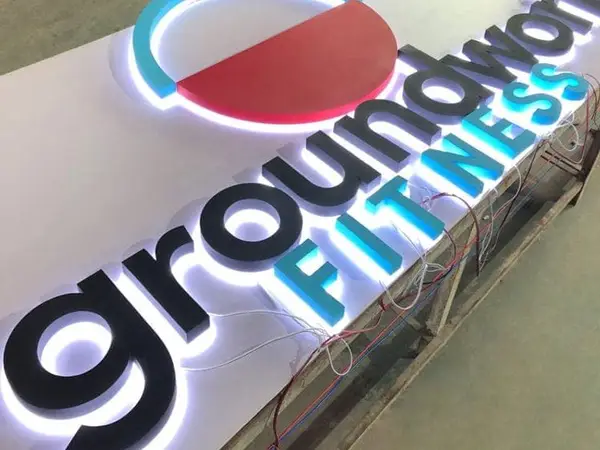
Real photo from our production floor — every sign we ship is made here.
Products mentioned or relevant to this topic — factory-direct, custom built.
Factory-direct since 2010. Free quote within 24 hours — no obligation.
Get a Free Quote → Copy EmailMOQ: 1 piece · Flexible lead time · 2-year warranty · Worldwide shipping
See pricing, specs, and get a free quote for the sign type you need. Built in our factory, shipped worldwide.