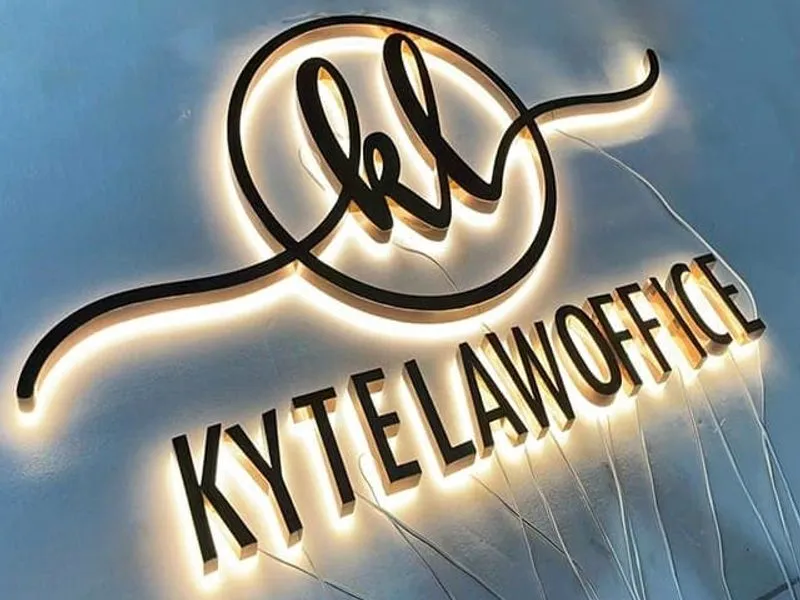
You want the truth about bulk acrylic LED letters? Fine. I've been on the factory floor since 2010, burned my hands on hot acrylic, and argued with suppliers about LED quality until my voice gave out. If you're pricing a storefront job, a franchise rollout, or a wholesale order, you need numbers that don't come from a brochure.
At their simplest, custom acrylic LED letters are dimensional letters with an acrylic face, an LED module inside, and a metal or plastic body. You see them on storefronts, office lobbies, restaurant walls, and corporate signage. They're the workhorse of the sign industry—front-lit, back-lit, side-lit, or some combination.
If you're pricing custom acrylic LED letters for a client, you're usually deciding between a clean front-lit look and a halo-lit architectural effect. The acrylic matters more than most people think. Quality acrylic from Mitsubishi or Degussa runs 90-92% light transmittance and won't yellow for 5-8 years. Cheap domestic acrylic? You'll see it start to yellow in 1-2 years. That's not a warning, it's a guarantee. I've watched those jobs come back.
LED modules are the other half of the equation. The industry standard is the SMD 2835, which puts out 100-150 lumens per watt. Need RGB? You're looking at SMD 5050. Want maximum brightness? SMD 5730 gives you 40-60 lumens per chip. Quality modules from Samsung, Osram, or Blueview will run 5+ years real lifespan. Cheap modules die in 12-18 months. I've seen it happen on signs the client thought they got a deal on.
Here's what nobody tells you: acrylic thickness matters for both durability and light output. Common specs are 2mm, 3mm, and 5mm. If a letter spans over 2.5 meters, use 5mm or the face will flex and crack. A 3mm face cuts 92% light output. A 2mm face cuts 90%. Your customer won't notice the 2% difference, but they will notice the 40% cost bump from stepping up to 3mm when they didn't need it.
I've watched sign shops pay $800 for a front-lit letter from a domestic fabricator. Same 304 stainless body, same Samsung LEDs. We ship that letter for $120 from the factory floor. That's not a sales pitch—that's the gap between factory-direct and distributor markup.
Factory-direct pricing for front-lit channel letters runs $20-80 per letter. Back-lit halo letters run $35-120. Stainless steel non-lit letters run $15-40. When you're ordering bulk, those numbers are your baseline. A US retail installed price for front-lit letters is $200-700 per letter, so the savings on product alone is 50-65% before you even talk shipping.
The ugly truth is that many online "wholesale" suppliers are just importers with a warehouse and a website. They add 40-60% and call it a deal. You don't need a middleman. You need a factory that will put your spec sheet in front of an engineer and send photos from the production line.
When you're comparing quotes, don't ask for a price per letter without a spec sheet. An 18-inch front-lit acrylic letter with a domestic 2mm face and generic LEDs might cost $22. That same letter with Mitsubishi 3mm acrylic and Samsung LEDs? $65. Both are factory-direct. Anyone who quotes a single flat price without knowing your acrylic source, LED brand, and finish is guessing.
Let me kill the mystery on MOQs. Our factory MOQ is one piece. One. You want a single custom acrylic LED letter? Fine. But if you order one piece, you're paying the full per-letter cost plus setup. Bulk pricing starts when you give us something to amortize.
Here's a rough framework from what I see on the floor every day:
| Quantity | Per-Letter Price Range (Front-Lit Acrylic LED) | What You Actually Get |
|---|---|---|
| 1-9 units | $20-80 | Full per-letter cost, setup fees possible |
| 10-49 units | 5-10% off per letter | Setup costs spread, material waste drops |
| 50-99 units | 10-15% off per letter | Better LED module pricing, faster line setup |
| 100-499 units | 15-20% off per letter | Serious negotiation, preferred production slots |
| 500+ units | Custom quote | You're now a factory partner, not a one-off |
Those percentages aren't set in stone. They move with acrylic thickness, LED brand, letter size, finish, and whether you need custom mounting patterns. Anyone who gives you a hard per-letter price at 500 units without seeing your drawings is lying to you. That's not how this works.
Look, if you're ordering front-lit channel letters for a strip mall, 50-100 units is where the math starts working. At that volume, the factory isn't re-tooling for every job. The laser cutter runs longer, the welder stays on one jig, and the acrylic CNC operator doesn't have to reprogram for every face.
Every customization decision hits your cost. Let's walk through the big ones. Acrylic face thickness: 2mm is cheapest, 3mm is 40% more in material cost, and 5mm is your only option for letters over 2.5 meters. The light output difference between 2mm and 3mm is 2%, but the cost difference is real. Don't upsell your client into 3mm for an indoor hallway sign.
LED modules are where you can either save money or someday lose a client. Quality modules from Samsung, Osram, or Blueview cost more upfront but run 5+ years. Cheap modules fail in 12-18 months. The solder joints tell you everything. Shiny silver joints mean proper lead-free solder. Dull gray joints mean the factory used cheap solder and cheap LEDs. I've inspected modules that looked fine on the surface and were dead inside a year.
Color temperature matters for the end use. 3000-3500K warm white works for hospitality and restaurants. 4000-5000K neutral white is the corporate and retail standard. 6000-6500K cool white is for industrial and highway signs. Picking the wrong color temp is a rookie mistake that makes a nice sign look sick.
Acrylic source is a big one. Mitsubishi or Degussa UV-resistant acrylic runs 5-8 years before yellowing. Domestic acrylic starts to yellow in 1-2 years. If your client is in Arizona or Florida, don't spec domestic acrylic. They'll call you back when the sign looks like an old tooth.
Side-lit options like side-lit acrylic change the whole LED layout and the edge finishing. Back-lit halo letters cost more than front-lit because the acrylic is inset and the light has to bounce. RGB capabilities with SMD 5050 modules add control costs. None of this is free.
Certifications are not equal. CE marking costs 20,000-50,000 RMB and takes 2-8 weeks. Most factories will say they have it. Ask to see the certificate with today's date. Watch them sweat. Anyone who hesitates doesn't have a current cert. RoHS is basic. ISO 9001 means they have a documented quality system, not that every letter is perfect.
UL 48 is the big one for the US market. It costs $4,000-15,000 and takes 4-9 months, plus quarterly audits. ETL is a cheaper alternative, about 10-30% less. If your client requires UL-listed signs, make sure the factory actually has the listing—not just a story about a lab they once used.
IP ratings get misused constantly. IP65 means dust-tight and protected from water jets from any direction. It's the minimum for an outdoor sign. IP66 handles powerful jets, so it's better for coastal areas. IP68 means submersible, which is overkill for 99% of signage. But here's the thing: IP65 does not mean your sign survives a Florida hurricane. I don't care what the spec sheet says. Wind load and mounting matter more.
Our factory runs an 8-12 hour aging test on every batch, then 100% QC inspection before packaging. That's not industry standard—that's factory floor discipline. The aging test catches LED failures before the sign ships. It's the difference between a sign that works for five years and one that dies on install day.
Standard production lead time is about 5-15 days from design confirmation to export packaging. That's not a guess. The 10-step process is: design confirmation (1 day), laser cutting at ±0.1mm (1-2 days), bending and TIG welding (1-2 days), grinding and polishing (1-2 days), acrylic face CNC (1 day), LED assembly (1-2 days), sealing with neutral silicone (1 day), 8-12 hour aging test, 100% QC inspection, then export packaging.
Export packaging is foam, carton, then plywood crate. If you're ordering LCL sea freight, your crate gets handled 6-8 times between our dock and yours. Every touch is a chance for damage. That's not in the brochure. If your order is over 10 crates or you're doing a full container, FCL is the way to go. Sea freight LCL runs $80-200 per cubic meter. FCL runs $1,200-3,000 for a full container.
Shipping options: express takes about 5-15 days and costs $30-100 for small shipments. Air freight runs about 10 days at $4-12 per kilogram. Sea freight runs about 65 days. Add the US Section 301 tariff of roughly 30% on top of your landed cost. If you're pricing a bid and forget that tariff, you just lost money on the job.
Here's what nobody tells you: the cheapest sea freight quote is often the most expensive. A low per-cubic-meter rate doesn't cover crating, fumigation, or customs broker fees. Ask for an all-in landed cost including freight, tariff, and port charges. If the factory can't give you that, they haven't shipped enough to the US.
First, ask for photos of the actual production floor, not a stock photo from a trade show. Our facility is 3,000 square meters with 50+ workers. That's not huge—it's focused. You want a factory that does signage as a core product, not a metal shop that sometimes makes letters.
Second, demand to see current certificates. CE, RoHS, ISO 9001. Ask for the certificate number and issue date. If they stall, move on. I've lost count of how many factories claim CE and then send a certificate from 2019 that expired three years ago.
Third, get a sample. A real factory will send you a sample letter. Look at the solder joints on the LED modules. Shiny silver means lead-free solder. Dull gray means cheap solder and a short life. Inspect the acrylic edges. Rough edges mean poor CNC or bad polishing. Look at the silicone seal. It should be smooth, not globbed on.
Fourth, ask about warranty. Standard is 2 years on LED modules, 1 year on the power supply. If a factory offers less, they don't trust their own product. If they offer 5 years on cheap modules, they're lying to you. Cheap modules die in 12-18 months, period.
The ugly truth is that some buyers spend more time vetting a $200 office chair than a $20,000 sign order. You're putting your client's brand on the side of a building for five years. Vet the factory like your reputation depends on it, because it does.
What's your actual MOQ for custom acrylic LED letters?
One piece. Just one. But don't call and ask for bulk pricing on one letter. That's not how math works.
How long will my acrylic LED letters actually last?
Cheap LEDs die in 12-18 months. Samsung, Osram, or Blueview modules run 5+ years. Mitsubishi or Degussa acrylic lasts 5-8 years before yellowing. Domestic acrylic starts yellowing in 1-2. Pick accordingly.
Do I need IP65 for an indoor mall sign?
No. Stop paying for marine-grade protection when you're mounting a sign above a food court. IP65 is the minimum for outdoor. IP68 is submersible. If your indoor sign is submerged, you have bigger problems.
Why is my sea freight taking longer than about 65 days?
Because LCL crates get handled 6-8 times between our dock and yours. Add customs holds, port congestion, and a broker who's on vacation. about 65 days is normal when everything goes right. It usually doesn't.

Real photo from our production floor — every sign we ship is made here.
Products mentioned or relevant to this topic — factory-direct, custom built.
From $24/letter · MOQ 1 piece · Flexible lead time · CE & UL certified · ships to 20+ countries
Custom sizes, colors, and finishes. Get a factory price in 24 hours.
Get a Free Quote Copy EmailWhatsApp +86 13865703472 · business@aochuangsign.cn
See pricing, specs, and get a free quote for the sign type you need. Built in our factory, shipped worldwide.