I get this call every week. A contractor who’s two days past his own deadline. A sign shop owner whose client is screaming about a quote. And always the same panic: “Metal or acrylic — just tell me which one won’t come back to bite me.”
After 16 years on a factory floor that ships worldwide, I don’t ride fences. There is no one “better” material. There is the material that matches your climate, your budget, and how long you want the sign to last before the phone rings with complaints. I’ll walk you through every variable that actually matters, using real numbers from our production line in Lu’an, not marketing fiction.
By the end of this, you’ll know exactly what to spec. And you’ll also know which half-truths to stop repeating to your own customers.
I’ve seen this go wrong: a restaurant chain bought 40 acrylic face signs with aluminum backs. Looked sharp. Two years in, the acrylic yellowed and cracked along the edges. They called us to replace them with stainless. That job cost them $28,000 extra because they thought “UV-resistant” meant the same thing in every factory. It doesn’t.
Look, acrylic is plastic. Some plastic bought from Mitsubishi or Degussa will hold 90-92% light transmittance for 5 to 8 years without yellowing. That’s what we use when a client specs outdoor storefront and we stamp the order “Japanese import.” But domestic acrylic? Cheaper, yes. It can start to yellow in 18 months, lose clarity in 2 years, and turn brittle after 3. The cost difference per square meter is maybe 40%. The reputation damage when a landlord calls about a haggard sign is incalculable. So the dirty secret: a lot of “acrylic” signs sold at a low price are using domestic material that won’t survive a second summer in Arizona.
Metal signs don’t yellow. They don’t crack from UV. They corrode if you pick the wrong alloy. That’s the trade-off. So the question isn’t “which is better” — it’s “what failure mode can you live with.”
Here’s what nobody tells you: a sign shop in Chicago ordered 304 stainless letters for a lakeside boutique hotel. Beautiful mirror finish. Within 18 months, pitting showed up near the edges. They blamed the factory. I pulled the certificate: it was 304, 18% chromium, 8% nickel. Perfectly legitimate. But that hotel is 200 feet from Lake Michigan. Salt spray in the air, constant moisture, winter de-icing chlorides. 304 isn’t marine grade.
For coastal strips, industrial zones, or anywhere with aggressive airborne chemicals, you need 316 stainless. It contains 2-3% molybdenum. Costs 20-30% more. Lasts 15+ years outdoors without surface breakdown. Our factory packs 316 when the spec says “beachfront,” and we charge accordingly. If a shop spec’d 304 for that hotel, it wasn’t the factory’s fault — it was a material selection error. I’ve been that guy arguing with a supplier, and I was wrong. Don’t repeat it.
Aluminum is the lightweight cousin. One-third the weight of steel, naturally rust-proof. Durability runs 8-12 years outside. It’s perfect for second-story installations, soffits, or interior feature walls where you don’t want to reinforce the structure. Our aluminum letters go out the door powder-coated, brushed, or anodized. They won’t match the heft of stainless, but they won’t corrode. And they eat less budget on freight because they’re lighter.
The ugly truth is that many “stainless” signs sold online are actually 201-grade. Lower nickel, no real corrosion resistance. It’ll flash rust in a humid warehouse. I can spot 201 by the weld discoloration and surface speckling after 3 months. Genuine stainless steel letters from a factory with ISO 9001 should come with a mill certificate if you ask. Not all shops ask. You should.
Metal is lousy at transmitting light. Obvious, yes. But what that means is if you need a storefront with internal illumination, pure metal letters become a non-starter. You’d have to go with back-lit halo mounting or combine metal returns with an acrylic face. That’s where channel letters take over the conversation.
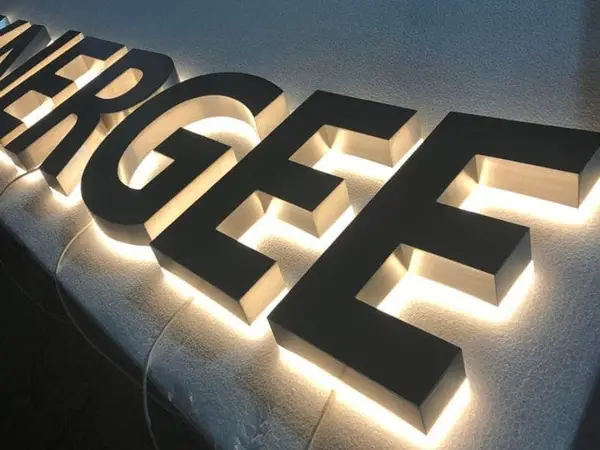
Look, 90% of storefronts want to be seen at night. A solid stainless letter mounted directly to a wall reflects zero light unless you hit it with a ground spot. If your client wants that sleek, high-end metallic look during the day and glowing presence after dark, you don’t choose metal OR acrylic — you marry them. A back-lit halo letter uses a metal face, metal returns, and an acrylic back panel that lets LED wash spill onto the wall. Gives that architectural float effect. Costs more, about $35-120 per letter from our factory floor, but it’s the sign equivalent of a tailored suit.
Pure acrylic face signs — like a flat-cut logo mounted to a raceway — aren’t really “acrylic signs” in the durability sense. They’re plastic faces that need protection. If you paint the backside, you lose translucency. If you leave it bare, UV eats it. The better path is a front-lit channel letter, where the acrylic face is a replaceable lens inside an aluminum or stainless return. Now the structural component is metal, the light-diffusing component is acrylic, and you’re not betting the whole sign on a sheet of plastic.
The factory price for a non-lit, cut-and-polished stainless letter is $15-40 per piece, depending on height and gauge. For a back-lit halo letter, $35-120. For a front-lit channel letter, $20-80. These are Lu’an factory-gate numbers, before shipping and tariffs. A U.S. contractor installing a 24-inch front-lit channel letter on a storefront will likely quote the end client $200-700 per letter. That’s profit, markup, installation, and risk baked in. I know the spread because half our customers are sign shops who import from us and resell.
Acrylic-only letters — like laser-cut 10mm thick acrylic with standoffs — run lower in material cost but higher in long-term risk. We can produce them, but we steer outdoor clients toward metal-composite solutions. For interior lobby logos, sure, acrylic is cheap and crisp. For a south-facing storefront in Texas, acrylic alone is a warranty claim waiting to happen.
A full acrylic light box runs $80-250 per square meter from the factory. Looks great for retail promos. But after 3-4 years, the face will diffuse less evenly, the edges may craze, and you’re paying someone to re-face it. Metal letters with LED lighting might cost more upfront, but they won’t need a face swap. Do that math over a 5-year lease and the metal option usually wins.
An architect once specified a 2mm thick, 8-foot wide acrylic panel for a hotel entrance. It bowed so badly in the August heat that it pulled the mounting studs clean out of the drywall. The replacement used 5mm cast acrylic with edge stiffeners. No more problems. Any span over 2.5 meters, you go 5mm or thicker. I repeat that to every buyer because I’ve repeated it to my own bending team a hundred times.
Look, thickness is a structural call, not an aesthetic preference. Thinner metal tells a similar story: 1.0mm stainless letters look cheap on a 9-foot storefront span. They warp when someone leans a ladder against them. Standard outdoor letter gauge should be 1.5mm minimum for anything under 500mm tall, and 2.0-3.0mm for larger. Our factory stocks 1.0 to 3.0mm, but we’ll push back if a client asks for 1.0mm on a big sign. We’d rather lose the order than ship a warranty problem.
This is the conversation that makes sign shop owners nervous. A beautiful stainless channel letter with cheap LED modules is a time bomb. The metal face will look perfect for a decade, but the light source will be dead in 18 months. Then you’re paying an electrician $300 to cut into the sign and replace modules, and the client is furious because the sign is “broken.” The acrylic didn’t fail. The metal didn’t fail. The $0.12 LED chip did.
We use SMD 2835 chips from Samsung or Osram when specified, delivering 100-150 lumens per watt. Real-world lifespan before L70 drop is 50,000 hours — roughly 5.7 years if run 24/7, longer if on a timer. Quality LED modules last 5+ years. Cheap ones, 12-18 months. The price difference per module is pennies. The labor to swap them later is dollars. Our aging test runs 8-12 hours on every lit sign before it gets packed. I’m not shipping a fire hazard or a lumen drop that’ll embarrass us both.
So when you compare metal vs acrylic signs, factor in where the lights live. In a front-lit channel letter, the LED is inside an acrylic-faced enclosure. In a halo-lit metal letter, the LED is mounted against the back, exposed to more weather. Both need proper IP-rated sealing. IP65 is minimum for outdoor: dust-tight and protected against water jets. Not submersible, not hurricane-proof. Just good enough for rain. I tell clients: if you’re within 5 kilometers of salt water, demand IP66 and 316 stainless, not IP65 and 304. The difference is a 15-year sign vs a 2-year redo.
You can buy a 14-inch front-lit channel letter from a U.S. supplier for $400 installed. That same letter, made with the same Samsung LEDs and 304 stainless returns, costs us about $55 to produce. We add our margin, you pay air or sea freight, and you’re still at roughly $90 landed. Even after the ~30% Section 301 tariff, you’re under $120. That’s why sign shops import. That’s not me bragging — it’s simple manufacturing economics. Labor and material costs in Anhui are a fraction of Ohio’s.
But the ugly truth is that direct factory saving only works if you know how to spec things yourself. If you order the wrong alloy, skip the silicone seal, or forget to request UL-listed power supplies, your cheap sign becomes an expensive lawsuit. Our factory holds CE, RoHS, ISO 9001. We can coordinate UL or ETL certification if the project demands it, though that adds $4,000-15,000 and 4-9 months lead time. That’s the honest cost of compliance. If some factory tells you they already have UL for all their signs, ask to see the product-specific listing and the quarterly audit reports. Most can’t produce them.
Freight wise, you pick your poison. Express gets you a sample sign in 7-10 days at $30-100. Air freight for a batch is about 10 days, $4-12 per kilo. Sea freight is about 65 days and $80-200 per cubic meter for less-than-container loads. We recommend sea for full storefront refits, air for rush jobs. The packaging won’t rot: foam, carton, then plywood crate. I’ve shipped worldwide, and the only sign that arrived damaged was run over by a forklift. Not the crate’s fault.
Law firm on a suburban boulevard. No direct salt, moderate sun, needs to look prestigious. Stainless steel letters with brushed finish, maybe with halo backlighting. Acrylic would look like a dentist’s office after 3 years. Metal holds value.
Coffee shop in a renovated industrial building, huge window front. You want warmth and glow. An acrylic light box with 3000K LEDs mounted inside, or a front-lit channel letter set with warm white modules. Acrylic face here makes sense because the sign is mostly light, not durable metal coolness. Just make sure the face is UV-stabilized import acrylic and the returns are aluminum to keep weight down.
Beachfront grill on the Florida coast. 316 stainless letters, no questions, with IP66-rated halo lighting. Acrylic will craze within 12 months from salt aerosol and UV. Don’t even quote acrylic. If the budget screams, drop the halo lighting and do an oversized non-lit stainless logo. But don’t try to save $200 by downgrading the metal grade.
High-traffic retail chain in a Midwest strip mall that needs a consistent look across 30 locations. Standardized aluminum letters with powder coat finish. Lightweight for fast installation, durable for 8-12 years, no rust, easy to replace if a panel gets dinged. Acrylic faces across that many sites would require a maintenance schedule for cleaning and re-facing that a chain operator doesn’t want.
We’re not a design agency. If you send us a napkin sketch, we’ll make it production-ready, but we don’t invent your brand identity. We need vector files. We can advise on material thickness, LED color temperatures, and mounting methods, but we won’t pretend to be your architectural sign consultant. That’s your job.
We don’t install. We ship to your dock, your sign shop, your job site. The crate lands, and you handle the lift truck and the anchor bolts. I’ve seen importers get annoyed about that. But that’s the deal. We make the sign; you make it appear on the wall.
Here’s what nobody tells you: a storefront sign isn’t a purchase. It’s a lease on your client’s reputation. The material you pick — metal or acrylic — determines how soon you’ll get that call that starts with “the sign looks terrible.” Acrylic calls come faster. A UV-blasted, yellowed piece of plastic screams neglect. Metal calls come slower, and they’re usually about corrosion from using the wrong grade. Both calls cost you time you won’t bill anyone for.
If you want a storefront sign that outlasts the 5-year lease, go metal. If you need the luminous pop of a backlit face for a 2-year pop-up, go acrylic but spec the good stuff and put it in a metal return. The in-between, the hybrid, the channel letter, is where 90% of our orders land. And that’s not because it’s a compromise — it’s because it’s the smartest long-term spec for a business that needs to look professional at noon and impossible to miss at midnight.
I’ve shipped front-lit letters to a bakery in Melbourne and halo-lit stainless to a law office in Denver. Both are still up, five years in. The bakery used 304, the law office used 316 because of snow melt chemicals. Both used Samsung LEDs. That’s the difference between picking a sign and engineering a sign. Most buyers just lean on the cheapest quote. The ones who don’t call us back with a second project, not a problem.
Call it what it is: a custom metal sign that incorporates acrylic for light diffusion will run you more on the front end but half as much on the back end. If that logic makes sense to you, you’re already ahead of 80% of the market.

Real photo from our production floor — every sign we ship is made here.
Products mentioned or relevant to this topic — factory-direct, custom built.
From $24/letter · MOQ 1 piece · Flexible lead time · CE & UL certified · ships to 20+ countries
Custom sizes, colors, and finishes. Get a factory price in 24 hours.
Get a Free Quote Copy EmailWhatsApp +86 13865703472 · business@aochuangsign.cn
See pricing, specs, and get a free quote for the sign type you need. Built in our factory, shipped worldwide.