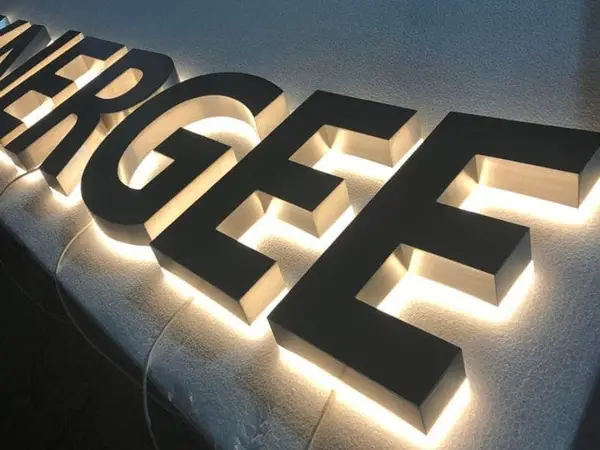
Look, I've watched sign shops pay $800 for a front-lit letter from a domestic fabricator. Same 304 stainless, same Samsung LEDs. We ship that letter for $120.
I've been building signs since 2010. 3,000 square meters of production floor, 50+ workers, and more arguments about acrylic than I care to remember. If this article sounds grumpy, it's because I wrote it at 11pm after a 12-hour day on the factory floor.
Here's what nobody tells you: acrylic isn't all the same. Mitsubishi or Degussa UV-resistant acrylic holds color for 5-8 years. Domestic sheet yellows in 1-2 years. And if the sign spans over 2.5 meters, you need 5mm thickness minimum. Not negotiable.
Stainless steel is my default for exterior letters. 304 has 18% chromium and 8% nickel, good for 10+ years outdoors. For coastal or industrial, 316 adds 2-3% molybdenum and costs 20-30% more. In Miami Beach, that's not an upgrade—it's the only choice. If you're ordering stainless steel letters, specify the alloy.
Aluminum weighs a third of steel. Anodized or powder coated, it'll go 8-12 years outdoors. Common thicknesses run 1.0 to 1.6mm. Aluminum won't rust, but it's soft. Don't spec thin aluminum on big structural returns unless you reinforce it.
Here's a mini-story. A customer once insisted on 1.0mm stainless for 800mm-tall letters because it was cheaper. First windstorm, the returns oil-canned and the sign looked like a potato chip. Use 2.0mm for anything over 600mm. Pay now or pay twice. Ask me how I know.
Our laser cutter holds ±0.1mm. That's the difference between a clean return bend and a seam you can see from across the street.
I've seen this go wrong: a shop CNC-routes acrylic faces without accounting for thermal movement. First summer, the face bows out of the return. You get a wavy sign. A 3mm acrylic face gives you 92% light transmission, 2mm gives you 90%. The customer won't notice the 2% difference, but they will notice a 40% cost bump if you spec 3mm everywhere.
Stainless letters get TIG welded. Grinding and polishing after matters more than the weld itself. A good fabricator spends as long polishing as welding. If the weld bead looks like bubble gum, the polisher can't fix it.
CNC routing is for acrylic faces and aluminum backs. Laser cutting is for stainless returns and detailed perforations. Don't laser-cut thick acrylic; it melts the edge and leaves stress cracks. We route acrylic, we laser metal. Not a preference. It's how you avoid remakes.
Tolerances aren't decoration. I tell customers: if your drawing doesn't call out tolerance, the factory will guess. Then you'll argue about a 1mm gap. For fabricated letters, ±1mm on letter height is realistic. For a 10-foot sign, that's nothing.
Thermal movement is real. Aluminum and acrylic expand at different rates. Leave 2-3mm expansion gap on long runs or you'll see buckling in July. That's not theoretical. I've seen it happen on a 20-foot sign in Texas.
Look, seams are where water gets in. If you can't avoid them, seal with neutral silicone and design the seam so water drains away, not into the electrical cavity.
Stroke width matters. If your letter stroke is under 20mm, you can't fit standard LED modules inside. That's when you switch to side-lit acrylic or mini LEDs. Design the sign around the light source, not the other way around.
Ugly truth: powder coating only lasts as long as the pre-treatment. Skip the chromate conversion and the paint flakes in two years. Stainless 304 with brushed #4 finish needs no coating. Mirror #8 is gorgeous but shows fingerprints from ten feet.
Anodizing aluminum gives you that architectural look. Powder coat any RAL color you want. But powder on sharp edges is thin. Expect chipping on 90-degree corners if you don't radius them.
PVD coating on stainless is applied in a vacuum chamber, not sprayed on. That thin layer won't peel like paint, but it'll scratch. For luxury retail, it's worth it. For a gas station canopy, it's wasted money.
Finished aluminum won't rust on its own. That doesn't mean you skip pre-treatment before powder. Clean, etch, chromate, then coat. Rookie mistake: powdering over mill finish and wondering why it blisters in six months.
Let's be blunt: cheap LED modules die in 12-18 months. The solder joints go dull gray. Good modules from Samsung, Osram, or Blueview last 5+ years of real use. L70 says 50,000 hours—on paper. In the field, it depends on heat and the power supply. If you're ordering front-lit channel letters for a storefront, spec the LED brand.
SMD 2835 puts out 100-150 lumens per watt, the industry standard. For RGB, use 5050. For highest brightness, 5730. If your customer wants warm hospitality light, 3000-3500K. Corporate retail runs 4000-5000K. Cool 6000-6500K looks industrial.
IP65 means dust-tight and water-jet resistant. That rating won't stop a hurricane. Near saltwater, you need IP66 or IP68. A one-year power supply warranty is standard. If someone offers 5 years on the power supply, read the fine print. For premium architectural work, back-lit halo letters hide the modules behind the letter and create that soft glow.
Power supplies need ventilation. Seal them up tight and they overheat. Use 12V or 24V. Run the correct wire gauge. Our aging test runs 8-12 hours and catches failures before anything leaves the factory. If your supplier doesn't do aging tests, you're their quality control department.
CE marking costs 20,000-50,000 RMB. Most factories will say they have it. Ask to see the certificate with today's date. Watch them sweat.
UL 48 runs $4,000-15,000 and takes 4-9 months with quarterly audits. ETL is 10-30% cheaper. Don't skip it for US installs. NEC Article 600 applies. Your local inspector won't care about a CE mark.
Our aging test runs 8-12 hours. Every sign gets 100% QC inspection. Then export packaging: foam, carton, plywood crate. LCL sea freight means your crate gets handled 6-8 times. Every touch is a chance for damage.
Certifications are not interchangeable. ISO 9001 is process. CE is safety. RoHS is materials. I've had customers ask if ISO covers UL. No. Stop it. If you need a US electrical listing, that's UL or ETL, period.
Factory-direct pricing: front-lit channel letters run $20-80 per letter. Back-lit halo letters $35-120. Stainless steel non-lit $15-40. US retail installed? $200-700 for front-lit, $400-1,000 for halo. You do the math. That's 50-65% savings on product.
Shipping adds cost. Express about 5-15 days for $30-100 small. Air about 10 days at $4-12/kg. Sea about 65 days at $80-200/m³ LCL or $1,200-3,000 FCL. US Section 301 tariff is about 30%. Don't forget that when you compare to domestic.
Lead time from our factory is about 5-15 days. MOQ is 1 piece. Two-year warranty on LEDs, one year on power supply. If a supplier can't match that, keep looking.
The total cost of ownership includes engineering stamps, crating, freight, tariffs, and installation. A $120 letter might become $300 installed. Still cheaper than $800 for the same letter from a US shop, but don't pretend those costs don't exist.
What's the difference between IP65 and IP66?
IP65 handles water jets from any direction. IP66 handles powerful jets. For coastal, IP66. For a strip mall in Ohio, IP65 is fine. Stop overthinking it.
Can I install these myself?
You can. But NEC Article 600 applies. If you don't know what that is, hire a licensed electrician. I've seen DIY installs fail because someone used wire nuts in a wet location.
Why do your prices seem too low?
Because you're used to US retail markup. We're a factory. 3,000 square meters, 50+ workers, CE, RoHS, ISO 9001. We ship worldwide. That's not too low. That's what it costs without three middlemen.
How long do these signs really last?
Stainless 304 lasts 10+ years. 316 lasts 15+ marine. LED modules from Samsung or Osram last 5+ years real lifespan. Cheap LEDs die in 12-18 months. If you want a sign that lasts, don't buy the cheapest quote.

Real photo from our production floor — every sign we ship is made here.
Products mentioned or relevant to this topic — factory-direct, custom built.
From $24/letter · MOQ 1 piece · Flexible lead time · CE & UL certified · ships to 20+ countries
Custom sizes, colors, and finishes. Get a factory price in 24 hours.
Get a Free Quote Copy EmailWhatsApp +86 13865703472 · business@aochuangsign.cn