When I crunched the numbers on a 20-letter channel letter sign for a retail chain, the difference between direct mount and raceway installation came out to nearly $4,000 per location. That's not a rounding error. That's a whole store's lighting budget.
Your boss wants to know why one method costs more upfront and another bleeds you on labor. You want a decision that minimizes total cost of ownership. After sourcing signs from Chinese factories, domestic shops, and every shade of fabricator in between for 12 years, I've seen what works and what's a salesman's fantasy. Here's the real breakdown on direct mount, raceway, and backer panel installation—backed by hard data from the factory floor and the field.
Direct mount means each letter is fastened individually to the wall. Raceway uses a metal channel that runs all the wires and mounts as one unit. Backer panel is a single sheet of aluminum or acrylic that holds all the letters and attaches to the building as one piece.
Your boss will ask: "Why are we paying more for labor on direct mount when the parts are cheaper?" Good question. Direct mount parts cost less—no raceway or backer panel to fabricate. But installation labor runs 30–40% higher because you're aligning each letter, drilling separate holes, pulling individual pigtails, and sealing every penetration. A 15-letter sign with direct mount takes a two-person crew two full days. Same sign with a raceway? One day, maybe less.
Line by line, here's where the money goes:
The ROI works out to raceway winning for chains with 20+ locations where standardized install speed cuts field time. Direct mount wins for historic buildings where you can't attach a raceway. Backer panel wins for messy walls—brick, stone, stucco—where drilling 40 holes is a nightmare and one panel with four mounts is faster.
I've watched sign shops pay $800 for a front-lit letter from a domestic fabricator. Same 304 stainless, same Samsung LEDs. We ship that letter for $120. That's factory-direct pricing from Aochuang Sign, which has been exporting for 14 years from a 3,000m² facility with 50+ workers. But the material grade matters more than where it's made.
Stainless 304 gives you 10+ years outdoors with 18% chromium and 8% nickel. For a suburban shopping center in Ohio, that's all you need. But if your sign faces ocean salt or industrial chemicals, 316 stainless adds 20–30% cost premium and boosts life to 15+ years thanks to 2–3% molybdenum. I had a client in Miami Beach who saved $400 by using 304. Three years later, every letter had pitted surfaces. The replacement cost ate up all the savings and then some.
Aluminum runs about one-third the weight of steel and naturally rust-proofs. Life expectancy: 8–12 years outdoor if powder coated properly. Here's the rookie mistake: using cheap domestic acrylic for backer panels. Good UV-resistant acrylic (Mitsubishi or Degussa) lasts 5–8 years before yellowing. Domestic knockoff acrylic starts fading in 1–2 years. The cost difference per sheet is maybe $15–20. The reputation hit from a yellowed sign in year two? Priceless in the worst way.
When I crunched the numbers on a national coffee chain's re-sign program, swapping from 2mm domestic acrylic to 3mm Mitsubishi acrylic added $0.45 per letter. That's $9 for a 20-letter sign. The franchisee complained until I showed him the warranty cost for a full replacement in year three: $2,800 per sign. He didn't argue again.
Quickest way to spot bad LED modules: look at the solder joints. Dull gray = won't last 18 months. Shiny silver = proper lead-free solder. I've seen cheap modules fail within a year while quality Samsung or Osram chips (L70 ≥50,000 hours) run 5+ years. The factory-direct price difference is $2–5 per module. On a 15-letter sign with 30 modules, you're risking $90–150 of savings against a $1,200+ re-servicing call.
Color temperature matters too. For hospitality, you want 3000–3500K warm. For corporate or retail, 4000–5000K neutral. For industrial or highway, 6000–6500K cool. Mixing suppliers across batches gives you a rainbow effect that your facilities manager will curse you for. I always spec SMD 2835 for general use (100–150 lm/W, industry standard) and SMD 5730 only when I need brute brightness at 40–60 lm/chip. The higher-end 5730s are overkill for a typical storefront channel letter.
Your boss will ask: "Why do we need UL certification if we're buying from China?" Because NEC Article 600 requires it for commercial signs in the US. UL 48 certification costs $4,000–15,000 and takes 4–9 months with quarterly audits. Most Chinese factories don't have it. They'll show you CE marking instead. CE costs 20,000–50,000 RMB (about $3,000–7,000) and takes 2–8 weeks. It's valid in Europe, not the US. I've seen factories claim CE equals UL. They're lying. Ask to see the certificate with today's date. Watch them sweat.
If you're on a tighter budget, ETL is a UL alternative that's 10–30% cheaper and accepted by most US inspectors. Make sure your factory has ETL on file, not just a promise. IP65 is standard for outdoor signs—dust-tight and water jets from any direction. It does NOT mean your sign survives a Florida hurricane. For coastal locations, spec IP66 or IP68. Those are real.
You're saving 50–65% on product cost by going factory-direct from China. But shipping and tariffs eat into that. Here's the math on a 20-letter sign with raceway (approx. 0.8 m³, 40 kg):
The Section 301 tariff is roughly 30% on steel and aluminum signs from China. That's law until at least 2024. You can't dodge it by shipping via Vietnam unless you're doing real value-add there. I had a client who tried transshipping—customs caught it, fined him, and seized the goods. Bad idea.
When I crunched the numbers for a 12-store rollout using air freight, the total cost per sign was $1,250 landed versus $4,800 US retail. Even with the tariff, we saved $3,550 per sign. For 12 stores, that's $42,600. The CFO signed off same day.
The choice isn't just about upfront cost. It's about total cost of ownership over the sign's life, which for quality LED and stainless should be 7–10 years minimum. Let's run the scenario for a 15-letter channel letter sign on a brick facade with a 10-year lifespan.
Direct mount: Installation labor $1,400. Each letter has its own mounting holes—15 penetrations through brick. Every hole needs a stainless anchor, silicone seal, and flash patch. Leak risk is additive: 15 holes, 15 chances for water intrusion. Over 10 years, expect at least one call-back for resealing ($200–400 per trip). LEDs are easy to replace individually but removing a letter requires dismounting and rewiring. Total 10-year TCO: ~$2,000–2,500.
Raceway mount: Installation labor $700. The raceway has 4–6 mounting points, heavily sealed at the top edges. Fewer penetrations, lower leak risk. All wires run inside the raceway—no individual pigtails to corrode. If a transformer fails, it's inside the raceway, not inside a letter. Replacements are

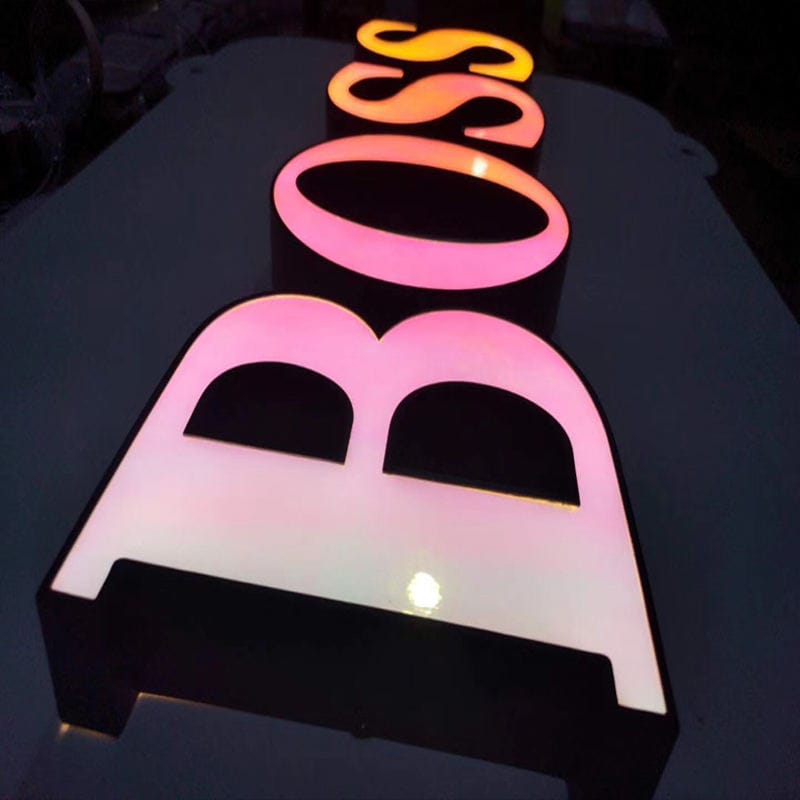
Real photo from our production floor — every sign we ship is made here.
Products mentioned or relevant to this topic — factory-direct, custom built.
From $24/letter · MOQ 1 piece · Flexible lead time · CE & UL certified · ships to 20+ countries
Custom sizes, colors, and finishes. Get a factory price in 24 hours.
Get a Free Quote Copy EmailWhatsApp +86 13865703472 · business@aochuangsign.cn
See pricing, specs, and get a free quote for the sign type you need. Built in our factory, shipped worldwide.