Types • Materials • Sizing • Installation • Pricing • Certifications • Maintenance
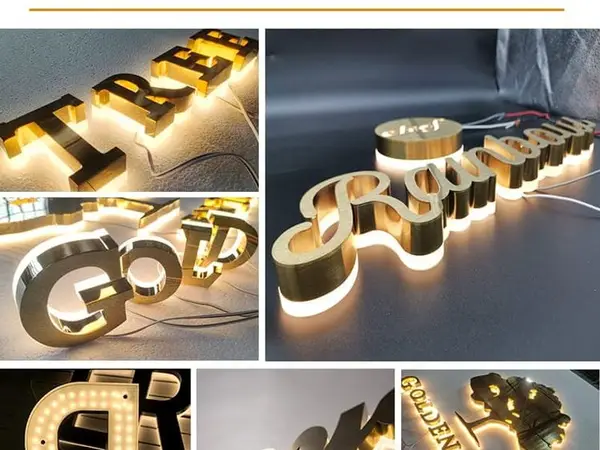
Channel letters are three-dimensional, individually fabricated letters — each character is its own separate unit, typically made from aluminum with an acrylic face, illuminated from within by LED modules. They are the most common type of commercial storefront signage in North America and the industry standard for professional branding.
Think of them as custom 3D letters that light up. Each letter is a sealed unit containing its own LED light source, wired together and mounted to a building facade or raceway. The global channel letter lighting market was valued at 177.5 billion RMB (~$2.45 billion USD) in 2026, and LED channel letters now represent over 60% of new commercial signage installations worldwide.
A standard channel letter consists of four components:
Not all channel letters glow the same way. The illumination style changes the entire look — and the cost.
The most common and cost-effective option. LED modules inside the letter shine through a translucent acrylic face, creating bright, even illumination. The face can be produced in any Pantone color. This is what you see on 80% of retail storefronts — restaurants, pharmacies, clothing stores, and medical offices.
Best for: Maximum readability, any business that wants to be seen from a distance.
The letter face is opaque metal (painted aluminum or stainless steel), and LEDs face the wall behind. Light spills around the letter edges, creating a soft "halo" glow on the mounting surface. During the day, it looks like premium metal lettering; at night, the halo effect creates a sophisticated silhouette.
Best for: Law firms, corporate offices, luxury retail, hotels — anywhere that wants to signal "premium." Costs 15-25% more than front-lit due to more complex fabrication.
Both front illumination through acrylic AND a back-lit halo from a secondary set of LEDs. Maximum visual impact — but also the most expensive option. Requires two sets of LED modules and more complex wiring.
Best for: Flagship stores, casinos, entertainment venues where signage IS the marketing.
No acrylic face — the letter body is open, and LED neon flex or traditional glass neon tubing is visible inside. Creates a retro, vintage aesthetic. Popular with bars, barbershops, and entertainment venues going for an old-school look.
| Type | US Retail Price/Letter | Factory Price/Letter | Best Application |
|---|---|---|---|
| Front-Lit | $200–$700 | $20–$80 | Retail stores, restaurants, medical offices |
| Back-Lit (Halo) | $400–$1,000 | $35–$120 | Law firms, corporate HQ, luxury retail |
| Combination-Lit | $500–$1,200 | $50–$180 | Flagship stores, casinos, entertainment |
| Open Face (Neon) | $300–$800 | $30–$100 | Bars, barbershops, retro-themed venues |
Factory-direct insight: The price difference between US retail and factory pricing is not just about labor — it's the entire supply chain. A US sign shop buys materials, fabricates, permits, and installs. When you buy factory-direct, you handle installation locally and save 60-80% on the sign itself. More on this in Section 8.
Acrylic (PMMA) is the standard face material with 90-92% light transmittance. But not all acrylic is equal:
The LED modules are the heart of the sign. Here is what matters:
China's new LED standard: GB/T 24823-2024 took effect June 1, 2025, replacing the 2017 version. It requires actual LED module efficacy ≥90% of rated value, and lumen maintenance of 70-90% during the test period. It aligns with international standard IEC 62717-2019. When sourcing from China, ask manufacturers if their LED modules comply.
All channel letters run on 12V DC constant current drivers that convert 110V/220V mains power. The formula: Total wattage = (number of LED modules × wattage per module) ÷ 0.8 — the 0.8 factor leaves a 20% safety margin. Outdoor installations require weatherproof drivers rated IP65 or higher. Power supplies typically carry a 1-year warranty (vs 2 years for the LED modules themselves).
Letter height is determined by viewing distance, not personal preference. Here are the rules of thumb used by professional sign shops:
Stroke width matters too. A font with thin strokes (like Times New Roman) will look washed out when illuminated. Bold sans-serif fonts (Helvetica, Arial, Gotham) are the standard for channel letters. Minimum stroke width should be 1/8 of letter height for good readability and enough space to fit LED modules.
Each letter mounts individually to the building facade with stainless steel studs and silicone sealant. This is the cleanest-looking method — letters appear to float on the wall. But it requires drilling holes for every single letter through the facade, which means more sealing and more potential leak points.
All letters mount onto a rectangular aluminum box (raceway) that houses all wiring and power supplies. The raceway is then mounted to the building with fewer attachment points. This is the standard for shopping centers where property managers want to minimize wall penetrations. The raceway is painted to match the building facade. Easier to service — remove one panel instead of dismounting individual letters.
Letters mount through or onto a decorative backer panel (often ACM — aluminum composite material). Good for uneven wall surfaces. The backer can incorporate branding colors or graphics behind the letters.
| Method | Appearance | Wall Penetrations | Service Access | Cost |
|---|---|---|---|---|
| Direct Mount | Cleanest | Many (per letter) | Harder | $ |
| Raceway Mount | Functional | Few (per raceway) | Easy | $$ |
| Backer Panel | Premium | Fewer (per panel) | Moderate | $$$ |
An outdoor channel letter sign is essentially an electronic device mounted on a wall in the rain. Water ingress is the #1 cause of failure. Here is how a properly built sign handles it:
Common failure modes and their causes:
Understanding the price gap helps you decide whether to buy locally or import:
| Scenario | USA Retail (Installed) | Factory Direct + Local Install | Savings |
|---|---|---|---|
| 6 letters, 18" front-lit, basic font | $3,000–$4,500 | $400–$600 (sign) + $800–$1,200 (install) | ~50-60% |
| 6 letters, 18" halo-lit, stainless steel | $5,000–$8,000 | $600–$900 (sign) + $1,000–$1,500 (install) | ~55-65% |
| 12 letters, 24" front-lit, custom color | $7,000–$12,000 | $800–$1,400 (sign) + $1,200–$2,000 (install) | ~55-65% |
What the savings don't cover: You handle permitting, you coordinate the local installer, and you carry the shipping risk. But for a sign shop owner or contractor who already does these things, importing factory-direct is a major margin opportunity.
Shipping costs to factor in:
A properly built channel letter sign should be a 10+ year asset. Here is what wears out and when:
Maintenance checklist for building owners:
After 15 years in this factory, here is what separates a sign that lasts a decade from one that fails in a year:
| Aspect | Quality Build | Junk Build |
|---|---|---|
| Aluminum thickness | 0.040–0.063" (1.0–1.6mm) | 0.025" or thinner — dents easily |
| LED brand | Samsung, Osram, or tier-1 Lan Jing | No-name modules, inconsistent brightness |
| LED spacing | Engineered layout for uniform light | Random spacing, visible hotspots |
| Welding | Full seam TIG/MIG weld, ground smooth | Spot welds or glue — fails under wind load |
| Sealing | Continuous neutral silicone, weep holes | Gaps in sealant, no drainage |
| Paint | Automotive-grade, UV-resistant, 7+ years | Cheap spray paint, fades in 1-2 years |
| Wiring | Soldered and heat-shrinked, no bare connectors | Twist-on wire nuts, exposed copper |
| Packaging | Plywood crate + foam padding + waterproof wrap | Cardboard box with bubble wrap |
When you're sourcing channel letters — whether from a local sign shop or an overseas factory — ask these questions:
Quality LED modules (L70 rated) last 50,000+ hours — that's 11+ years at 12 hours of daily use. In practice: the LEDs will likely outlast the power supply. Budget for a power supply replacement every 3-5 years for outdoor signs.
Many Chinese factories (including ours) have a 1-piece minimum. You can order a single custom letter if that's what you need. The per-letter price is higher for singles, but there's no forced bulk minimum.
If you're comfortable with basic electrical work (wiring a 12V driver) and have the equipment to drill into your building's facade — yes, many contractors DIY the installation. We provide a full-size paper mounting template and wiring diagram with every order. For large or high-elevation installations, hire a licensed sign contractor — permitting usually requires one.
Standard lead time is 7-15 days for most orders. Rush service (5-7 days) is available. Shipping time is additional — 7-15 days express, about 65 days sea freight.
Vector files: AI, EPS, PDF, or CDR. These contain scalable outlines that our laser cutter reads directly. JPG and PNG are raster images — we can work from them, but fonts need to be identified and vectorized, which adds time.
In most US cities, yes. The process typically involves submitting engineered drawings (showing attachment methods and wind load calculations), obtaining landlord/property owner approval, and passing a final inspection. Permitting takes 2-6 weeks and costs $100-300+. Start the permit process early — it's often the longest lead time item.
Channel letters are individual 3D letters, each self-contained. A light box is a single rectangular cabinet with a translucent face — the whole thing lights up as one unit. Channel letters look more premium; light boxes are more budget-friendly and provide a larger illuminated surface area for the same cost.
Send us your design file or just tell us what you need. We'll respond with a quote and production timeline within 24 hours — no obligation.
Get a Free Quote → Copy EmailExplore specific topics from this guide in depth — each article is a comprehensive 1,500–2,500 word resource written by our factory experts.
MOQ: 1 piece • Lead time: 7-15 days • Worldwide shipping
Dive deeper with these in-depth articles from our factory floor.