Here's what nobody tells you: the most expensive part of a sign isn't the sign. It's the guy standing on the ladder.
The factory price on a front-lit channel letter runs $20 to $80. The same letter installed by a US sign company? $200 to $700 a letter. That gap isn't all markup. Part of it covers electrical work, permits, insurance, a crane, two guys who've done this before, and the risk that if it falls off the wall, it's their ass, not yours.
But you already know that. You're an importer, a contractor, or a shop owner trying to figure out if you can cut that $200-per-letter cost and DIY the install. Sometimes you can. Sometimes it's the dumbest money move you'll make all year.
Factory-direct pricing saves you 50 to 65% on the product itself. That's real. A set of front-lit channel letters for a storefront might cost you $1,200 from us. The local sign shop quotes $4,500 installed. Room to play.
But the difference between 50% savings and 100% disaster often comes down to one thing: install labor. You think you're paying $1,000 for a crane rental. Fine. But what about the insurance rider for that crane? What about the stamped engineering drawing the city requires for a sign over a certain size? What about the electrician who has to pull a permit and handle the 277V feed from the building's roof?
I've seen this go wrong: a contractor installed a 12-foot channel letter sign without a permit because the client wanted to save $300. City inspector showed up, red-tagged the building, and the tenant had to close for two days. That cost $8,000 in lost revenue. The sign cost $2,200.
There are two types of "DIY install" in this business. The first is a sign shop or contractor doing it in-house with their own crew. The second is a business owner who buys a factory-direct sign and hires a handyman, or tries to install it himself with a friend.
The first one can work. The second one is usually a legal accident waiting to happen.
Here's what nobody tells you: the factory doesn't care who threads the bolts. We care that you don't call us in three months blaming the product. You install it wrong, and a 40-pound letter drops onto a sidewalk. Nobody asks about the LED quality. They ask who hung the sign.
We warranty our LEDs for 2 years, power supplies for 1 year. That's real. But it only covers manufacturing defects — not water ingress from a silicone job you did over a weekend, not a short circuit from wiring that isn't rated for outdoor use, not a panel that snapped because you drilled through the return leg instead of the mounting hole.
Most factories include IP65 sealing. That's dust-tight and water jets from any direction. That's the minimum for outdoor signs. But if you cut a hole in the back for wire access and don't repack it with a proper conduit hub, you've turned an IP65 sign into a rain catcher.
The ugly truth is: cheap imports fail because of installation, not manufacturing. You can buy a $90 SMD 2835 LED module with excellent lumens per watt. It'll still die in a year if the junction box fills with water.
"IP65 means it's waterproof." No. It's water-resistant under specific conditions. A hurricane off the coast won't care about your IP rating. For coastal or high-wind zones, you calculate wind load, not just IP. You use 316 stainless, not 304. That's 20-30% more money, but it's not optional if you're screwing this to a beachfront wall.
And "CE certified" — I've seen factories post that PDF so loosely you'd think it came from a cereal box. Real CE testing runs 20,000 to 50,000 RMB and takes weeks. Ask to see the certificate with your factory's name on it. Don't accept a generic file. If you're buying from us, we'll show you the actual reports, not a screenshot from a trade show.
Same goes for UL. UL 48 testing for signs runs $4,000 to $15,000 and takes 4 to 9 months. If your factory has it, they'll brag. If they don't, they'll say "UL isn't required." And maybe it isn't — until you hit a city inspector who demands it. Then your DIY install turns into a $200-an-hour electrical engineer problem.
Not everything needs a licensed crew. If you're installing a neon flex sign inside a coffee shop, plug it into a standard outlet and hang it with two screws. You don't need a crane. You don't need a permit. You don't need to spend $600 in labor on a $150 sign.
Same goes for small aluminum letters mounted on a flat wall at eye level. Lightweight, rust-proof, and if you've got a stud finder and a level, you can finish a 3-letter logo in an afternoon. The mounting hardware is simple. The wire runs through the wall to a standard switch. That's not rocket surgery.
But here's the rule: if you can do it without leaving the ground, without connecting to line voltage, and without needing a second pair of hands because of the weight, DIY is fine. That describes about 20% of commercial signage.
Now the other 80%. Any sign over 8 feet above grade. Any sign that weighs more than 50 pounds. Any sign that pierces the building envelope. Any electrical connection that isn't a simple plug-in. Each of those is a license to lose money, and often a building.
Let me give you numbers. Wind load on a 3-foot tall channel letter at 30 feet elevation isn't just the letter's weight. It's the drag coefficient times the local gust frequency. A 10-square-foot sign in a 90-mph wind can generate 1,500 pounds of force. Did your DIY bracket account for that? Or did you use two lag bolts and a prayer?
That's why professional installers use engineered mounting systems, rebar into concrete, and structural adhesives rated for 1,000+ psi. That's also why they charge $500 just for the labor. They bought the insurance and the torque wrench.
And if you're importing a sign and hiring a "handyman" to install it, you've just become the general contractor. Every issue is your fault. Every injury on site is your workers' comp claim. Every code violation is your fine. Congratulations, you saved $300.
If your project sits within half a mile of saltwater, you need stainless steel letters in 316, not painted aluminum. The 20-30% premium isn't a luxury. It's the difference between a clean sign in 8 years and a rust-stained eyesore in 2. And if you're mounting that signage on a parapet wall, DIY is not an option. Period.
Here's what nobody tells you: professional sign installers are overpriced when you don't need them, and worth every cent when you do. You're not paying for the hour of labor. You're paying for the permit experience, the lift rental, the liability insurance, and the fact that if the sign falls in a windstorm, someone's coverage pays for it — not your business.
A commercial install might cost $1,200 on a sign you bought for $800 factory-direct. That's still 40% cheaper than a $3,200 quote from a sign company that's just reordering the same letters from China. But only if you're using a licensed electrician and a bonded installer. Don't hand a factory-direct sign to the same guy who hangs garage doors. He'll hang it, but he won't know about the drip loop, the expansion anchors, or the sealant compatibility with acrylic.
That last one matters. Neutral silicone, the sign industry standard, is what we use in the factory. If your installer uses generic hardware-store silicone — acetic acid cure — it will degrade acrylic over a few years. That's a slow, silent failure. You'll blame the acrylic quality. It's not. It's the chemistry.
Let's be blunt: Aochuang Sign is a factory, not an installation crew. We don't hang signs. We don't pull permits. We don't know whether your storefront in Columbus requires a stamped engineered drawing or just a building permit. That data is local, and it changes. Don't ask us if your sign is ADA compliant or NEC compliant — we know our products are manufactured to CE, RoHS, and ISO 9001 standards, but your electrical hookup is on you.
What we can do: precision CNC cutting (±0.1mm), TIG welding, 8-12 hour aging tests on every LED batch, and export packaging that survives a forklift drop. We can give you the exact weight, wind load calculations for the letter face, and wiring diagrams. We can ship to your door in about 5-15 days, with express or sea freight. And we'll help you plan for the Section 301 tariff — roughly 30% — so it doesn't blow up your margin after you've already ordered.
But the last 20 feet — from the tailgate to the wall — that's yours. Don't ask us to send a "technician" to supervise. We've done that for a few whale customers. The cost of a field service engineer from China to the US is $25,000 and takes three weeks for visa paperwork. You don't need that. You need a good local electrician and a sign company that's been around longer than your attorney.
Run this checklist. If you answer "no" to any of these, call a pro.
If all of those get a "yes," DIY that thing. Save the $400. A small neon flex sign in a restaurant, a light box behind a bar, a set of aluminum letters at eye level — do it yourself.
But if any answer is "no," the cheapest professional installation quote is still better than the most expensive DIY mistake you'll ever make. Because the sign isn't the liability. The install is.
And that's the truth from a guy who's seen both sides. Buy the right letters from a factory that's honest about what it can and can't do. Then use the right hands to put them up.

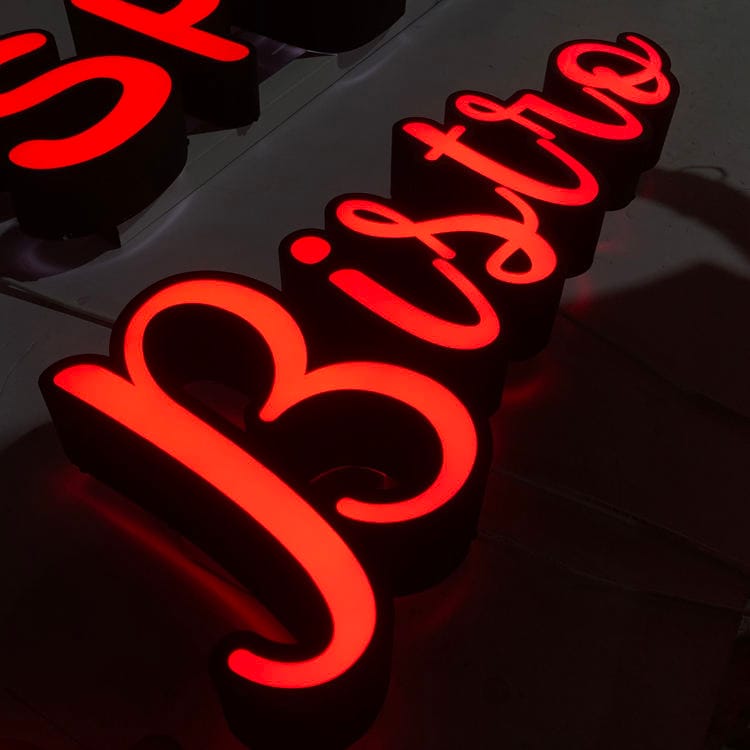
Real photo from our production floor — every sign we ship is made here.
From $24/letter · MOQ 1 piece · Flexible lead time · CE & UL certified · ships to 20+ countries
Custom sizes, colors, and finishes. Get a factory price in 24 hours.
Get a Free Quote Copy EmailWhatsApp +86 13865703472 · business@aochuangsign.cn
See pricing, specs, and get a free quote for the sign type you need. Built in our factory, shipped worldwide.