You just saved $1,200 on three front-lit channel letters from a factory like ours. Now you’re staring at a scissor lift rental quote and thinking, “I can knock this out Saturday.” Look, I’ve sold signs worldwide. I’ve never once had a customer call to thank me for an easy DIY install. I have, however, taken tearful calls about cracked acrylic faces, a $400 letter tumbling onto a parked car, and one guy who drilled into a live 277V circuit because he “eyeballed” the conduit.
The real bill isn’t in the hardware. It’s in the ambulance ride, the reorder lead time, the voided warranty, and the building owner who blacklists you. This guide doesn’t care if you hire it out or torch your weekend. I’ll give you the numbers I know—factory costs, material realities, the kind of screw-ups that write themselves onto a hospital invoice—and you can decide how lucky you feel. Aochuang Sign makes the product. We don’t install it. We definitely don’t climb ladders for you. But after 16 years on a factory floor, I can tell you exactly where your money disappears when you skip the crew.
Here’s what nobody tells you: the product price is half the battle, at best. A typical set of three 20-inch front-lit channel letters from us runs $60–$240 total, depending on LED spec, acrylic thickness, and finish. That same set, professionally installed at a US strip mall, quotes out at $600–$2,100. The gap? Labor, lifts, permits, insurance, and the installer’s hard-won knowledge that silicone doesn’t stick to dirty concrete. I’ll break it down.
Factory-direct pricing for channel letters: our front-lit channel letters leave Lu’an at $20–$80 per letter. Back-lit halo letters hit $35–$120. Stainless steel non-lit stainless steel letters are $15–$40. All with Samsung-grade LEDs, properly sealed, aging-tested for eight hours. Shipping adds another $30–$100 by express, or $80–$200 per cubic meter by sea if you can wait about 65 days. Even with the Section 301 tariff at ~30%, you’re paying 50–65% less than local sign shop retail. But that’s the easy part.
The ugly truth is that a sign in a crate is not a sign on a facade. There’s no price list for mounting because every wall is a special snowflake. Concrete tilt-up. EIFS over foam. 100-year-old brick that crumbles if you breathe on it. The install dictates whether your 5mm UV-resistant acrylic face survives one year or eight. Get the anchor wrong, and you’ve turned a precision laser-cut letter into a wind-driven missile. I’ve seen it go wrong: a contractor mounted our beautiful 304 stainless halo letters with drywall screws into aluminum composite panel. First nor’easter, one ‘O’ spun around and took out the window trim. The reorder cost him $340 plus rush shipping. The window repair was $1,800. He’s no longer a customer—he blames the product, obviously.
For a flat, ground-level monument sign, DIY can work. Think a 4x8 aluminum sign panel anchored into pre-poured concrete footers. Rent a concrete saw, buy structural adhesive, call it a day. You’re out $200–$400 in tools and materials, plus six hours of sweat. Any elevation over 8 feet, though, and the risk graph goes vertical. Ladders are for changing lightbulbs, not for wrestling a 40-pound illuminated sign in a crosswind.
Lift rental: a 19-foot scissor lift runs $150–$250 daily, but you’ll need a flatbed trailer to haul it, another $70–$120 from Sunbelt or United Rentals. A boom lift for higher work? $350–$600 per day, plus a delivery fee that makes you wince. Most municipalities require a permit displaying the lift; without one, you’re one annoyed neighbor away from a stop-work order. Electricians charge $85–$150 per hour. Sign installers bill $75–$125 per hour, two-man crew minimum. Each hour you spend deciphering the junction box is an hour you’re not running your actual business.
Look, I’m not your mom. If you’re a competent contractor who’s hung exterior signs before, you already know the drill: tap-con into masonry, toggle bolts for hollow backup, never pierce the weep screed on stucco without sealing it. But I’ve seen too many sign shop owners let their nephew “handle it” because the nephew once assembled IKEA furniture. The result is always a box of bent trim returns and a frantic email to our factory floor at 10pm Lu’an time. We can’t unfry an LED driver that shorted out because the waterproof gland was left open.
That $1,800 invoice you got for mounting three channel letters isn’t a scam. It’s the price of a crew that shows up with a calibrated hammer drill, a Megger insulation tester, a caulking gun loaded with Dow 795, and a certificate of insurance naming the property manager as additional insured. They’ve already filed the permit with the city, done a site survey, and located every hidden conduit with a wand. They don’t guess. They don’t retap a #10 hole to #12 because they stripped it. They know that UL 48 requires a certain bonding method, so if the fire marshal shows up, your sign doesn’t get red-tagged.
The ugly truth is that most DIY jobs fail on sealing. We send every channel letter with a neutral-cure silicone bead already sealing the face to the can. But the wire entry on the back, where the installer pokes through the wall? That’s on them. A ¼-inch open hole will pump rain into your building envelope and your power supply. One restaurant owner in Houston called me, furious, because water had dripped through the neon flex sign’s penetration, followed the conduit into the main panel, and tripped the breaker for the walk-in freezer. $4,000 in spoiled seafood. The sign? Perfectly dry inside. The hole in the brick wasn’t. Professionals fill that hole with expanding foam and top it with a weatherproof escutcheon plate. Amateurs stuff it with electrical tape.
Permitting is another minefield. Most cities require engineered drawings for illuminated signs, showing wind load calculations and electrical compliance with NEC Article 600. A structural engineer stamps that. A pro installer either has an in-house PE or knows one who’ll do it for $250–$500. You, on a DIY mission, will spend three afternoons at the permit counter, realize you’re lacking a UL label because you didn’t pay the extra $4,000–$15,000 for a listed sign, and someone from code enforcement will notice the letters aren’t exactly 48–60 inches from the finished floor for ADA tactile requirements. Back-lit halo letters are gorgeous, but they won’t save you from an ADA lawsuit.
We factory-test every single sign. Eight to twelve hours continuous burn-in. 100% QC inspection. We photograph the junction box wiring before it ships. Our LEDs carry a 2-year warranty; the power supply has one year. That’s solid. It covers manufacturing defects, not act-of-gravity foolishness. Here’s what nobody tells you: if you install our sign incorrectly, the warranty evaporates faster than acetone on a hot shop floor.
I’ve seen this go wrong: a distributor in Sydney mounted our rimless channel letters directly to a steel substructure without isolation. Galvanic corrosion ate the aluminum flanges in eighteen months. He demanded replacement letters. I pulled up the installation photos he’d emailed months earlier, the ones where we said, “Use nylon washers or rubber gaskets between dissimilar metals.” He hadn’t. No replacement. Not because we’re jerks, but because that’s a corrosion cell you created, not a factory flaw. Professional installers understand cathodic protection as a basic concept. DIYers skip the 20¢ nylon washer.
The same goes for LED drivers. Our drivers have an IP65 rating, which means they shrug off hosedirected water. It does not mean you can submerge them in a puddle inside a leaky wall cavity. I’ve cut open “failed” drivers where the PCB looked like a tide pool. Not warranty. If a certified electrician installs the sign, they’ll pull a dedicated circuit, check the load, and make sure the driver isn’t cooking in an unventilated raceway. Your cousin Vinny will daisy-chain it off the parking lot lights and wonder why it flickers.
Mounting a non-illuminated aluminum letters sign onto a flat wooden fascia at 6 feet? Go for it. Use a template, a level, and stainless screws. You’ll save maybe $400. It’s utterly manageable. Installing a 10-foot acrylic light box into a storefront transom? The glass alone is worth more than your insurance deductible. Hire a glazier, not a DIY warrior.
Look, if you’re an importer buying container-loads of our signs, you’re likely supplying install crews across a region. You already know that a single lawsuit from a fallen sign can erase a year’s profit margin. The professional installation fee isn’t an expense; it’s a liability hedge. They carry $2 million in general liability. You carry a Home Depot credit card. The math isn’t complicated. Our factory quality can survive a hurricane if properly mounted—316 stainless letters with a 15+ year marine-grade life, correctly anchored, will outlast the building. Leave the mounting tabs loose on a rimless letter, and a 30mph gust will peel it off like a postage stamp.
The true cost of DIY is the reorder. Shipping one replacement letter via air freight costs $90–$280 just in freight, plus a $20–$80 product cost. A pro install failing is rare, but when it does, the installation company’s insurance pays the claim, and you reorder from us as a happy, not-desperate, client. You’re not on the phone with us at midnight, begging to skip the standard 7–15 day lead time because the store’s grand opening is in three days. Rush orders happen. I charge a 30% surcharge for the overtime. You’ll pay it.
Let’s price a real project. Three 24-inch front-lit channel letters, white acrylic, 304 stainless returns, Samsung SMD 2835 modules, 6500K. Factory cost: $70 each x3 = $210. Sea shipping LCL: $180. Tariff 30% on $210: $63. Total delivered to your door: roughly $453. That’s your factory-direct price. No markup, no funny business.
Professional install quote for the same set, Southern California market, includes permit, lift, electrician, two-man crew, sealants, and one-year workmanship warranty: $1,900–$2,700. The product is 17–24% of the total installed cost. You might think, “I’ll pocket the $2,200 difference.” The actual pocketing, after you rent a lift, buy mounting hardware, pay a buddy with a truck, and lose two days of your own billable time, might be $1,400. That $1,400 buys the risk of a single loose letter decapitating a pedestrian. One ER visit costs more. One lawsuit costs infinitely more.
Here’s another number: if you buy neon flex signs from us, they come with a dry LED flex strip and a driver. The driver must be housed in a ventilated, weatherproof box. I’ve seen graphic designers install these with zip ties behind a window display. Six months later, the window acts as a solar oven, the driver hits thermal cutout, and the restaurant’s signature sign goes dark at 8pm on a Saturday. The professional would have placed the driver below the counter in a shaded raceway. The product didn’t fail. The install did.
Insurance. If you run a business and you’re doing your own exterior sign installation, your current commercial general liability may not cover that activity unless you’ve classified it. A standard retail policy excludes “construction operations.” You mount a 30-pound sign, it falls, you’re uninsured. Pro installers carry installation floater policies that specifically cover the work. I keep telling my clients: read your policy’s “elevation exclusion.” Many self-performed install jobs are only covered if a licensed contractor pulls the permit. Skip that, and you’re personally on the hook.
Electrical code. NEC 600.6 requires that all sign circuits be provided with an external disconnect. DIY folks often tap into an existing lighting circuit and call it done. An inspector will tag that. A professional electrician adds a lockable disconnect within sight of the sign, often costing $200–$400 in materials plus labor. Not optional. Then there’s grounding. Our stainless steel letters are conductive; if you don’t bond them properly and a hot wire chafes against the metal can, the whole sign becomes energized. I’ve touched a 120V letter shell. It feels remarkably like an industrial-grade insult. Don’t do it.
The ugly truth is, nobody thinks about de-rate. LED drivers lose current capacity over distance. A pro sizes the wire to keep voltage drop under 3%. Your DIY setup might use 14 AWG for a 100-foot run because it’s what you had in the truck. Your letters will glow a dim, sickly pink. I’ve had customers blame our LEDs when their 24V driver was outputting 18.7V at the sign due to #16 wire over 120 feet. That’s not a product defect. It’s physics, and physics doesn’t care about your pride.
I’d rather sell you one set of letters that lasts a decade than three replacement sets because you cheaped out on mounting. Aochuang Sign’s reputation hangs on that facade next to yours. When a dual-lit channel letters sign looks flawless for years, people ask where it came from. They don’t ask who installed it. But if the letters sag or leak, the brand they see at fault is ours. So we have a selfish interest in your install being bulletproof. That’s honest.
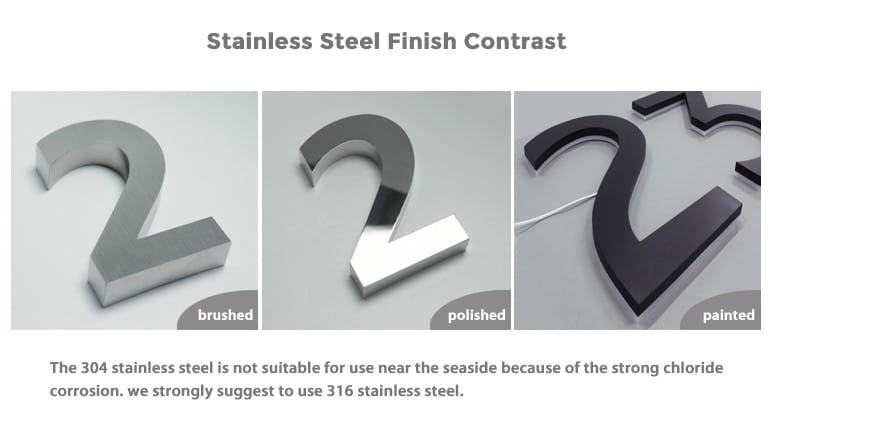
We sometimes get blamed for shitty installs. The worst was a hotel in Mumbai that ordered 48 brushed #4 finish 304 stainless letters, 36 inches tall, with back-lighting. Beautiful. The local crew mounted them with ordinary steel lag bolts directly into untreated mild steel brackets. Monsoon season hit. Dissimilar metal corrosion fused the brackets to the letters and rust-stained the facade like a murder scene. The hotel manager blamed our “low-grade steel.” We shipped them 304 alloy certs and a metallurgist’s report. The installers never responded. We can’t control what happens after the crate is opened, but we can tell you exactly how to not end up like that hotel.
Answer three questions. First, is the sign above 8 feet from grade or requires a ladder taller than 6 feet? If yes, hire. Second, does the sign connect to line voltage (120V/277V) rather than a simple wall plug? If yes, hire a licensed electrician. Third, is the facade material something you’ve drilled into before and know the load capacity? If you can’t identify EIFS vs stucco vs fiber cement, hire. Your confidence isn’t a substitute for knowing that an EIFS wall has almost zero pull-out strength.
If all three are no—a small, non-illuminated metal sign on a wood storefront at chest height—then DIY can be a satisfying afternoon. Use a template, pre-drill, apply marine-grade silicone behind each stud, and never use flat-head screws for letter mounting. Always pan head with a bonded washer. That’s free advice from a guy who’s fabbed thousands of signs and heard every sob story.
We include a paper template, a drill pattern guide, and specific fastener recommendations with every sign we ship. For our stainless steel letters, we note whether the mount is stud-mount or pad-mount, and the exact thread size. For halo-lit signs, we send a detailed wiring schematic showing driver placement and minimum clearance for heat dissipation. You hand those to a competent installer, and they’ll finish the job in half a day. You hand them to someone who’s never read a spec sheet, and you’ll get a string of texts that start with “Hey, quick question…”
Look, I can’t stop you from grabbing a hammer drill and going at it. I can only tell you that in 16 years, the people who complain loudest about “sign failure” are the ones who installed it themselves. The ones who hire pros? They email me photos of the lit sign at dusk, proud as hell, and their only request is a reorder for the next location. That’s the relationship I want. So do what you want with the installation—I’ll make the sign. Just don’t call me from the emergency room.
Our lead time is 7–15 days. MOQ is one piece. You can get a set of food menu signs or a full monument solution, and I’ll ship them with the same care whether you’re a solo contractor or a national franchise. The sign will be right. The install is on you. Choose wisely.

Real photo from our production floor — every sign we ship is made here.
From $24/letter · MOQ 1 piece · Flexible lead time · CE & UL certified · ships to 20+ countries
Custom sizes, colors, and finishes. Get a factory price in 24 hours.
Get a Free Quote Copy EmailWhatsApp +86 13865703472 · business@aochuangsign.cn
See pricing, specs, and get a free quote for the sign type you need. Built in our factory, shipped worldwide.