Look, I've built double-sided sign boards for a casino parking garage, a hospital wayfinding system, and a taco joint that needed to be seen from both directions of a one-way street.
That's the whole point of double-sided signage: one cabinet, two faces, no wasted visibility. You're not bolting two signs together. You're buying a built panel with internal lighting, real framing, and a face on each side that has to survive wind, sun, and the occasional idiot with a shopping cart.
A double-sided signage board is any sign panel that has a visible face on both sides. Think of the projecting sign outside a barber shop, the hanging directory in a mall corridor, or the lightbox over a pharmacy entrance. Pedestrians see it from the east and west. Drivers see it from north and south. One fixture, two directions of eyeballs.
Most of what we ship out of Lu'an is a double-sided lightbox with an aluminum extrusion frame, an acrylic face on each side, and a center spine where we mount LED modules so light hits both faces evenly. The frame runs 1.0-1.6mm aluminum sheet, because aluminum weighs one-third of steel and won't corrode for 8-12 years outdoors. We make them from 100mm deep to 250mm, depending on how far you need it to project from a wall or ceiling.
Here's what nobody tells you: the word "board" covers a lot of junk. A cheap double-sided board from a local sign shop might be two pieces of corrugated plastic zip-tied to a PVC frame. That's not what you want for a storefront that has to survive a Midwest winter. I've had buyers send me photos of signs that sagged after one season because the face panel was 2mm domestic acrylic that yellowed and cracked. We only use UV-resistant acrylic with 90-92% light transmittance, the same stuff in our double-sided lightboxes.
Let's talk materials, because that's where your money goes. The workhorse for double-sided boards is aluminum for the cabinet and frame. Aluminum sheet is naturally rust-proof, weighs 1/3 of steel, and lasts 8-12 years outdoors. You'll usually see 1.0-1.6mm sheet. Powder coated or anodized finishes hold up fine in most climates.
Then you need a face material. Acrylic's the standard. It transmits 90-92% of light, and if you buy the Mitsubishi or Degussa grades, it's UV-resistant and holds up 5-8 years without yellowing. Domestic acrylic? Maybe 1-2 years before it looks like a chain smoker's teeth. For panels over 2.5 meters, use 5mm acrylic minimum. 2mm and 3mm faces are fine for smaller cabinet depths, but don't let anyone sell you 3mm on a 3-meter-wide board and expect it not to bow.
If the board is going near salt water or industrial exhaust, you need 304 stainless steel for mounting hardware and frame brackets at minimum. 304 has 18% chromium and 8% nickel, good for 10+ years outdoors. But if it's Miami Beach or Galveston, pay the 20-30% premium for 316 stainless, which contains 2-3% molybdenum and survives 15+ years in marine air. I've seen 304 brackets turn brown in 3 years on a boardwalk sign. Don't be that guy.
Here's the ugly truth: a lot of shops spec 316 but build with 304 because it looks identical on paper. If you're buying from a factory, ask for a mill test report. A real factory will send it in an afternoon. A reseller will go quiet. Walk away.
Lighting counts as a material, too. Use SMD

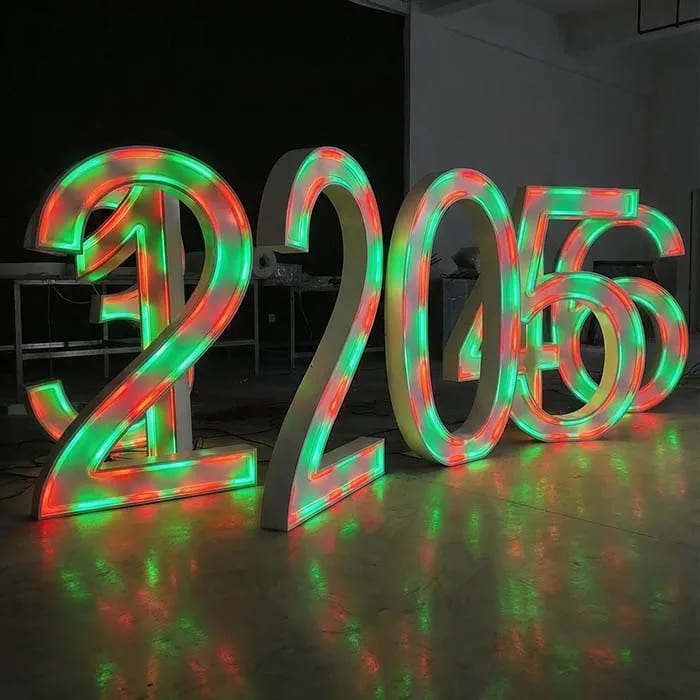
Real photo from our production floor — every sign we ship is made here.
Products mentioned or relevant to this topic — factory-direct, custom built.
From $24/letter · MOQ 1 piece · Flexible lead time · CE & UL certified · ships to 20+ countries
Custom sizes, colors, and finishes. Get a factory price in 24 hours.
Get a Free Quote Copy EmailWhatsApp +86 13865703472 · business@aochuangsign.cn
See pricing, specs, and get a free quote for the sign type you need. Built in our factory, shipped worldwide.