Hotel lobby signs are the handshake between a brand and its guests. They need to look expensive, last through a decade of cleaning crews, and install without a headache. And here’s the thing: most sign shops lose margin on these jobs not because of the sign itself, but because of the mounting logistics.
I’ve seen it happen a hundred times. A shop wins a contract for a 4-foot stainless steel lobby sign, quotes the fabrication, and then eats the cost of rework because the client didn’t like the finish. Or the installer shows up and the pre-drilled holes don’t match the wall studs. That’s a 30% installation time penalty, and a damaged relationship.
This guide is built from 15 years of factory-floor experience. We’ll cover stainless steel grades, thickness specs, fabrication methods, and—most importantly—how to source custom signs from overseas without getting burned.
For a hotel lobby sign, grade 304 stainless steel is your default. It contains 18% chromium and 8% nickel. It’s corrosion-resistant, easy to weld, and holds a brushed finish beautifully. Expect a 10+ year outdoor life—indoors, it’s effectively permanent.
But here’s where most sign shops get it wrong: they spec 316 stainless for coastal hotels, thinking they need it. 316 contains 2-3% molybdenum, making it marine-grade. For indoor use, even in a coastal lobby with salt air from open doors, 316 is overkill. The cost premium is 20-30% over 304. That extra $5-8 per letter adds up fast on a 40-letter sign.
Stick with 304 for 95% of indoor lobby jobs. The exception? If the sign is in a pool area, a spa with high humidity, or a hotel directly on the beach with open-air lobbies, then 316 is worth the money. Otherwise, you’re paying for insurance you don’t need.
| Grade | Key Specs | Best Use | Cost vs. 304 | Outdoor Life |
|---|---|---|---|---|
| 304 | 18% Cr, 8% Ni, density 7.93 g/cm³ | Standard indoor lobby, covered outdoor | Baseline | 10+ years |
| 316 | 16% Cr, 10% Ni, 2-3% Mo | Coastal, pool, spa, high-humidity | +20-30% | 15+ years |
A 4-foot lobby sign will warp if you use the wrong thickness. I’ve seen shops use 1.0mm stainless for a 48-inch sign. That’s a disaster waiting to happen. The sign bows in the middle, the client sees a wave, and you’re cutting a replacement.
For letters up to 12 inches tall, 1.0mm to 1.5mm is fine. For a 4-foot sign—say, the hotel name across the lobby wall—you need 2.0mm minimum. If the sign is over 6 feet wide, go to 3.0mm. The rule is simple: larger surface area needs more rigidity. Aluminum is lighter, at one-third the weight of steel, but for that premium feel, stainless steel wins every time.
Here’s a practical spec from the factory floor: Aochuang Sign uses 1.0-3.0mm stainless for most custom work. For a 4-foot lobby sign, I recommend 2.0mm brushed 304. It’s stiff enough to resist warping, light enough to mount with standard standoffs, and holds a clean edge after laser cutting at ±0.1mm tolerance.
Laser cutting is the standard for stainless steel signs. The tolerance is ±0.1mm. That means your letters will be identical every time. For a hotel lobby sign with 40 letters, that consistency is critical. Waterjet cutting is slower and more expensive, but it leaves no heat-affected zone—useful for thin materials under 1.0mm. For 2.0mm stainless, laser is the way to go.
Welding matters more than most shops realize. TIG welding produces clean, spatter-free seams. But the real test is the grind and polish. A bad weld seam will show through a brushed finish. A good fabricator spends 1-2 days grinding and polishing per sign. That’s not wasted time—it’s the difference between a sign that looks cheap and one that looks like it belongs in a Ritz-Carlton.
Finishes are where the rework happens. Brushed #4 finish is the most popular for lobby signs. It hides fingerprints and scratches better than mirror #8. Mirror finish looks great in photos but shows every smudge. If your client wants mirror, insist on a satin or brushed alternative for the main surface, with mirror only for accent details. This one conversation saves hours of polishing and client complaints.
Most sign shops lose money on mounting. The reason is simple: they don’t pre-drill holes to match the wall stud spacing. A hotel lobby wall is usually drywall over metal studs at 16 or 24 inches on center. If your sign has standoffs pre-drilled at those spacings, installation takes 30 minutes. If the installer has to mark and drill on site, it takes 2 hours and risks damaging the finish.
Insist on CNC-drilled backplates with tolerance of ±0.5mm. This is a game-changer. Tell your fabricator the stud spacing, and they can drill the holes before shipping. You’ll reduce installation time by 30% and virtually eliminate damage claims from dropped signs or misaligned holes.
For lobby signs, hidden bracket systems are the premium option. The sign mounts flush to the wall with no visible hardware. This requires a welded bracket on the back of the sign and a matching plate on the wall. It costs more—add $50-100 per sign for fabrication—but clients love it. Standoffs (threaded rods with decorative caps) are the standard choice. They’re cheaper, easier to adjust, and look clean. Use 1-inch diameter standoffs for signs under 3 feet, and 1.5-inch for larger signs.
Hotel lobbies love channel letters with halo backlighting. The combination of stainless steel faces and LED backlighting creates a floating effect that screams luxury. But the integration is tricky.
For backlit stainless steel letters, you need a return (sidewall) that’s at least 1.5 inches deep to house the LEDs. The face is laser-cut stainless steel, the back is laser-cut aluminum or acrylic, and the LEDs are mounted on an internal strip. Use SMD 2835 LEDs at 100-150 lm/W for even illumination. Color temperature matters: 3000-3500K warm white for hospitality, 4000-5000K neutral for corporate lobbies.
The challenge is sealing. Water ingress will kill LEDs fast. Quality modules from Samsung or Osram last 5+ years. Cheap modules die in 12-18 months. For a hotel lobby sign, you want the good stuff. The warranty from a reputable manufacturer like Aochuang Sign is 2 years on LEDs and 1 year on the power supply. That’s your baseline.
Acrylic faces on stainless steel frames are another option. Use Mitsubishi or Degussa acrylic with 90-92% light transmittance and UV resistance for 5-8 years. Domestic acrylic yellows in 1-2 years. For a lobby sign that’s meant to last, never use domestic acrylic. The cost difference is small—maybe 10-15%—but the longevity difference is enormous.
Here’s where the math gets interesting. Factory prices for custom stainless steel non-lit letters run $15-40 per letter. Front-lit channel letters with stainless steel faces are $20-80 per letter. Backlit halo letters with stainless steel faces are $35-120 per letter.
Compare that to US retail installed prices: $200-700 per letter for front-lit, $400-1,000 per letter for halo-lit. The factory-direct savings are 50-65% on the product itself. That margin is yours to keep or pass on to win the bid.
For a 10-letter hotel lobby sign with halo backlighting, here’s the cost breakdown from an overseas manufacturer like Aochuang Sign in Lu’an, Anhui, China:
| Component | Cost per Letter | Total (10 Letters) |
|---|---|---|
| Stainless steel face (2.0mm 304) | $35 | $350 |
| LED modules (Samsung SMD 2835) | $15 | $150 |
| Power supply (1 per sign) | $50 | $50 |
| Mounting hardware (standoffs + brackets) | $10 | $100 |
| Packaging (foam + carton + plywood crate) | $5 | $50 |
| Total Factory Cost | $700 | |
| Shipping (air, about 10 days, ~$8/kg for 15kg) | $120 | |
| US Section 301 tariff (~30%) | $210 | |
| Landed Cost | $1,030 |
Your US retail price to the hotel: $4,000-10,000 for a 10-letter halo-lit sign. Your gross profit: $3,000-9,000. That’s a healthy margin, even after shipping and tariffs.
When you’re sourcing from overseas, you can’t afford to skip QC. Here’s a checklist I’ve developed over years of factory visits:
One more thing: insist on photos or video of the aging test. If the factory can’t provide it, that’s a red flag. Aochuang Sign runs an 8-12 hour aging test as standard. That’s one reason their rejection rate is below 1%.
Custom stainless steel signs from Asian manufacturers typically have a lead time of about 5-15 days. That’s from design confirmation to shipping. For a 10-letter hotel lobby sign, expect 10-12 days. The production process has 10 steps, from laser cutting to export packaging, and each step takes 1-2 days.
The MOQ is 1 piece. That’s right—you can order a single sign. Most manufacturers, including Aochuang Sign, have no minimum. But the pricing improves with volume. For 10+ units, you can negotiate a 10-15% discount on the per-letter price. For 50+ units, the discount can go to 20-25%.
Shipping options: Express (7-10 days, $30-100 for small packages), Air (about 10 days, $4-12/kg), or Sea (about 65 days, $80-200/m³ for LCL). For a single lobby sign, air freight is the sweet spot. It’s fast enough to meet tight hotel opening deadlines and costs $100-200 for a 10-letter sign. Sea freight is for bulk orders of 10+ signs.
Hotel lobbies are commercial spaces. That means fire codes and electrical safety standards. Here’s what you need:
For most hotel lobby signs, an ETL-listed power supply and IP65-rated sign body will satisfy code. Don’t over-engineer it.
1. What is the best stainless steel finish for a hotel lobby sign to resist fingerprints and scratches?
Brushed #4 finish. It has a directional grain that hides fingerprints and minor scratches. Mirror #8 shows everything. For high-touch areas like lobby entrances, specify a clear powder coat over brushed #4. It adds a protective layer that’s easy to clean with glass cleaner. Cost increase: about $5-10 per square foot.
2. How do I calculate the right thickness for a 4-foot lobby sign to prevent warping?
Use 2.0mm minimum for signs up to 4 feet wide. For signs 4-6 feet, use 2.5mm. Over 6 feet, go to 3.0mm. The formula: thickness in mm = (width in feet) × 0.5. So a 4-foot sign needs 2.0mm. A 6-foot sign needs 3.0mm. This prevents warping even in temperature-controlled indoor environments.
3. What are the typical lead times for custom stainless steel signs from Asian manufacturers?
about 5-15 days from design confirmation. Aochuang Sign averages 10-12 days for custom stainless steel lobby signs. Add about 10 days for air freight. Total time from order to installation: 3-4 weeks. For rush orders, some factories can do 5-7 days production with air freight for a 2-week total.
4. Can I combine stainless steel with acrylic or LED elements in one sign, and what are the challenges?
Yes, but the challenges are sealing and thermal management. LEDs generate heat, and acrylic expands with temperature changes. Use a silicone gasket between the stainless steel frame and acrylic face. For LEDs, use aluminum-backed modules that dissipate heat. Never seal the sign completely airtight—allow for pressure equalization. Aochuang Sign uses neutral silicone sealant and leaves a small vent hole covered with Gore-Tex membrane.
5. What certifications are required for lobby signs in commercial hotels?
At minimum, the power supply must be UL or ETL listed. The sign body should be IP65 rated. Some jurisdictions require the entire sign to be UL 48 listed, but that’s expensive. A workaround: use a UL-listed power supply and have the sign shop do a field evaluation with a local electrical inspector. Most will accept it. For ADA compliance, tactile signs must be mounted 48-60 inches above the floor and have Grade 2 Braille. Stainless steel can be etched or engraved for tactile text.
The bottom line: hotel lobby signs are high-margin work if you get the specs right. Grade 304 stainless steel, 2.0mm thickness, brushed #4 finish, and pre-drilled mounting holes. Source from a factory with CE, RoHS, and ISO 9001 certifications—like Aochuang Sign—and you’ll sleep well knowing the sign will last. The 50-65% factory-direct savings mean you can win the bid and still make a healthy profit.

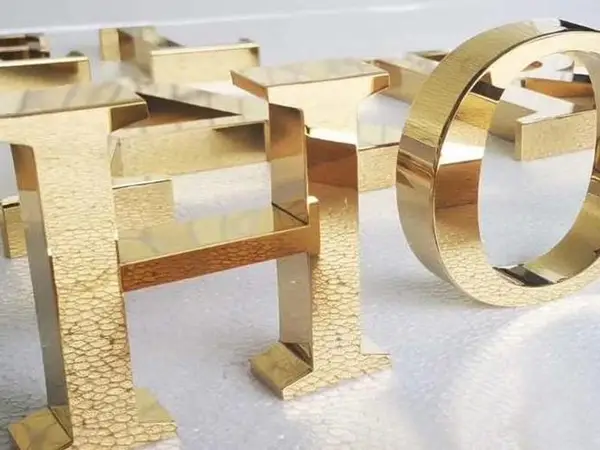
Real photo from our production floor — every sign we ship is made here.
Products mentioned or relevant to this topic — factory-direct, custom built.
From $24/letter · MOQ 1 piece · Flexible lead time · CE & UL certified · ships to 20+ countries
Custom sizes, colors, and finishes. Get a factory price in 24 hours.
Get a Free Quote Copy EmailWhatsApp +86 13865703472 · business@aochuangsign.cn
See pricing, specs, and get a free quote for the sign type you need. Built in our factory, shipped worldwide.