I’ve watched sign shops pay $800 for a single front-lit stainless letter from a local fabricator. That same letter, with the same 304 steel and Samsung LEDs, leaves our factory floor in Lu’an for $120. That’s not a typo. That’s the difference between buying through three layers of distributors and talking to the people who weld the metal.
Let’s get one thing straight right now. A custom metal sign isn’t the same as a channel letter. Metal signs—whether they’re solid stainless, cast aluminum plaques, or cut-and-polished brass—play by different pricing rules. Our factory floor price for stainless steel non-lit letters ranges from $15 to $40 per letter. That’s for 1.0mm to 3.0mm thick 304 stainless, cut with a ±0.1mm tolerance laser, TIG-welded, ground, polished, and packed for export. I’m talking about the kind of letters that survive 10+ years outdoors without rusting through.
Here’s what nobody tells you: most sign shops in the US mark up custom metal letters by 60% to 80% before they even touch them. Then they add installation. Then they blame the material when the cheap Chinese import they didn’t vet starts yellowing after two years. I’ve seen it happen. A 12-inch stainless letter that costs $32 factory direct ends up on a customer invoice for $220. And the installer spent 20 minutes mounting it. You do the math.
Look, the ugly truth is that the sign industry runs on middlemen who add cost but not value. When you buy custom stainless steel letters factory direct, you remove at least two of those layers. You’re paying for metal, labor, and shipping—not for someone’s corner office in a Dallas industrial park. Our factory ships worldwide, and we’ve seen exactly what happens when a sign broker gets involved: the same crate of 304 letters that leaves our dock at $1,200 arrives at the end user’s site after a $3,800 quote.
Rookie mistake number one: ordering 316 stainless for a strip mall sign in Kansas City. I’ve seen it go wrong. Someone’s sales rep up-sells them on “marine grade” for a job 1,200 miles from saltwater, and the client pays 20-30% more for nothing. 316 stainless contains 2-3% molybdenum. That’s what makes it fight off chloride corrosion. Unless your installation is 500 meters from a coastline or in a factory with chemical fumes, 304 does the job.
Here’s what nobody tells you: the difference in outdoor life between 304 and 316 for inland signs is zero. Both will outlast the building they’re mounted on. 304’s 18% chromium and 8% nickel content forms a passive layer that shrugs off rain and UV for decades. I’ve pulled a 304 letter off a wall after 12 years—the back side looked like new. Spend the extra money on thicker gauge metal or a better baked paint finish in any RAL color. That’s where the eye sees the value.
Now, if you’re doing a high-end steakhouse in Miami Beach or a resort in Cancun, order the 316. And if your fabricator can’t show you the mill certificate for the steel, run. We stamp every batch. I can tell you the exact nickel content of any letter we shipped last month. Bad fabricators just say “it’s stainless” and hope you won’t test it with a magnet.
Factory-direct pricing isn’t just about cheap metal. It’s about control. When you deal with a middleman, you never talk to the welder. You never ask why a return has a 3-day delay because the powder coating oven went down. And you definitely don’t get to say, “I want that edge polished to a #8 mirror finish, not the standard #4 brushed.” We take those calls at 9pm China time because someone in California is starting their day and needs an answer.
I’ve seen this go wrong: a US-based sign company ordered 50 cast aluminum plaques from a broker they found on a trade site. The broker sent the PO to us. We built the plaques, shipped them, and the client was happy. The broker made $4,000 sitting at a desk forwarding emails. The sign company could have emailed us directly, saved that $4,000, and had the exact same cast aluminum signs on the same timeline. But the broker’s website used buzzwords like “bespoke” and “cutting-edge.” None of that nonsense survives contact with a shipping container.
Look, direct buying means you shoulder a little extra legwork: file format prep, import paperwork, maybe a tariff classification call. But Section 301 tariffs on signs are about 30%. That’s factored into the price you see from a US distributor anyway, hidden under a “shipping and handling” line item. When you import direct, you see the tariff. When you buy from a middleman, you pay the tariff plus their accounting team’s interpretation of what a tariff might be someday. I’d rather know.
The ugly truth is that LCL sea freight handles your crate 6 to 8 times between our loading bay and yours. Every touch is a chance for a forklift driver to have a bad day. We pack every custom metal sign with 2cm of closed-cell foam, double-walled carton, and a plywood crate that could survive a small explosion. I’ve seen signs arrive with a boot print on the crate. The sign was fine because we over-build. Cheap domestic shops stick a letter in a cardboard box with some newspaper and call it done.
Shipping costs aren’t magic. Express freight for a small box of metal letters costs $30 to $100 and takes 7-10 days. Air freight runs $4 to $12 per kilo and adds a week. Sea freight is $80 to $200 per cubic meter for LCL, or $1,200 to $3,000 for a full container, and you wait about 65 days. I tell clients: if you’re not in a rush, sea freight turns a $120 letter into a $135 letter. Air freight turns it into $160. Still cheaper than $800 retail.
Here’s what nobody tells you: the shipping quote you get from a factory doesn’t include customs brokerage or the 30% tariff bill that comes later. Factor that in. A $2,000 order of metal letters with sea freight might cost you $2,600 landed, plus another $600-800 in duties and fees. That’s $3,400 total for something that would retail-installed for $9,000. You’re still ahead by a new truck.
Certifications are the biggest smoke-and-mirrors show in the metal sign trade. I’ll say it: CE marking costs 20,000 to 50,000 RMB. Many factories will claim they have it. Ask to see the certificate with today’s date. Watch how fast they change the subject. We’re ISO 9001 certified, CE and RoHS compliant. Our test reports are from third-party labs, not from the factory owner’s nephew. When a US client needs UL 48, we tell them it’s a $4,000 to $15,000 process with quarterly audits—and that’s on them if they want the sticker. No lying about “pending” certifications.

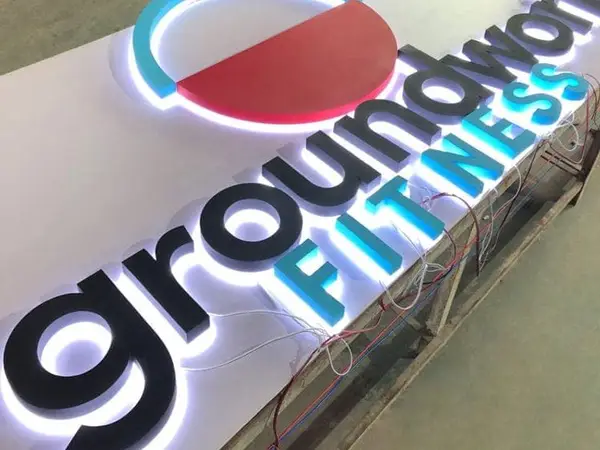
Real photo from our production floor — every sign we ship is made here.
Products mentioned or relevant to this topic — factory-direct, custom built.
From $24/letter · MOQ 1 piece · Flexible lead time · CE & UL certified · ships to 20+ countries
Custom sizes, colors, and finishes. Get a factory price in 24 hours.
Get a Free Quote Copy EmailWhatsApp +86 13865703472 · business@aochuangsign.cn
See pricing, specs, and get a free quote for the sign type you need. Built in our factory, shipped worldwide.