Look, I've been bending metal and wiring LEDs long enough to watch three generations of sign installers make the same mistake. They pick a lighting style based on what looks good in a brochure, then curse the weather three years later when the seal fails or the brightness drops. So let's cut through the crap.
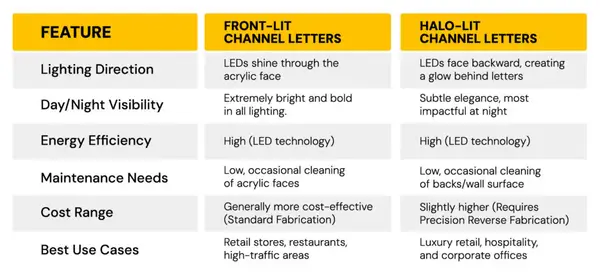
Front-lit channel letters are your standard storefront sign. Light comes through the acrylic face, hits your eyes direct. Factory price per letter: $20 to $80, depending on size and steel gauge. Back-lit (halo) letters push light through the back, against the wall — that's $35 to $120 per letter. And rimless? Clean modern look but you pay more for the engineering. I've seen sign shops pay $800 a letter from domestic shops for the same 304 stainless and Samsung LEDs we ship for $120. That's the real world.
Here's what nobody tells you: front-lit is not always the brightest option. If your customer's sign faces south and that acrylic face catches afternoon sun, the contrast drops to garbage. The light looks washed out. Back-lit avoids that because the glow comes from behind, hugging the wall. But then you lose punch from the street. There is no perfect answer — only trade-offs.
The ugly truth is most guides ignore what happens when you mount these signs on brick, glass, or dark stone. Bricks absorb back-lit glow. Glass reflects it. Dark metal soaks front-lit like a sponge. I've installed front-lit channel letters on a black granite facade and had the client scream because the letters looked dim. They weren't dim — the background ate the light. Should've gone with white acrylic backer or a halo-lit setup.
Weather? Front-lit takes the worst beating. Rain pools on the bottom of the acrylic face. Sun bakes the top edge. If you use 2mm domestic acrylic instead of 3mm Mitsubishi, you're looking at yellowing in 18 months. I've seen it happen on a pizza joint in Phoenix. The owner blamed me. I blamed the penny-pinching. Mitsubishi lasts 5 to 8 years. Cheap stuff? One summer and it's piss-yellow. Spend the 40% extra — or don't call me for the redo.
Back-lit halo letters are better for high humidity and coastal areas because the electronics sit inside a sealed can, not pressed against the wall. But the seal has to be good. Neutral silicone, not that caulk from the hardware store. I've seen IP65 seals fail in six months because the installer used quick-dry silicone that cracked. IP65 means water jets from any direction. It does NOT mean your sign survives a Florida hurricane. For that you want IP68 and a drainage hole in the bottom.
Let's talk TCO — total cost of ownership. Not the price on the quote, the real cost over five years. Front-lit: LEDs are already inside the can, easy to swap if you leave access panels. But if you sealed the back with silicone? Now your labor bill doubles to cut it open. Back-lit halo letters are worse — you have to pull the whole letter off the wall to replace a dead driver. I had a client with 30 letters on a strip mall. Four drivers failed in year three. The service call cost more than the original sign.
Here's what nobody tells you: cheap LED modules from Alibaba have a life of 12 to 18 months. Quality Samsung or Osram chips hit L70 at 50,000 hours — that's about 5.7 years running 24/7. Quickest way to spot bad modules: look at the solder joints. Dull gray = won't last. Shiny silver = proper lead-free. Don't trust the certificate unless you see the date stamp. CE marking costs 20,000 to 50,000 RMB. Most factories claim they have it. Ask to see the cert with today's date. Watch them sweat.
Then there's energy. Front-lit uses less power than back-lit because the light doesn't have to bounce off the wall. A typical front-lit letter pulls about 0.5W per cm of letter height. Back-lit pulls 0.75W. Over 20 letters at 60cm tall, running 12 hours a day, that's about $150 a year difference in commercial power. Not huge, but it adds up. If the client has a chain of 50 stores, that's $7,500 annually wasted on glow that nobody sees at noon.
And don't forget the 304 stainless steel letters vs 316. For a strip mall in Ohio? 304 is fine. For Miami Beach, pay for 316 or you're replacing letters in 3 years. The 20-30% cost premium saves $2,000 in corrosion repairs.
I've watched a dozen signs get red-tagged because the installer didn't check local codes. Front-lit is usually the safest for code — it's what inspectors expect. Back-lit halo signs are often considered "indirect illumination" and can have lower allowable brightness in residential zones. Some cities like Santa Monica ban back-lit entirely because of light spill into apartments. Check NEC Article 600 for wiring. And if the sign is below 8 feet? ADA kicks in. Tactile characters, Grade 2 Braille, non-glare finish. Good luck with that on a halo-lit letter — the edge can't have sharp points.
Then there's the Section 301 tariff. Most US buyers don't factor that into their comparison. About 30% on top of the factory price. If you're comparing a $50 front-lit letter from a Chinese factory vs a $200 domestic one, the tariff brings it to $65. Still a 67% savings. But if you need UL 48 certification, add $4,000 to $15,000 and 4 to 9 months. ETL is 10-30% cheaper and accepted everywhere. I've shipped back-lit halo letters with CE only to have them sit in customs for weeks because the buyer's inspector didn't accept it. Know your destination.
Shipping itself is a hidden cost. LCL sea freight: your crate gets handled 6 to 8 times between our dock and yours. Every touch is a chance for damage. Air freight is faster but $4 to $12 per kg. A set of 10 steel letters can weigh 80kg — that's $960 in air freight. Sea takes 50 to 70 days but costs $80 to $200 per cubic meter. Plan ahead, or your client's grand opening gets pushed into next season.
Which is brighter, front-lit or back-lit?
Front-lit is brighter to the eye because you're looking directly at the lit face. But "brightness" is subjective. Back-lit glow is softer, more premium. For reading from a car at 50 mph, front-lit wins. For a boutique hotel entrance, back-lit looks better. Stop asking which is "best" — ask which fits the building and the viewer's distance.
Can I use back-lit letters on a glass storefront?
You can, but you'll lose most of the glow. Glass reflects back-lit light into the building, not out to the street. You'll need front-lit or side-lit acrylic for glass. I've seen a restaurant owner try it. Letter was glowing, but on the inside. The street saw a dark metal shape. Waste of money.
How long do these signs really last?
If you use quality LEDs (Samsung/Osram, not the cheap bins), proper 304 or 316 stainless, and 3mm UV-resistant acrylic? 10 years outside easily. The LEDs will dim to 70% before failing, usually around 5 to 7 years of 24/7 use. You'll replace the power supply maybe once. But if you buy the $60 per letter special? You'll be swapping modules in 18 months. You get what you pay for.
What about the 30% tariff — should I go domestic instead?
Domestic fabrication costs 3 to 5 times more. Even with the tariff, factory-direct is still 50-65% cheaper. But domestic means faster shipping and easier UL compliance. For a one-off sign needed in three weeks? Go local. For a chain of 20 stores? Factory-direct with air freight still beats domestic pricing. Do the math. I'm tired of explaining this.
Products mentioned or relevant to this topic — factory-direct, custom built.
Factory-direct since 2010. Free quote within 24 hours — no obligation.
Get a Free Quote →MOQ: 1 piece · 7-15 days · 2-year warranty · Worldwide shipping