Most Buyers Don't Realize the Real Price of Your Sign Isn't the Sign
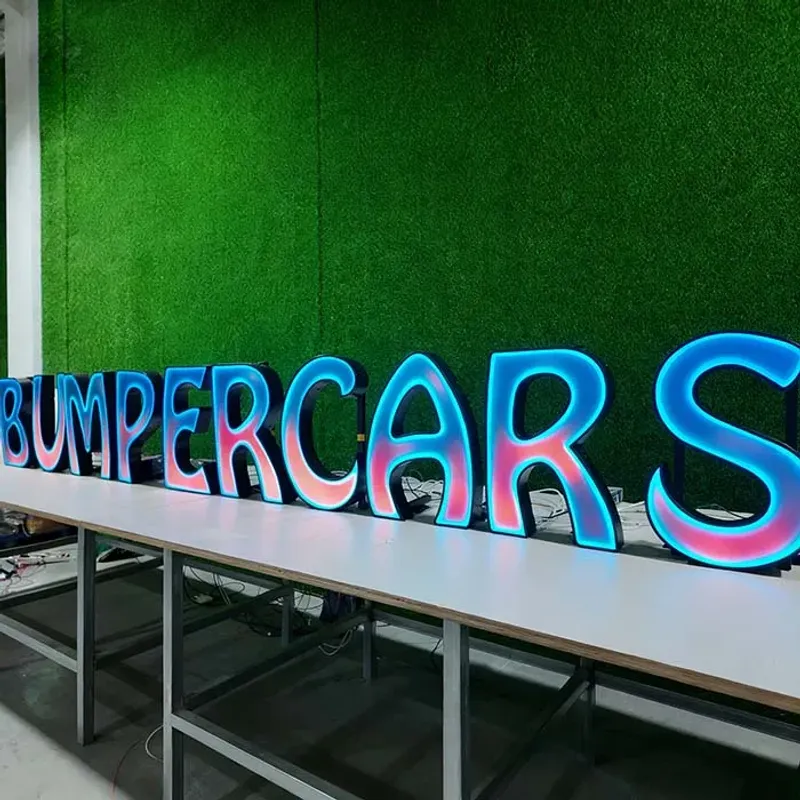
You get a quote from a Chinese factory: $120 for a 304 stainless halo-lit letter. You do the happy dance. Then the freight quote comes in: $400 for air, $200 for sea — plus customs, plus a 30% tariff, plus broker fees. Suddenly that “cheap” letter costs more than the domestic shop down the street.
I've watched sign shops pay $800 for a front-lit letter from a domestic fabricator. Same 304 stainless, same Samsung LEDs. We ship that letter for $120. But if you don't know the shipping game, you'll pay $700 after everything and wonder why you bothered.
Shipping kills the deal.
Let me break this down. You've got three ways to get signage from China — express courier, air freight, and sea freight. Each has a different cost, timeline, and hidden headache. Express (DHL, FedEx, UPS) runs 7-10 days and costs $30–100 for small stuff, like samples or a single letter under 10 kg. It's door-to-door, includes customs clearance, and you don't need a broker. Great for small orders.
But try shipping a full set of
channel letters for a 40-foot storefront on express — we're talking $800+ in shipping alone. Air freight: about 10 days, $4–12 per kg. You need a customs broker, a commercial invoice, and a headache. Sea freight: about 65 days, $80–200 per cubic meter for LCL (less than container load). A full container (FCL) runs $1,200–3,000. Sounds cheap until you see the port handling fees, demurrage, and the 6–8 times your crate gets handled between our dock and yours. Every touch is a chance for damage. That's not in the brochure.
The Spec Says 30% Tariff — But in Reality You Have to Factor in the Whole Tax Sandwich
The US Section 301 tariff on Chinese signage is around 30% right now. That's on the declared value of the goods plus freight. But it's not the only cost. You've got the customs brokerage fee (typically $150–400), the harbor maintenance fee, the merchandise processing fee, and possibly a cargo insurance premium if you're smart.
Most buyers don't realize that customs assesses the tariff on the CIF value (Cost, Insurance, Freight), not just the FOB (Free on Board) factory price. So if your sign costs $500 FOB, and you pay $200 to ship it, the tariff is roughly 30% of $700, or $210. Not 30% of $500. That's $60 you didn't budget for.
Multiply that across 20 letters, and you've lost a month's coffee budget.
Here's the math: Say you order a set of 10 front-lit channel letters, total factory price $1,200 (that's $120 each from our price list). Sea freight for the crate: $250. Insurance: $50. Customs broker fee: $200. Tariff at 30% on $1,500 CIF = $450. Landed cost: $1,200 + $250 + $50 + $200 + $450 = $2,150. That's $215 per letter — still way cheaper than the US retail installed price of $700 per letter, but you have to account for 8–10 weeks of waiting and the risk of damage. One dented letter and your savings disappear in rework.
Certifications Are Not Free — and Most Factories Don't Have Them
CE marking costs 20,000–50,000 RMB. Most factories will say they have it. Ask to see the certificate with today's date. Watch them sweat. For the US market, you need UL 48 or ETL for electrical safety. UL 48 costs $4,000–15,000 and takes 4–9 months, plus quarterly audits. ETL is 10–30% cheaper and faster, but still a hassle. Your Chinese factory probably doesn't have UL. That means you, the importer, are responsible for certifying the sign after it arrives. Or you buy from a factory that's already UL-certified — but those are rare and charge a premium.
Quickest way to spot bad LED modules: look at the solder joints. Dull gray = won't last 18 months. Shiny silver = proper lead-free solder. But even good modules need proper wiring and enclosure to pass UL or ETL. NEC Article 600 requires specific grounding, raceway, and disconnect means for electric signs. Most Chinese factories wire signs to Chinese standards, not US codes. You'll need to add a UL-listed disconnect switch, strain relief, and sometimes replace the power supply. That's more labor, more money.
IP65 sounds impressive. It means dust-tight plus water jets from any direction. It does NOT mean your sign survives a Florida hurricane. For coastal areas, you need IP66 at minimum, and even then you should spec 316 stainless steel with 2–3% molybdenum. 304 will pit in five years within a mile of saltwater. I've seen it happen. 316 costs 20–30% more than 304. For a strip mall in Ohio, 304 is fine. For Miami Beach, pay for 316 or you're replacing letters in 3 years.
Materials and Weight — Why Your Aluminum Sign Costs Less to Ship
Aluminum weighs about one-third as much as steel. A 1.6mm aluminum letter weighs 1.8 kg per square foot. The same letter in 1.5mm 304 stainless weighs 5.4 kg. That's three times the weight, which means three times the air freight cost. For sea freight, weight matters less than volume, but heavy crates are more likely to be tossed around. Aluminum is naturally rust-proof for 8–12 years outdoors. Stainless 304 lasts 10+ years indoors, less near salt. If you don't need the premium look of stainless, go with powder-coated aluminum. Our aluminum letters start at $10–25 per letter, compared to $20–80 for front-lit channel letters. You save on materials and shipping.
But here's the brutal honesty: Chinese factories often quote with domestic acrylic (Mitsubishi/Degussa is better). Domestic acrylic yellows in 1–2 years. Mitsubishi/Degussa lasts 5–8 years before yellowing. The difference in cost is maybe 20% on the acrylic itself. If you don't specify the brand, you'll get domestic. I've watched contractors rip out entire storefronts because the faces turned yellow in 18 months. Specify "Mitsubishi acrylic" or "Degussa" in your PO. Same for LED modules — ask for Samsung or Osram chips. Our standard is SMD 2835 with 100–150 lm/W. Cheap modules using fake chips have L70 of maybe 12 months. Samsung modules hit 50,000 hours. That's your sign's lifespan.
Packaging and the Hidden Damage Tax
LCL sea freight: your crate gets handled 6–8 times between our dock and yours. Every touch is a chance for damage. That's not in the brochure. We use export packaging: foam wrap around each letter, then a corrugated carton, then a plywood crate with braces. That's standard. But I've seen factories throw letters in a cardboard box with bubble wrap and call it good. The letters arrive dented, scratched, or bent. Then you blame the factory, they blame the shipping line, and you're stuck with the rework cost.
Our standard process includes an 8–12 hour aging test on every sign before boxing. We run the LEDs for 8–12 hours to catch early failures. Then 100% QC inspection checks brightness, color consistency, seal integrity. Then foam + carton + plywood crate. But even with that, sea freight damage happens maybe 2% of the time. Air freight is safer because boxes are handled less. If you have a critical deadline, pay for air. The $4–12 per kg is cheaper than a rush remake.
FAQ — Things I've Answered a Thousand Times
Do I need a customs broker for signs?
No, but you're gonna want one. Express courier includes clearance for small packages. But for LCL sea or air freight, you need a broker. They'll set up your bond, file ISF (10+2), and handle the tariff classification. Signs fall under HTS 9405.60 (illuminated signs) or 9405.90 (parts). The tariff rate is around 30% for Chinese-origin under Section 301. Your broker can check the latest — it changes. If you try to clear it yourself, one wrong code and your shipment sits in customs for weeks. Broker fees run $150–400. Worth it.
What's the minimum order at your factory?
One piece. No joke. We do MOQ 1. But shipping a single letter by sea costs the same as a crate of 50. So the real minimum is "however many fill the crate economically." For a single 12-inch letter, express freight is $30–60. Good for samples. If you order a full set for a storefront