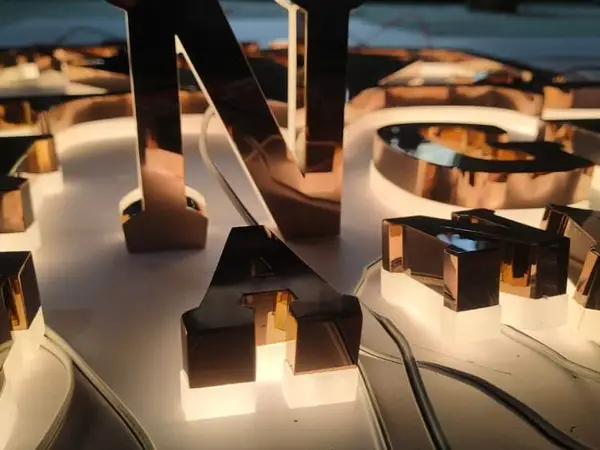
I’ve been on factory floors for 16 years—16 years of acrylic burns, TIG welding booths, and arguing with purchasing managers who think 0.5mm thickness savings will go unnoticed. I run production at Aochuang Sign in Lu’an. Our 3,000m² shop ships worldwide. We pump out front-lit channel letters, back-lit halo letters, heavy-gauge stainless steel logos—fifty-plus workers, every day. And the single biggest headache real buyers face isn’t price. It’s that no two sign quotes describe the same object.
One shop assumes 3mm domestic acrylic, another specs Mitsubishi UV-stable. One uses SMD 2835 LEDs at 60 chips per meter, another loads SMD 5730 at 120 chips. One quotes with brushed stainless side returns, another charges extra. That $19,200 might include the local electrical permit, UL field inspection, and four-point mounting cleats—stuff the cheap quote omitted and will bill you for later. If you’re comparing sign quotes without forcing every supplier onto the same spec sheet, you’re not shopping. You’re gambling.
Look, I’ll be direct: our factory can’t give you the lowest lowball price. We lose to guys who use 1.0mm recycled stainless, skip the silicone seal on the acrylic face, and ship drywall screws instead of 304 stainless studs. We can beat any retail shop price by 50–65% once you account for product cost alone, but only when you’re comparing identical build quality. That’s what I’m going to lay out—how to standardize a sign quote down to the fastener, so you actually know what you’re buying.
The ugliest industry lie I see weekly: “Fully waterproof outdoor letter.” It’s meaningless. Outdoor letters need an IP rating—a real one. IP65 means dust-tight and protected against water jets from any direction. That’s the minimum for a wet climate. IP66 handles powerful jets and coastal spray. If your sign ends up mounted low where snow piles or water pools, you might need IP68—submersible. Nobody can claim an IP rating without a test report. Yet quotes throw around “waterproof” like it’s a spray coating.
Here’s what nobody tells you: cheap channel letters use neutral-cure silicone on the acrylic return, but if the shop doesn’t tool it into a solid bead, water wicks into the LED compartment inside six months. We run an 8-to-12-hour burn-in aging test on every single illuminated sign, then inspect for fogging and condensation before crating. Most rushed shops skip that. Ask for the IP test certificate—and if they bluff, walk.
While we’re on materials, let’s kill another myth: “stainless steel” isn’t one material. Stainless 304 costs less and lasts 10+ years inland. Stainless 316 contains 2–3% molybdenum, the element that fights salt air corrosion. It costs 20–30% more but buys you 15+ years at a beachfront or chemical-plant site. I’ve seen a contractor install beautiful stainless steel letters without specifying 316 on a Miami office tower. Eight months later, pitting. Eighteen months, rust blooms bleeding down the facade. The sign shop blamed the customer for not ordering marine grade. The quote just said “stainless.” That’s why you standardize the grade, 304 or 316, in every single line item.
Light transmittance matters. You want 90–92% minimum. UV resistance is the real wallet-saver. Domestic acrylic lasts 1–2 years before yellowing starts. Mitsubishi or Degussa UV-stable acrylic will hold its clarity for 5–8 years. We stock both. If a client needs a budget-saver for a temporary retail pop-up, I’ll quote domestic. If it’s a flagship store that’s supposed to look pristine for a decade, I’ll push the import sheet. But I write it on the quote, line by line. You should demand the same.
Thickness is the other trick. For a face under 2.5 meters, 3mm is fine. Over that, you need 5mm or the face will belly inwards and distort the letter halo. Some fabricators will quote 3mm on a four-meter logo to shave $18 per letter, then act surprised when it warps. I’ve pulled apart letters where the face popped out of the return—thin acrylic, hot LEDs, zero ventilation. Our front-lit channel letters spec sheet always lists the acrylic brand, thickness, and whether we’re routing a push-through face or using an injected-molded trim cap. No ambiguity.
The ugly truth is that most quotes leave acrylic thickness blank. When you see “acrylic face included,” call them. If they can’t give you the brand and millimeter number in thirty seconds, they’re using whatever’s left on the shelf.
Same game with aluminum. Aluminum letters weigh a third of steel and won’t rust—beautiful for indoor lobbies or dry climates. But 1.0mm versus 1.6mm thickness makes a massive difference in rigidity and wind load resistance. We punch out aluminum letters from 0.040–0.063-inch stock depending on size. If a quote for a 30-inch tall aluminum letter doesn’t list material gauge, you’re probably getting the thinner sheet. That’s not always a disaster, but it’s not apples-to-apples.
Look, the datasheet says L70 ≥ 50,000 hours. That means after 50,000 hours powered, the LED will still emit 70% of its original brightness. Here’s the part nobody puts in the quote: a Samsung or Osram SMD 2835 chip with good thermal management will actually last 5+ years running dusk-to-dawn. A no-name chip pushed at higher current to squeeze out brightness—12 to 18 months before you see dead sections. I’ve got a pile of failed modules on my bench from a competitor that burned out before the second winter. The customer paid $5 less per letter. It cost them $2,100 to have a bucket truck come back out and replace the faces.
Standardize the LED spec in every quote: chip brand, chip type (SMD 2835, 5050, 5730), lumens per watt, color temperature, and module spacing. For most channel letters, we space SMD 2835 modules at 15–20cm to eliminate hotspots behind the acrylic. For shallow returns under 50mm, we tighten to 10–12cm and switch to a lensed module. Ask your supplier for a photo of the back of an installed letter with the LEDs on—if you see bright spots every 25cm, the spacing is too wide.
Sound picky? Good. That’s how you compare quotes. Our spec sheet for a standard 12-inch front-lit letter reads: “Samsung SMD 2835, 120 lm/W, 5000K neutral white, 15cm spacing, front-lit channel letters sealed with Dow Corning neutral silicone, Mean Well or Eaglerise power supply.” If another quote says “LED included,” you’re missing four decision points that change the price by $8–20 per letter and the lifespan by four years.
Here’s what nobody tells you: power supplies fail twice as often as LEDs. We warranty six quality-brand units for one year, the LEDs for two. The cheapest 12V driver on a 60W system might save you $12, but when it pops in July, the service call to swap it eats that forty times over. Spec the power supply brand and weatherproof rating. They need to be IP65 at minimum if they live behind the letter. Or go remote and house them in a dry NEMA box—I’ll spec that too if the sign’s size allows it. Show me a quote that says “driver included” and I’ll show you a future service ticket.
I’ve seen this go wrong: a first-time importer bought 300 letters from a factory in Guangzhou. Letters arrived in flimsy cardboard with a single sheet of bubble wrap. Six letters dented beyond repair, twelve more scratched. The factory blamed the freight forwarder. The freight forwarder blamed the packing. The buyer ate $2,700 in reorders and freight.
Our standard packaging is foam-lined inner carton, then a plywood crate strapped to a pallet. That costs $18–35 per letter depending on size, and it’s on the line item. Compare quotes, and I guarantee you’ll see some that hide packaging cost until the final invoice or don’t even mention crating. Call it out. Demand to see a packing photo from a recent shipment. We keep a library of crated jobs for exactly this reason.
Now, mounting hardware. Stud-mounted letters with M6 stainless threaded rods and a mounting pattern template—we include that. If a quote says “silicone adhesive only,” that’s a red flag for anything over 12 inches tall. Silicone adhesion fails on painted concrete, textured EIFS, wood that swells. I will refuse to ship large letters with only adhesive spec if the buyer can’t prove the substrate will carry the load. So specify fasteners: weld-on studs, combination stud-and-VHB-tape, or if absolutely necessary, hidden keyhole mounts with mechanical backup. Then compare the included hardware in each quote. Some shops will subtract $350 from their price, wait until install day, then sell you the same hardware for $900.
Look, I’ve also seen this: a sign is built perfectly, but the local electrician can’t certify it because the UL label isn’t there. We know the drill. Our shop doesn’t stock UL-listed inventory because UL 48 certification costs $4,000–15,000 per category and demands quarterly audits—a cost we’d have to spread across all orders. If your jurisdiction strictly requires UL-listed signs, we can and do coordinate with a US-based UL field evaluation body to inspect and label the signs after they arrive. You pay the inspection fee ($1,200–2,500) and we build to the exact standard so it passes. I’ll put that in the quote with a separate line. Any factory who tells you “we have UL” without showing you the active file number and the list of approved components is lying. I’ll give you our CE, RoHS, ISO 9001 certificates in thirty minutes. A fake UL gets you a red tag at final inspection and a furious building owner.
We ship EXW, FOB, or CIF depending on your forwarder. The bill of lading matters, but so does Section 301 of the US tariff code—around 30% duty on most channel letters entering the States. Some importers don’t factor that into their budget. When you compare a local shop’s installed price of $400–700 per letter to our factory price of $20–80 for a standard front-lit, remember you’re adding shipping (air freight $4–12/kg, sea LCL around $80–200 per cubic meter), customs broker fees, tariffs, and local installation. Even after all that, the spread is usually 50%+ savings on the product alone. But it’s not magical; numbers are numbers.
I’ve seen bids from importers who forget to account for sea freight’s about 65 days transit, then pay $700 in storage fees at the port. I won’t sell you a sign without explaining the real lead time and recommending a freight agent we trust. Our standard production lead is 7–15 days, but I’ll warn you now: if you need a 40-foot container delivered to Chicago in three weeks, we’re air freighting or you’re pushing the install date. I’d rather lose an order than lie about a timeline.
Next time you send an RFQ to three different suppliers, attach this exact list. Force them to fill it in. If any cell comes back blank or says “standard,” mark it as non-compliant. I’ll use a common front-lit channel letter as the example.
Look, I’m not giving you a generic procurement form. This is what I fill out before my foreman fires up the laser cutter. When a buyer sends this list back to me pre-filled with their requirements, I know they’re serious, and I can skip the 20 emails of clarification. That keeps my price sharp and the timeline fast.
If you hand this to a local shop, they’ll probably bristle—installers aren’t used to listing alloy grades. Do it anyway. When they push back, it tells you exactly where they’re hiding margin. The good ones will fill it out honestly. The bad ones will go silent. Either way, you win.
Aochuang can do a lot: complex back-lit halo letters with clear standoff spacers, push-through acrylic faces with precise returns, brass lettering with patina, curved neon flex signs with embedded aluminum profiles. We fabricate rimless channel letters that look painted-on from ten feet. What we can’t do is pretend we’re a full-service US installer. We don’t pull permits in Houston. We don’t dispatch a bucket truck to your strip mall. We don’t arrange the city electrical final. If you need installation, we can recommend a partner, but the contract is yours.
We also can’t make tariffs disappear, magically shorten ocean freight, or give you a UL label without you doing the inspector collaboration I described. Any factory who says they can get a full UL listing for a small order within two weeks is either lying or committing fraud. I sleep fine by telling you the truth. It’s why our repeat order rate is over 60% from buyers worldwide—they know what lands at their dock.
Here’s what nobody tells you: once you standardize the spec, the cheapest compliant quote is often the right one. Because the differences that remain are real—shipping speed, communication, after-sales support. I’m not threatened by a cheaper factory if they’re using the same Samsung LEDs, 5mm UV-stable acrylic, and 1.5mm 304 stainless with brushed #4 and welded studs. I know my shop’s quality control and lead time will win on the 80% of orders where trust matters more than $3 per letter.
So send the spec sheet. Ask the ugly questions. And if you’re comparing our quote to three others, I want you to find the line items we’re including that they aren’t. Because when you’re looking at apples, the rotten ones show up fast.

Real photo from our production floor — every sign we ship is made here.
From $24/letter · MOQ 1 piece · Flexible lead time · CE & UL certified · ships to 20+ countries
Custom sizes, colors, and finishes. Get a factory price in 24 hours.
Get a Free Quote Copy EmailWhatsApp +86 13865703472 · business@aochuangsign.cn
See pricing, specs, and get a free quote for the sign type you need. Built in our factory, shipped worldwide.