Look, I’ve been standing on concrete floors since 1998, and I still hear the same damn question three times a week: “How do I find a sign manufacturer in China that won’t ship me a box of rusty letters?” Fair question. I’ve opened crates where the LEDs flickered like a disco, and I’ve also pulled out letters so perfect the client cried. The difference isn’t magic — it’s knowing which questions make a factory rep sweat.
The ugly truth is most “manufacturers” you’ll find online are trading offices with a nice website and a rented conference room. A real factory smells like acrylic dust and TIG welding fumes. Mine has 3,000m² of production floor and 50+ workers who know the difference between 304 and 316 stainless by touch alone.
Here’s what nobody tells you: ask for a live video walkthrough of the shop floor, not a polished showroom. Make them pan the camera. If you don’t see a laser cutter with ±0.1mm tolerance humming away, that’s a red flag. 16 years in this trade, and I can spot a fake from a single zoomed-in shot of a workbench. Dull gray solder joints on an LED module? That’s a box of dead letters in 18 months. Shiny silver? That’s proper lead-free solder — the kind that actually passes a 50,000-hour L70 test.
CE marking costs 20,000-50,000 RMB and takes a couple weeks to a couple months. Most factories say they have it. I’ve seen this go wrong: ask to see the certificate with today’s date. Watch the rep fumble. Same goes for RoHS and ISO 9001 — if they can’t produce a valid, current document, their “quality control” is a guy with a magnifying glass.
If you’re ordering for the U.S., UL 48 certification is a $4,000-$15,000, 4-9 month ordeal with quarterly audits. Very few Chinese sign factories hold it because the cost kills their margin on one-off letters. ETL is a realistic alternative — 10-30% cheaper and accepted by most inspectors. For outdoor signs, IP65 is the bare minimum; it means dust-tight and resistant to water jets, but it won’t save your sign in a Florida hurricane. IP66 or IP68 are what you demand for coastal installs where salt spray eats cheap powder coat for breakfast.
316 stainless contains 2-3% molybdenum. That’s the difference between letters that look new after 15 years in Miami Beach and letters that pit in three. It costs 20-30% more than 304, and I don’t care — for marine environments, anything less is a callback waiting to happen. For a strip mall in Ohio, though, stainless steel letters in 304 are just fine. They’ll give you a decade outdoors if the brushed #4 finish is done right and nobody pressure-washes the letters like a maniac.
Acrylic faces: a 3mm Mitsubishi sheet cuts 92% light output. A 2mm domestic sheet cuts 90%. Your customer won’t notice the 2% drop, but they will notice the UV-resistant face that stays crystal clear for 5-8 years versus the cheap stuff yellowing in 18 months. When the sign is over 2.5 meters wide, step up to 5mm or the face will bow like a potato chip in the sun.
LEDs. Samsung or Osram modules will give you a real 5+ years of life. Generic no-name modules? 12-18 months before half the letters go dark. I don’t care if the factory says “high quality.” Ask for the model number. SMD 2835 at 100-150 lumens per watt is the industry workhorse; SMD 5050 if you need RGB; SMD 5730 if you want retina-searing brightness and don’t mind the heat. If they can’t name the LED brand, walk.
Here’s what nobody tells you: LCL sea freight gets your crate handled 6-8 times between the factory dock and your receiving bay. Every touch is a chance for a forklift blade through the plywood. I’ve seen $4,000 worth of halo letters arrive looking like a dropped accordion because someone skimped on the export crate. Plywood, foam, double-wall carton — that’s the minimum.
Shipping times: express gets a small sign to you in 7-10 days for $30-100; air freight in about 10 days at $4-12/kg. Sea freight takes about 65 days and runs $80-200/m³ LCL. A full container (FCL) is $1,200-3,000 depending on port. Then add the U.S. Section 301 tariff, roughly 30%. Factor all that in, and you’re still saving 50-65% on product compared to a domestic fabricator. I’ve watched sign shops pay $800 for a front-lit letter from a local shop. Same 304 stainless, same Samsung LEDs — our front-lit channel letters ship for $20

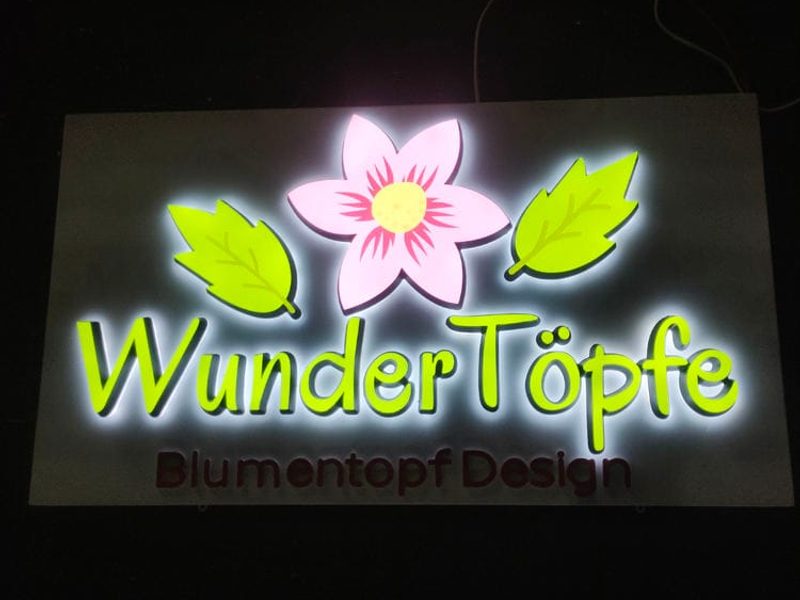
Real photo from our production floor — every sign we ship is made here.
Products mentioned or relevant to this topic — factory-direct, custom built.
From $24/letter · MOQ 1 piece · Flexible lead time · CE & UL certified · ships to 20+ countries
Custom sizes, colors, and finishes. Get a factory price in 24 hours.
Get a Free Quote Copy EmailWhatsApp +86 13865703472 · business@aochuangsign.cn
See pricing, specs, and get a free quote for the sign type you need. Built in our factory, shipped worldwide.