I've spent 16 years in this industry. I've watched sign shop owners fly to Guangzhou with stars in their eyes and come home with containers of garbage. I've also watched savvy importers save 60% on the exact same product.
The difference isn't luck. It's knowing what the hell you're looking at.
Here's the truth about sourcing from China: 80% of the factories you'll find on Alibaba are trading companies. They don't make anything. They answer emails in a rented office and mark up the real factory's price by 30-50%. The other 20% are actual manufacturers — but some of them still can't hold a tolerance to save their lives.
This guide shows you how to tell the difference before you wire a single dollar.
Here's what nobody tells you: asking for a "factory visit" via video call only works if you know what to look for.
Don't ask to see the showroom. That's where they put the pretty samples. Ask to see the production floor — live, on video. Then ask them to walk to the laser cutter and read the control panel. If they can't do it instantly, they're a trading company.
Real factories have scrap bins. Real factories have workers wearing dirty gloves. Real factories have a distinctive smell — metal dust and acrylic shavings. If the video feed looks too clean, run.
Things I'd demand from any factory before sending a deposit:
I've seen the bank-or-license mismatch kill deals. You wire money to "Shanghai Guangda Trading Co." and your contract says "Guangda Sign Factory." When the shipment's late, guess who's not liable? You.
Anyone can quote cheap. That's easy. The question is whether the quote is complete.
Here's what a legitimate factory quote must include — if it doesn't have these numbers, it's not a quote, it's a guess:
Brutal honesty moment: Most factories advertise "CE certified." CE marking costs 20,000-50,000 RMB and takes 2-8 weeks — but you know what else costs 50,000 RMB? A forged certificate. Ask to see the actual certificate with the European notified body number, then verify it on the NANDO database. If they hesitate for even a second, they don't have it.
Seven years ago, a "certified" supplier shipped a container of LED signs to a US importer. They arrived with a UL sticker on the back. The customer's electrician told him to strip the sign down before he'd wire it. The UL number on the certificate belonged to a kitchen appliance company. The importer ate $38,000 in customs, shipping, and disposal fees.
Don't be that importer.
Let me break down what real buyers need versus what factories tell you.
If you're shipping to the United States, UL 48 is the gold standard for signs. It costs $4,000-15,000 to get certified and takes 4-9 months. Many factories skip it because their customers never check. If your product goes through customs and gets flagged for an electrical review, expect delays that cost you more than the certification ever would.
ETL is UL's practical cousin, typically 10-30% cheaper and faster. It's still recognized by US inspectors. If I were launching a new sign product today, I'd do ETL first, then upgrade to UL once sales volume justified it.
For Europe, CE's the baseline. For the UK, UKCA now matters post-Brexit.
Nobody reading this needs IP68. IP68 is for submersible. Your sign is mounted on a storefront, not at the bottom of a pool. IP65 is the honest minimum for outdoor use — dust-tight and water jets from any direction. IP66 for coastal areas with driven rain. Anything above that is marketing departments selling you fear.
I'm going to show you how we run our factory in Lu'an, Anhui. This is transparency for a reason: you need to know what to look for when you're evaluating any shop.
Total time for our facility: about 5-15 days, depending on quantity and complexity.
The test that matters? A 50,000-hour LED lifespan claim. That's L70 — when a chip dims to 70% of its original output. With quality modules from Samsung, Osram, or Blueview/Lianzhen, I'll give you 5 years of real-world life. With cheap modules? 12-18 months, I tell customers. Right to their face.
Let me make this simple.
Our MOQ is one piece. That's not charity or exceptional flexibility, it's just how we operate. We make high-quality signs at factory pricing, so a single $100 order works... but understand that your per-unit price will drop significantly as the quantity climbs.
A couple quote benchmarks I can share, straight from our factory price card:
Compare to US retail installed prices: $200-700 per letter for front-lit, $400-1,000 for halo-lit. That's factory-direct savings of 50-65% on product.
But here's the catch nobody talks about: deposit terms.
Any factory asking for 70-100% deposit upfront is either a trading company burning cash or a scammer. Legitimate deposits sit at 30%. The remaining 70% is due against a copy of the bill of lading — meaning you pay after the goods are on the boat.
I've seen this go wrong: The buyer gets a fee from the bank and sends it via PayPal on a container order. Never. Ever. PayPal can tear up the transaction months later. For anything over $1,000, you work with a bank using T/T or L/C terms, and the contract is crystal clear about incoterms.
Shipping from our factory in Anhui to, say, Los Angeles:
And if you're importing to the United States — the Section 301 tariff on Chinese goods is roughly 30% right now. That's not our fee. That's not the shipping company's fee. That's Uncle Sam holding his hand out.
I've watched a buyer order $5,000 of signs, forget about the tariff, and get a surprise $1,500 customs bill. The product still saved them money, but the margin went from "holiday in Cancun" to "decent weekend in Vegas."
Plan for the tariff in your budget. It's part of the game.
Every scammer in China has a script ready for "Are you a factory?" Their response is always yes.
Instead, ask these:
Question 1: "What's your power-consuming LED option?"
A real factory can answer instantly — SMD 2835 at 100-150 lm/W for efficiency, or SMD 5730 at 40-60 lm/chip for peak brightness, or SMD 5050 for RGB color. A trading company will stumble. They don't know their own parts.
Question 2: "Show me your scrap rate."
Real manufacturing yields 3-5% scrap on a bad day. If they quote 0%, they're lying — or they're inspecting so loosely that defective parts ship to customers. I'd rather see numbers in the 2-4% range with a documented quality process than hear "zero defects" from a company doing no inspection at all.
This one's for the high-end sign buyers.
Stainless comes in different finishes, and the wrong spec can cost you 20-30% more for zero benefit. Our factory works with 304 stainless primarily — 18% chromium, 8% nickel, and it'll survive a decade outdoors easily. For coastal installations, 316 with its added molybdenum (2-3%) gets you 15+ years. The difference matters when you're selling a sign you expect to last through salt-spray seasons.
But here's what the marketing departments forget: you can't see the difference from the sidewalk.
If a customer is buying a sign for a suburban hardware store in Phoenix, 304 is overkill. It's the right engineering call, but the customer's paying for performance they'll never perceive. If the same storefront sits on Miami Beach — pay for 316. You'll be replacing the 304 one within four years.
This is the kind of honesty that gets me fired in good meetings. I'm supposed to sell you the expensive option. But the truth is, our 304-brushed stainless steel letters will handle most of mainland America with zero drama. If you're coastal or industrial, we'll upsell you to the 316. That's the difference between a salesman and an advisor.
In 2019, a franchise owner in Texas ordered 80 halo-lit letters from a factory he found on a Facebook ad.
The price was 30% below every other quote. He saved $4,200 on the product.
Six months later, half the letters had brown spots — the LED modules had no waterproofing sealant, and humidity had claimed them. The franchise owner called a local electrical contractor to diagnose the failure. Replacing the LEDs on the letters with warranty would cost $1,000... but the labor to unmount, repair, and remount on a two-story storefront was $6,800.
He paid $6,800. The failure wasn't the lights. It was the sealing.
Here's the second brutal honesty moment: Cheap fabrication is easy to spot, but cheap sealing is invisible. When you're comparing letters from different vendors, ask about the sealant brand and the application method. You're asking for the same care a fish tank builder takes. Water always finds its way in — it's a matter of whether your sign is built to keep it out.
Every factory has limits. If any manufacturer tells you they can do literally anything, they're lying to land the order.
Here's our honest list:
We can't ship a 30-foot illuminated sign in one piece by air. Our packaging is sturdy, but the freight cost would be absurd. Even by sea, we've had to design around oversized/overweight constraints. You're better off with modular construction for large signs — which does add some labor on site.
We can't hit a 2-day lead time. The fastest we've realistically shipped a finished custom sign is 5 days, and that required a 50,000 RMB air freight bill. Lead times are about 5-15 days standard. We build brands on those timelines.
We can't make an ultra-thin profile look like a flush architectural feature without you having a very specific mounting structure ready. Our rimless channel letters have their own flexibility, but the building's surface matters more than the letter's spec.
We can't fix a design that violates physics. If you order 5mm acrylic in a 3-meter span, it bends. That's not a manufacturing defect, that's gravity.
But what we can do is transparently tell you where those limits are. Before you order. Not after.
If you're a sign shop, an installer, or a contractor, you'll eventually order what we make: channel letters. Everything else is a variation.
For your standard storefront: front-lit channel letters are the workhorses. They're bright, they're reliable, and they cost $20-80 per letter from us — versus $200-700 installed in the US. The savings aren't hypothetical; that's your margin.
When a customer wants something premium: back-lit halo letters are the architectural choice. $35-120 per letter from us, $400-1,000 installed at retail. Notice the spread keeps the same ratio. The halo effect always commands a premium.
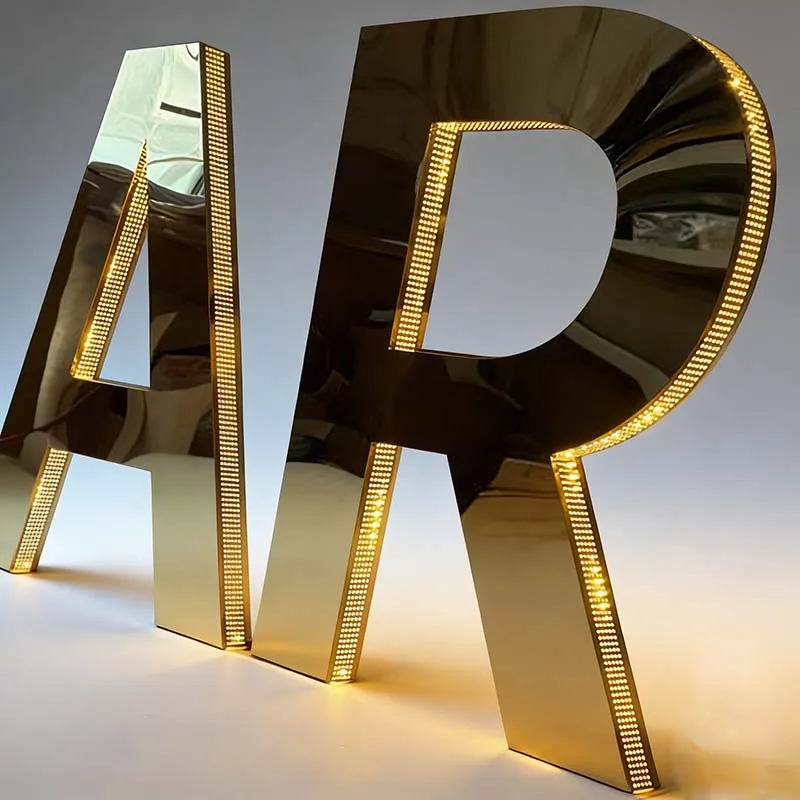
For high-end environments where the metal itself is the message: stainless steel letters — brushed, mirror, or PVD — give you that permanent, sculptural look. We run silk-smooth grinding and polishing, and for outdoor installs, 304 or 316 becomes your only real choice.
And when someone needs a lightweight, cost-effective option that won't rust: aluminum letters are a stealth favorite. They're one-third the weight of steel, they accept powder coating beautifully, and they've been in signage since the 1930s for a reason.
I've been in this industry since before LED modules were a standard option. Here's what I've learned about sourcing from China, in one paragraph:
The factory that tells you about their imperfections is the factory you can trust. The factory that promises you the world is the one that will disappear when you file a claim.
When you're ready to order, ask the hard questions. Ask about sealing, about LED brand, about scrap rate, about deposit terms, about tariffs. And if you get silence or a canned response — keep looking.
We're not the only factory in China. But we're the one that answers honestly.
If you want us to quote your next project, the door's open. We'll tell you what we can do, what we can't, and what it costs with no surprises at the end. That's not just good business. It's how you stay in business for 16 years..

Real photo from our production floor — every sign we ship is made here.
From $24/letter · MOQ 1 piece · Flexible lead time · CE & UL certified · ships to 20+ countries
Custom sizes, colors, and finishes. Get a factory price in 24 hours.
Get a Free Quote Copy EmailWhatsApp +86 13865703472 · business@aochuangsign.cn
See pricing, specs, and get a free quote for the sign type you need. Built in our factory, shipped worldwide.