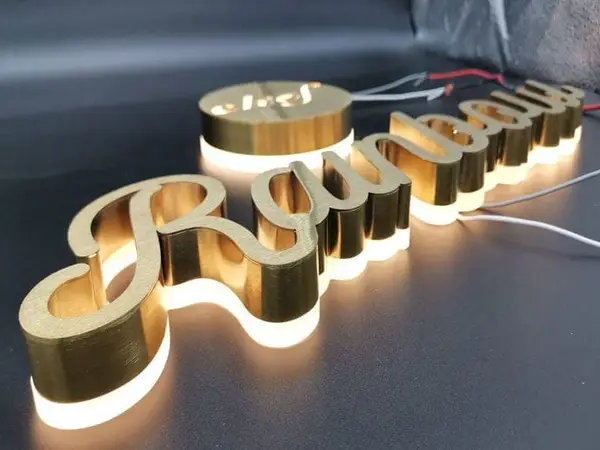
I’ve been on factory floors since before half the people reading this could spell “channel letter.” I’ve burned my hands on hot acrylic. Argued with LED suppliers who swear their modules last 50,000 hours when the solder joints look like someone chewed gum on them. So when I hear “MOQ 1 piece,” I don’t get excited—I get skeptical. The sign trade is full of factories that’ll tell you they’ll happily make you a single front-lit channel letter for a sample, then they’ll slap on a $200 “small order fee” or use leftover components from last year’s job.
But here’s the thing: MOQ 1 is real. Our factory in Lu’an, Anhui—3,000 square meters, 50+ workers, exporting worldwide—has done it for years. We don’t play the bait-and-switch game. Still, you need to know how to order a sample without stepping on a landmine. This is what I’d tell you over a beer at the end of a long day, the kind of stuff you won’t find in a glossy brochure.
Look, I’ve seen shop owners drop $15,000 on an overseas production run because the catalog photos looked sharp and the sales rep’s English was perfect. Six weeks later, the crate arrives. The LED modules turn out to be the cheapest SMD 2835 knockoffs, the acrylic already has a yellow tint, and the welding on the stainless steel looks like a pigeon did it. Suddenly that “great deal” is a loss you’ll be explaining to your accountant for months. Ordering a one-off sample isn’t optional—it’s the cheapest insurance you’ll ever buy.
When you order a single back-lit halo letter, you get to inspect everything. The acrylic light transmittance—a quality Mitsubishi sheet gives 90-92% and UV resistance for 5-8 years; domestic acrylic might yellow in 18 months. The LED color temperature. The TIG weld quality on the returns. The silicone sealing. The powder coat thickness. Then you can run that letter through an 8-12 hour aging test on your own bench. If it holds up, you scale with confidence. If it fails, you’ve lost maybe $200, not your entire project budget.
The ugly truth: some factories will send you a sample that’s absolutely perfect, then for the bulk order they’ll switch to cheaper materials. The only way to guard against that—document everything. Take photos of the sample’s internal components, measure the face thickness, note the LED brand. Then hold them to it. A quality factory like ours with ISO 9001 won’t flinch when you ask for a signed spec sheet. The ones who get nervous? Walk away.
Here’s what nobody tells you: most Chinese sign factories get 50 sample requests a day from people just fishing for freebies. You need to cut through that noise. I’ve found the best approach is an email that’s short, professional, and makes it clear you’re a real buyer with future volume. Mention the exact sign type you need, dimensions, materials, finish, and your target budget. Say something like, “I need one 24-inch stainless steel letter in 304 stainless, brushed #4 finish, front-lit with 6500K LED, as a sample. Please quote your sample price including door-to-door shipping to Chicago.” If you’re vague, you’ll get ignored.
Be ready to pay. A custom sample isn’t free. Factory prices for a front-lit channel letter run $20-80 per letter, back-lit halo $35-120, and a non-lit stainless steel letter $15-40. Then you’re adding shipping—express to the US can run $30-100 for a small crate and take 7-10 days, air freight $4-12/kg and about 10 days, sea freight LCL $80-200 per cubic meter but a painfully slow about 65 days. Most first-time orders go express so you get it fast. Expect to pay $120-250 all-in for a single letter sample to your door. That’s the cost of doing your homework, and it’s cheaper than a mistake.
I’ve seen this go wrong. One shop owner asked for a sample “in the cheapest possible way.” The factory used 1-year domestic acrylic and unlabeled LED strips held together with hot glue. The lesson? Don’t bargain-shop your sample. Pay the fair price so you’re evaluating the exact production quality you’d get at scale.
Your sample just arrived. Don’t just plug it in and say “looks good.” Here’s my grumpy old-timer checklist.
First, the acrylic face. Get a micrometer. Check the thickness—2mm if under 2.5 meters, 3mm or 5mm for larger. Hold the letter up to a bright window. If the material has a greenish hue, that’s domestic acrylic that’ll yellow in a year or two; UV-resistant Mitsubishi or Degussa stock is crystal clear. Look for micro-scratches from sloppy polishing. Next, grab a magnifying glass and look at the LED solder joints. Shiny silver is good—lead-free solder that’ll last. Dull gray means cheap tin-lead that corrodes and fails in 12-18 months. I don’t care what the spec sheet says. The solder doesn’t lie.
Turn the letter around. Examine the welds. TIG welds on 304 stainless should be clean, small, consistent. Spatter, pinholes, or discoloration mean rushed labor. If it’s a coastal project, and you asked for 316 stainless (which has 2-3% molybdenum and costs 20-30% more), run a magnet over it. 304 is slightly magnetic after welding, 316 is practically non-magnetic. I’ve seen shops pass off 304 as 316 because they think no one checks. You know what happens? In Miami Beach, that “316” letter starts pitting in three years. Check the sealing—neutral silicone should be fully around the face, no gaps. IP65 doesn’t mean hurricane-proof, but it should survive a pressure washer.
Here’s another brutal truth: LCL sea freight means your crate gets handled 6-8 times between the factory dock and yours. Every touch is a chance for damage. That’s not in the brochure. When you open the packaging (foam, then carton, then plywood crate), look for hairline cracks in the acrylic bends, bent returns, or popped LEDs. Document any damage immediately with photos. Filing a freight claim is a race against the clock. A good factory packs like the crate’s going to be dropped from a forklift. Because sometimes, it is.
I’ll say it loud: anyone offering a “free sample” is either building the cost into a future order or sending you a pre-made generic piece that doesn’t match your specs. Real custom sign factories don’t work for free. The sample price tells you everything—whether they’re serious or just hoping you’ll be too polite to check the invoice.
Pay attention. That $120 letter might cost you half that from another shop, but I’ve seen what comes out of those boxes. Acrylic faces thinner than promised, LEDs that flicker after a week, returns that aren’t even welded straight. Don’t look at the number on the quote; look at the guts of the thing. A fair sample price means the factory expects you to order again. A price that seems too good? They’ve already decided you’re a one-time mark.

Real photo from our production floor — every sign we ship is made here.
Products mentioned or relevant to this topic — factory-direct, custom built.
From $24/letter · MOQ 1 piece · Flexible lead time · CE & UL certified · ships to 20+ countries
Custom sizes, colors, and finishes. Get a factory price in 24 hours.
Get a Free Quote Copy EmailWhatsApp +86 13865703472 · business@aochuangsign.cn
See pricing, specs, and get a free quote for the sign type you need. Built in our factory, shipped worldwide.