Why You're Reading This
Seventeen hundred dollars. That's what a sign shop outside Chicago paid for one halo-lit letter, installed.
We shipped the same spec — 304 stainless, Samsung LEDs, Mitsubishi acrylic — for $120. Same materials, same letter, half the markup. That gap is the whole reason sign shop owners and contractors keep typing "LED
sign factory China wholesale" into Google.
The ugly truth is most buyers screw up their first direct order within five minutes of sending an inquiry. They ask the wrong questions, compare the wrong specs, then scream about "Chinese quality" when their own RFQ was a pile of vague wishes.
This is the guide I wish every new buyer would read before contacting us. Twenty-seven years on the floor. Thousands of
channel letters. I've seen every way this can go sideways.
Real Direct vs. "Direct"
Look, there's direct, and then there's direct.
A trading company in Shenzhen will call itself a factory. A broker with a laptop and an Alibaba storefront will quote you as if they own the lasers. Real direct means you can name the machine that cut your letter, the LED module brand inside it, and the batch number on the silicone sealant.
Here's what nobody tells you: the factory that lets you video-call the production floor, shows you last week's QC sheets, and tells you "no, we can't do that in 3 days" — that's the one that's actually direct.
Our own operation runs 3,000 square meters in Lu'an, Anhui, with 50+ skilled workers and exports worldwide. Founded 2010. Not a warehouse with samples on a shelf. A real production floor with lasers and welding stations. You can count the scars on my hands during a video walkthrough.
The Four Signs That Matter
For 90% of the commercial jobs I see, you'll order one of these:
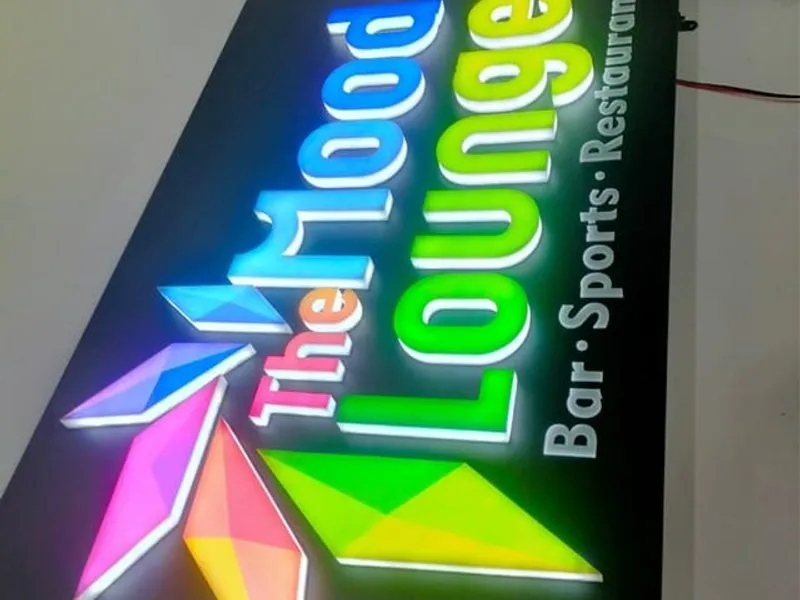
- Front-lit channel letters — the storefront standard. Trim cap, LED modules inside, acrylic face up front.
- Back-lit halo letters — premium architectural look. Stainless or aluminum returns, LEDs facing the wall, that warm halo glow.
- Rimless channel letters — clean modern edges, no trim cap, sharp sightlines for interior and sleek façades.
- Dual-lit channel letters — lit from the face and the back. Costs more, but you get day and night visibility from a single letter.
Each one carries a different labor profile. That's why the factory price spread goes from $20 to $80 per letter for front-lit, and $35 to $120 for halo. It's not a scam — it's stainless vs. aluminum, halo vs. front-lit, 5mm face vs. 2mm.
Don't stop at channel letters either. The same client needs door signage, window pieces, and menu boards. Bundling an
acrylic light box into the same order, or a
neon flex sign for that coffee shop window, turns one shipment into a full package. And if you're doing restaurants,
food menu signs are a margin gift that your local competitor won't bother to offer.
Materials: Where the Savings Die
I've seen this go wrong: a buyer specs "acrylic" and lets the factory pick the sheet. Twelve months later the face is yellow and brittle inside the flange, and the customer is posting photos on Google Reviews.
Here's what nobody tells you: domestic acrylic lasts 1-2 years before yellowing. Mitsubishi or Degussa UV-resistant acrylic holds 5-8 years and transmits 90-92% of incoming light. That's not a luxury upgrade — that's the difference between a sign that causes one angry phone call and one that's never mentioned again because it keeps working.
Same story with stainless. 304 runs 18% chromium and 8% nickel, good for 10+ years outdoors. 316 adds 2-3% molybdenum for marine and industrial coastal air, pushing outdoor life past 15 years — and it costs 20-30% more. For a strip mall in Ohio, 304. For Miami Beach, pay for 316.
For lightweight jobs,
aluminum letters weigh a third of steel, won't rust, and hold 8-12 years outdoors. Anodized, powder coated, or brushed — takes a finish like a dream.
The LED Lie
The most expensive part of a cheap sign isn't the metal. It's the LEDs you chose to save twelve bucks.
Quality modules with Samsung, Osram, or Lan Jing push 100-150 lumens per watt and hold 70% of output through 50,000 hours — real life of 5+ years. Cheap modules die in 12-18 months. I've pried open signs at month fourteen where half the diodes were dark because someone specified the $6 module.
The ugly truth is this: when your customer's sign dies in year one, they don't call the LED supplier. They call you. And they don't want a lecture about sourcing — they want the sign fixed, on your dime.
Spec SMD 2835 for standard white, SMD 5050 for RGB capability, SMD 5730 when you need the brightest single chip. Put the brand name in writing. If the factory can't tell you which LED they'll install, walk away.
Certifications: Half of What's Sold Is Fiction
CE marking costs 20,000-50,000 RMB and takes 2-8 weeks. That's real. What's not real is the "CE certificate" attached to half the cheap products on the market.
Ask to see a certificate dated this quarter, issued by a recognized body. Most fly-by-night shops can't produce one because they never paid for it. They just photoshopped the logo onto a PDF.
UL is another animal entirely. UL 48 certification runs $4,000-15,000 and takes 4-9 months, with quarterly factory audits. A $15 letter isn't UL-listed, no matter what the listing says. ETL is UL's practical alternative at 10-30% cheaper. And for US electrical work, NEC Article 600 compliance is non-negotiable — your inspector will check.
We hold CE, RoHS, and ISO 9001. We're straight with you about what we don't hold too. Ask directly, and you'll get a straight answer.
IP Ratings People Misread
IP65 means dust-tight and protected from water jets from any direction. It's the minimum for outdoor use.
It does not mean your sign survives a Florida hurricane, or a pressure washer aimed at the seam. I've pulled apart "waterproof" signs that were swimming inside because the gasket wasn't seated during assembly.
Coastal install? IP66 — powerful jets. Full marine exposure, or submersion risk? IP68. Don't let a sales rep quote "waterproof" — ask them which specific rating they'd put on their own mother's beach house.
Shipping and the Real Math
Express: 7-10 days, $30-100 for small packages. Air freight: about 10 days, $4-12 per kilo. Sea: about 65 days, $80-200 per cubic meter LCL, or $1,200-3,000 for a full container.
And don't forget the US Section 301 tariff — roughly 30% on sign products. Add it into your quote before you commit to a price, not after.
The Production Timeline Nobody Shortens
The full 10-step process takes about 5-15 days. Here's what it actually looks like when we run a job:
- Design confirmation — 1 day
- Laser cutting at ±0.1mm — 1-2 days
- Bending and TIG welding — 1-2 days
- Grinding and polishing — 1-2 days
- Acrylic face CNC routing — 1 day
- LED assembly — 1-2 days
- Sealing with neutral silicone — 1 day
- 8-12 hour aging test
- 100% QC inspection