Look, I've watched sign shops pay $800 for a front-lit letter. Same 304 stainless, same Samsung LEDs. We ship that letter for $120.
That's not some factory magic. It's the difference between a US shop marking up an imported letter 4x and a factory direct order with real QC documentation. We're Aochuang Sign in Lu'an, Anhui. 3,000m² floor, 50+ workers, exporting worldwide since 2010.
Verified quality isn't a PDF certificate with a blurry logo. It means when you ask us for the aging test report, the LED batch code, and the acrylic datasheet, you get actual files. Not a WeChat screenshot.
Here's what nobody tells you: LED module lifespan on a spec sheet is not the same as your sign's real lifespan. L70 ≥50,000 hours means the LEDs still hit 70% brightness at that mark. It doesn't mean the silicone seal, power supply, or acrylic face lasts that long.
SMD 2835 is the industry standard at 100-150 lumens per watt. If you need RGB, SMD 5050. If you want scorching brightness on a highway pylon, go SMD 5730 at 40-60 lumens per chip.
We use quality modules from Samsung, Osram, or Blueview. Real lifespan 5+ years. Cheap no-name modules? 12-18 months, then you're renting a boom lift to chase dead spots.
That's the $40 letter versus the $80 letter. Pay now or pay twice.
The ugly truth is acrylic yellowing happens faster than any supplier admits. UV-resistant acrylic from Mitsubishi or Degussa? 5-8 years before it yellows. Domestic acrylic? 1-2 years. If your client's brand is white and they're in Arizona, that's a visible problem.
Acrylic light transmittance runs 90-92%. Common thicknesses are 2mm, 3mm, 5mm. Anything over 2.5 meters wide needs 5mm+ or it will bow and crack under its own weight.
I've seen this go wrong: A contractor ordered 3mm acrylic faces for a 3-meter-wide sign because it saved $40. Six months later, the face cracked at the mounting studs. That $40 became a $600 replacement and a lost client.
If you're ordering front-lit channel letters, the acrylic face and 304 returns are the default. But ask about the face thickness for anything over 2.5m.
For metal returns, 304 stainless gives you a 10+ year outdoor life. It's 18% chromium, 8% nickel, density 7.93g/cm³. Common thickness 1.0-3.0mm. Brushed #4, mirror #8, PVD, powder coat.
316 stainless is for coastal or industrial. It adds 2-3% molybdenum and costs 20-30% more. For a strip mall in Ohio, 304 is fine. For Miami Beach, pay for 316 or watch pitting eat your returns. For coastal work, stainless steel letters in 316 are non-negotiable.
Aluminum is the lightweight option: one-third the weight of steel, rust-proof, 8-12 year outdoor life. 1.0-1.6mm thick. Anodized, powder coated, brushed.
Every job runs the same ten steps. Design confirmation (1 day) → laser cutting ±0.1mm (1-2 days) → TIG bending/welding (1-2 days) → grinding/polishing (1-2 days) → CNC acrylic face (1 day) → LED assembly (1-2 days) → neutral silicone sealing (1 day) → 8-12 hour aging test → 100% QC inspection → export packaging (foam + carton + plywood crate). Total: about 5-15 days.
That's not a marketing timeline. It's the reason we can ship one piece or 500 pieces without the wheels falling off.
Most factories skip the aging test. We don't. 8-12 hours powered up catches voltage drop, bad solder joints, and heat buildup before the crate gets nailed shut.
And the silicone step? That's where I lose my voice yelling at suppliers. Neutral silicone is the only thing that keeps water out of the letter. Cheap acid silicone corrodes LED legs. We use neutral. Every time.
Factory direct pricing per letter: front-lit channel letters $20-80. Back-lit halo $35-120. Stainless non-lit $15-40. 3D fabricated $40-120. Aluminum $10-25. Light boxes $80-250/sqm. Neon flex $30-200/sign.
Compare that to US retail installed: front-lit $200-700 per letter. Halo-lit $400-1,000. You're saving 50-65% on product before shipping and tariff.
Shipping is straightforward. Express: about 5-15 days, $30-100 for small packages. Air freight: about 10 days, $4-12/kg. Sea freight LCL: about 65 days, $80-200/m³. Full container: $1,200-3,000.
Then there's Section 301. US tariff on Chinese sign products is roughly 30%. Don't act surprised when customs sends the bill. We'll put the correct HS code on the docs, but you pay the duty. That's the game.
MOQ is 1 piece. You heard that right. Want one test letter before you commit to a 40-letter project? We'll build it. We'll ship it. You'll see the welds, the acrylic, the LED color temp with your own eyes.
For a floating glow, back-lit halo letters run $35-120 per letter. Architects love them until they see the mounting detail; then they love us more. If you're also pricing acrylic light boxes for a storefront, they run $80-250/sqm from the same floor, same QC.
If you're comparing wholesale suppliers and someone won't do a sample, walk away.
We hold CE, RoHS, and ISO 9001. CE marking costs 20,000-50,000 RMB and takes 2-8 weeks. RoHS is about restricted substances. ISO 9001 is the quality management system.
Here's what nobody tells you: UL 48 certification for electric signs costs $4,000-15,000 and takes 4-9 months with quarterly audits. ETL is a cheaper alternative, 10-30% less. Many factories claim UL. Ask for the certificate number and the UL file lookup. If they can't give you a valid file number in 10 minutes, they don't have it.

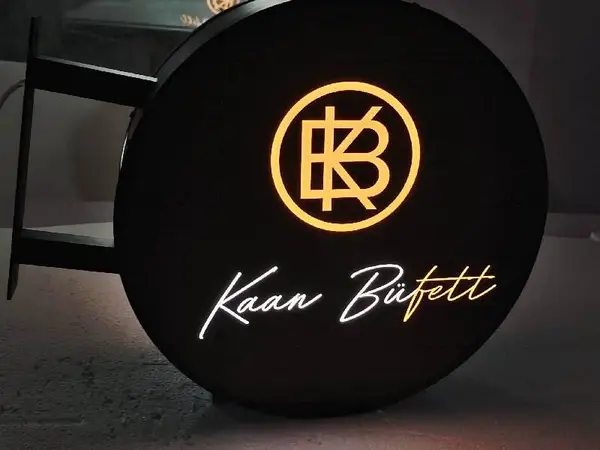
Real photo from our production floor — every sign we ship is made here.
Products mentioned or relevant to this topic — factory-direct, custom built.
From $24/letter · MOQ 1 piece · Flexible lead time · CE & UL certified · ships to 20+ countries
Custom sizes, colors, and finishes. Get a factory price in 24 hours.
Get a Free Quote Copy EmailWhatsApp +86 13865703472 · business@aochuangsign.cn
See pricing, specs, and get a free quote for the sign type you need. Built in our factory, shipped worldwide.