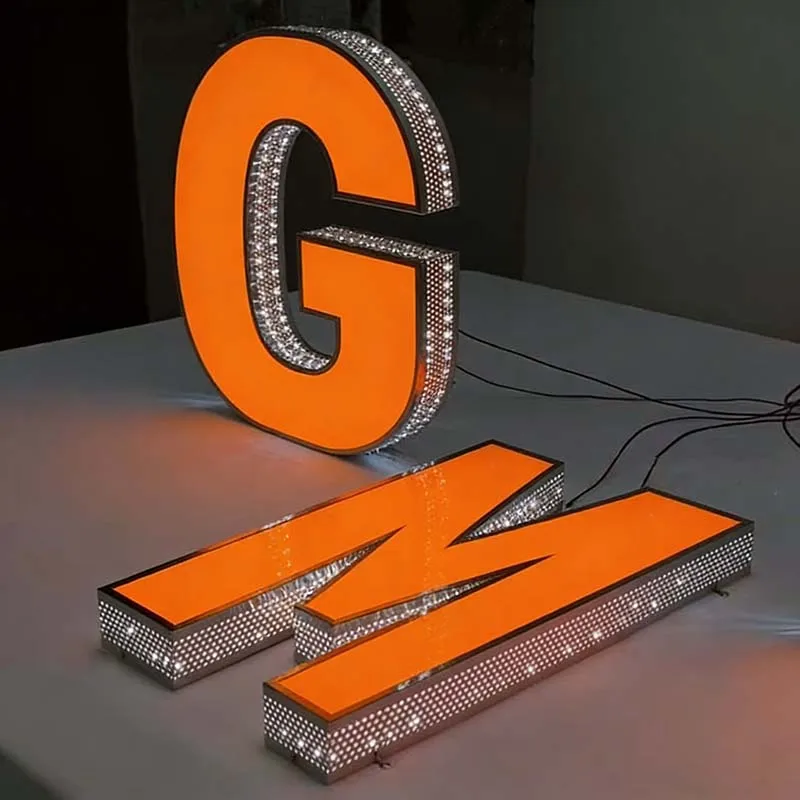
I've been in this trade since before LEDs were a thing. I've watched sign shops get burned by Chinese factories that promise the moon and deliver a pile of rust. The ugly truth is — most buyers don't know what they're looking at until the sign's on a truck and it's too late. So here's how you verify quality before you wire a dime. No BS. Just what I've learned from 16 years on the factory floor and 15 years working with shops in Lu'an.
You get a quote for a set of front-lit channel letters — $18 per letter. Another factory says $45. You think the $18 guy is the smart play. Here's what nobody tells you: that $18 quote uses 0.5mm stainless steel that'll rust in two years, domestic acrylic that yellows in 18 months, and LED modules with dull gray solder joints that die in a year. I've seen this go wrong: a shop in Ohio ordered 40 letters from a Shenzhen fly-by-night. The first two letters arrived with dents. The rest showed up six weeks late, painted the wrong color. They spent more on rework than the original order.
Real factory pricing: our front-lit channel letters run $20-80 per letter at the factory. That's for 1.0mm 304 stainless, UV-resistant Mitsubishi acrylic, and Samsung LEDs. The $18 guy is using 0.6mm steel and domestic acrylic. You save 10% up front. You pay 200% in replacements. Do the math.
Every Chinese factory will tell you they have CE, RoHS, ISO 9001. The ugly truth is — most of them lie. CE marking costs 20,000-50,000 RMB and takes 2-8 weeks. A factory that prints "CE" on their website without a certificate number? Run. Ask to see the actual certificate with today's date. Watch them sweat.
For the US market, UL 48 is the gold standard. Costs $4,000-15,000 and takes 4-9 months. A factory that has UL is a factory that's been audited. They're not cutting corners on wire gauge or grounding. If you're ordering back-lit halo letters for a hotel lobby, demand UL or ETL. ETL is 10-30% cheaper and accepted by most AHJs. If they can't show you either, find another supplier.
IP ratings are another lie factory. IP65 sounds impressive. It means water jets from any direction. It does NOT mean your sign survives a Florida hurricane. For outdoor use, minimum IP65. For coastal, IP66. For submersion, IP68. And check the test report — most factories just stamp "IP65" on the box. I've tested modules that claimed IP65. They died in a garden hose.
Here's what nobody tells you about stainless steel: 304 has 18% chromium and 8% nickel. That's what gives it 10+ years outdoor life. 316 adds 2-3% molybdenum for marine environments. Costs 20-30% more. If you're putting signs in Miami Beach, pay for 316 or you're replacing letters in 3 years. If it's a strip mall in Ohio, 304 is fine. But I've seen factories deliver "304" that's actually 201 stainless — less nickel, rusts in a year. Test it with a magnet. 304 is non-magnetic (slightly). 201 is magnetic. Simple.
Acrylic is the same story. Mitsubishi or Degussa UV-resistant acrylic lasts 5-8 years before yellowing. Domestic stuff — 1-2 years. The difference is about 40% in cost. A 3mm acrylic face cuts 92% light transmittance. 2mm cuts 90%. Your customer won't notice the 2% difference but they will notice yellowing in 18 months. I always spec 3mm Mitsubishi for outdoor stainless steel letters with faces. That extra 2% light output helps, but the UV resistance is what matters.
Quickest way to spot bad LED modules: look at the solder joints. Dull gray = won't last 18 months. Shiny silver = proper lead-free solder. A good factory like ours uses Samsung or Osram chips with L70 ≥50,000 hours. Cheap modules claim that too, but they test at 25°C ambient. Real life is 60°C inside a channel letter. That cuts LED life by half. Ask for the LM-80 test report. If they don't have it, they're guessing.
Another thing: laser cutting tolerance should be ±0.1mm. Ask them to send you a photo of the back face after cutting. If you see rough edges or burn marks, they're using an old machine or cheap gas. TIG welding on stainless should have clean, consistent beads. No spatter, no discoloration. If you can't see the weld, ask for a close-up. I've seen factories tack weld letters that fall apart in shipping because they skipped the full weld.
The finishing process: after welding, grinding and polishing take 1-2 days. Then acrylic face CNC (1 day). Then silicone sealing — neutral silicone, not acid. Acid corrodes aluminum. If the sealant smells like vinegar, it's acid. Reject it.
You get a quote for sea freight: $80-200 per cubic meter for LCL (less than container load). Sounds cheap. Here's what nobody tells you: LCL means your crate gets handled 6-8 times between our dock and yours. Every touch is a chance for damage. I've seen crates dropped off forklifts, crushed by other cargo, rained on because the container had a hole. Always pay for plywood crate packaging with foam and corner protectors. Our export packaging uses foam + carton + plywood crate. It costs more, but I've shipped worldwide and had zero damage claims in the last two years.
Shipping times: express 7-10 days ($30-100 for small), air about 10 days ($4-12/kg), sea about 65 days. And don't forget the US Section 301 tariff — roughly 30% on top of the value. Your $120 letter becomes $156 before you even install it. Factor that into your quote. Don't be the guy who forgets and eats the tariff.
No. If they can't afford a basic website, they can't afford quality control. We've got a 3,000m² facility with 50+ workers, CE, RoHS, ISO 9001 — all on our site. If a factory hides, they're hiding something.
That's the oldest trick. You get a hand-picked sample. Bulk is factory floor leftovers. Solution: order a sample that matches your exact spec, then ask for random photos during production. Better yet, pay for a third-party inspection. A factory that won't allow it is a factory you shouldn't use. We welcome any inspector. Our 8-12 hour aging test and 100% QC inspection happen every order, not just samples.
Ask for the brand and model. If it's not Samsung, Osram, or a known Chinese brand like Lan Jing, assume it's cheap. Then ask for the LM-80 report. If they waffle, walk. Also — L70 50,000 hours tested at 25°C means about 5.7 years continuous use. In real outdoor conditions, expect 3-4 years before noticeable dimming. A quality module with Samsung chips will last 5+ years. Cheap modules — 12-18 months.
Because we use real materials. Mitsubishi acrylic, 304 stainless, Samsung LEDs. The other guy uses domestic acrylic, 201 steel, and no-name LEDs. I can match their price if you want a sign that'll need replacing in two years. But you called me because you've been burned before. I'm offering the price that comes with 2-year LED warranty (1-year power supply) and a 1-year warranty on the whole sign. That's worth more than a $20 discount.
Products mentioned or relevant to this topic — factory-direct, custom built.
From $16/letter · MOQ 1 piece · 7–15 day production · CE & UL certified · ships to 20+ countries
Custom sizes, colors, and finishes. Get a factory price in 24 hours.
Get a Free QuoteWhatsApp +86 13865703472 · cairuisheng@aochuangsign.cn
See pricing, specs, and get a free quote for the sign type you need. Built in our factory, shipped worldwide.